
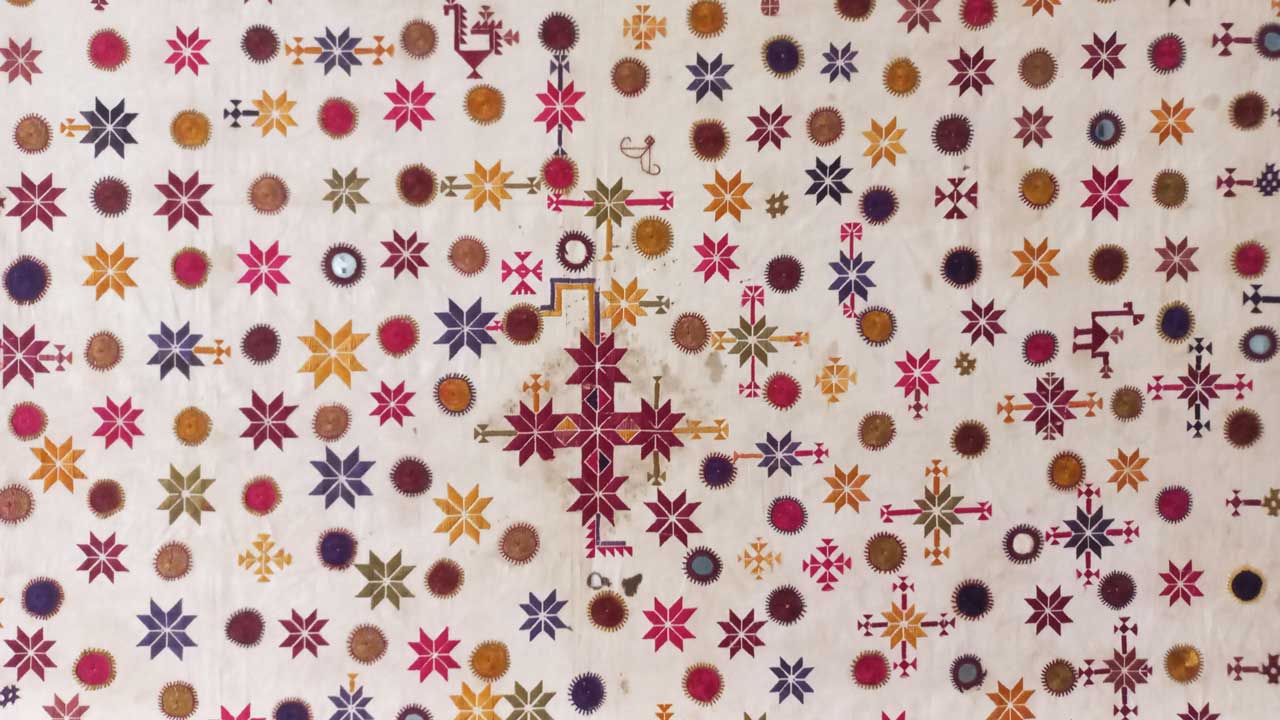
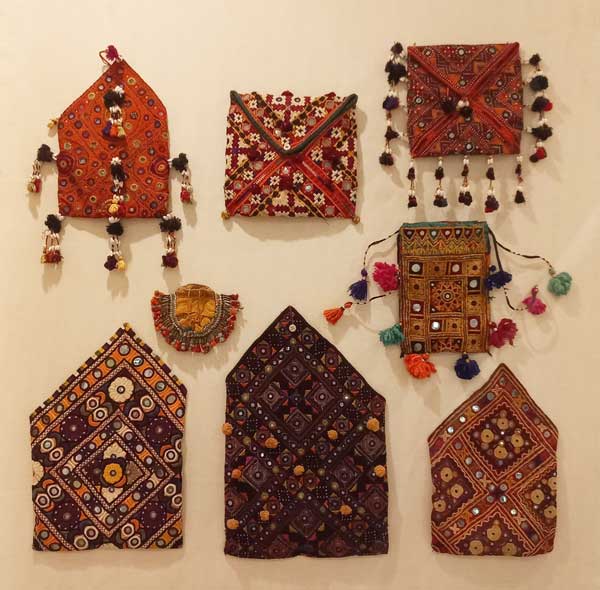
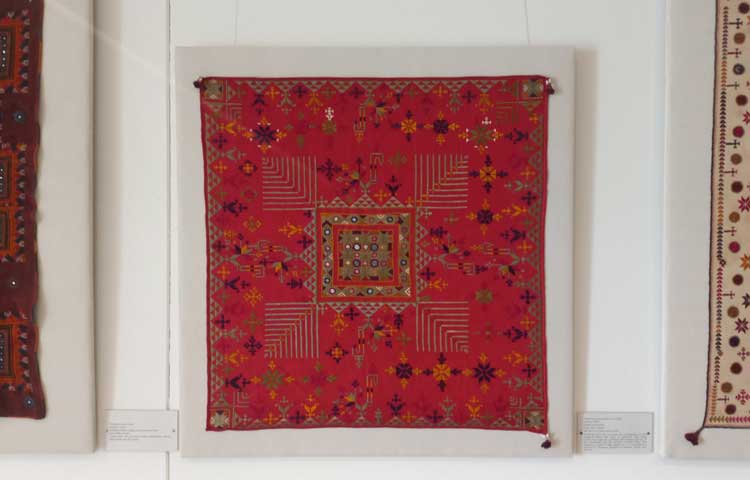
Dowry purses are a traditional coming-of-age symbol for girls in Sindh. As part of a gift-giving tradition, this is often the first item a girl stitches, though it is unclear if it is for personal use or to introduce her to craft-making. The coverlets, called the posh or thalposh, are square-shaped fabrics used as wraps for gifts or as handkerchiefs, but they may also be filled with cotton to function as pillows. Han theorizes that symbolic perception is at the core of rituals which are produced through duration; in the case of textiles, durational acts can include embroidery and weaving. 4
The motifs embroidered on these items can also signal spiritual meanings. “Rituals are processes of embodiment and bodily performances. In them, (sic) the valid order and values of community are physically experienced and solidified”.5 According to the exhibition wall texts at The Haveli, the central square on the coverlets (dari) is a talismanic symbol supporting happiness and fertility. The embroidered peacock symbolizes the union of the newlyweds and is often linked to Saraswati—the Hindu goddess of learning, music, and arts. This symbolic knowledge connects embroidery to the region’s pre-Partition history and ancestral traditions. Hindus and Muslims have long lived together in Sindh, and this shared cultural bond is reflected in the textiles. “In many pre-literate societies visual symbols are of great importance. The importance of non-verbal signs is further enhanced in situations where direct communication of feelings is not condoned.” 6 Today, technology offers many ways to express feelings through writing and speech. However, earlier generations communicated their blessings differently—through objects and craft practices.
Why would symbols replace verbal communication of bestowing blessings on the newlyweds? In ritual-focused societies, forms of communication can suggest meaningfulness without immediately being reducible to meaning.7 The site-based nature of communal textile making expands this beautiful exchange through local knowledge. Globally, site-specific making continues to shrink as social media reduces the importance of sensory and tacit narratives. The Haveli exhibition informs viewers about the history of these objects, but its displays are decorative in nature. Thus, the experiential meanings communicated through site-specific making are lost, once the objects are detached from their origins.
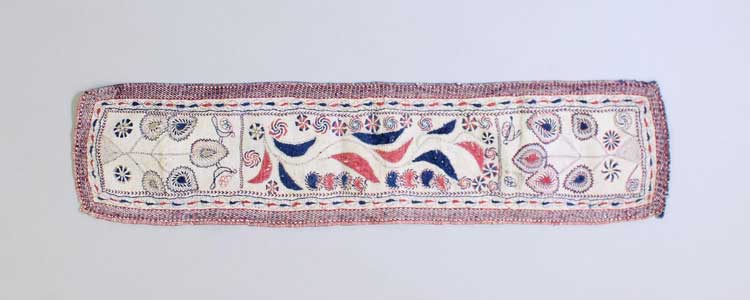
At The Haveli, I could not help but make parallels with Bengali Kantha embroidery and traditions from Uttar Pradesh, where my maternal lineage originates. As with all other visual studies, it is important to remember that the visual language of Pakistan is influenced by the diverse histories of its neighbours. Kantha originated in present-day Bangladesh and can be traced back to 2,500 years in the Indian region. Kantha is also known as sujani and is related to suzani embroidery of Central Asia8. This embroidery technique and fabric offered talismanic, pragmatic, and ceremonial motives. “The patterns often symbolised the affection for loved ones of the maker and were also thought to protect the wearer or user from the evil eye.” 9
Maternal care is symbolized both through the act of stitching and protective imagery. Kantha motifs include representations of Hindu deities such as Lakshmi and Radha, animals such as ducks, fish, and peacocks, organic motifs like seashells, paisleys, florals, along with geometric patterns.10 Circular designs recall mandalas and Buddhist traditions once widespread in Southeast Asia, while plantation evokes the “Tree of Life” motif found across cultures. Some Muslim-origin Kanthas avoid human and animal figures—instead using patterns inspired by architecture from the Islamic lands. This amalgamation of symbols reflects the cultural and religious diversity of the region and sees protection from evil as one of the core functions in ritual fabrics.
Kantha artisans were traditionally homemakers, who often could not read or write—thus Kanthas became an alternative way to express daily thoughts, stories, and lessons11. Their non-linear layouts resemble memory maps, turning fabric into a diary of everyday life. Female goddesses are often included to invoke feminine and maternal spirits. Unlike Sindhi textiles, Kantha is less bound by formal rules; motifs are not predetermined and thus give the work a strong presence of the maker. Kantha-embroidered saris were often made for brides, allowing them to carry these stories into their new homes and pass them on to future generations.
Gift-giving is a significant ceremonial act and has long held a “passion of form” 12. Akin to the gifting of Kantha saris from Bengal and creation of dowry gifting purses in Sindh, the Banarasi kimkhwāb has also been used for making bridal gossamers and dowry gifts. The word kimkhwāb is derived from Persian and means “a little dream,” referring to the intricate patterns employed in its making. 13 Kimkhwāb is a historic South Asian textile and has been recorded in Vedic literature (c. 1500 BCE) as hiraṇya or cloth of gold. 14 In many post-Partition migrant families living in Karachi (also colloquially known as the Urdu speaking communities), there remains a tradition of making kimkhwāb ghararas and saris for brides. Though its documentation seems to be missing, the practice connects textile labour to ancestry, continuity, and migration. Kimkhwāb gharara and saris are ceremonial heirloom clothing in my own family, though kimkhwāb is not woven with the solid gold thread any longer.
In Karachi, brides often customarily wear bridal and party dresses gifted by the groom’s family, at their weddings and subsequent events including “aqiqa” ceremonies of their newborn children. My mother owned banarsi and peach silk ghararas adorned with gotta-patti embroidery. My great-grandmother embroidered such garments for nearly every bride in the family. This labour occurred within the home, where textile making expressed ancestral love and the passing of cultural objects to the next generation. Maternal elders felt a responsibility to maintain this tradition, especially as migrants after the Partition of British colonized India. Today, these outfits remain as heirlooms of the land we left behind. My sisters and I share four of them—for wearing, safekeeping, and recollection. Alongside these garments, my mother prizes her plum-coloured velvet lihaaf (quilt) sewn by my great-grandmother, especially for her family—large enough for future children to sleep beneath. The quilt holds reminders of warmth, attachment, and collective rest.
“Rituals are to time what a home is to space: they render time habitable.”15 The labour and care of homemakers—recordkeeping and producing functional objects for the bride and her offspring—serve as markers of time and occupants of space. The wall text from The Coat of Many Colours at The Haveli notes that artisan women from the Sindhi Meghwar community are increasingly commissioned to produce dowry purses and coverlets. While such commissions bring income to the community, they also signal a shift from the slow duration of ritual labour toward consumerism. The logic of ritual has not disappeared entirely; rather, it is gradually changing form while continuing to act as a channel for continuity and memory.
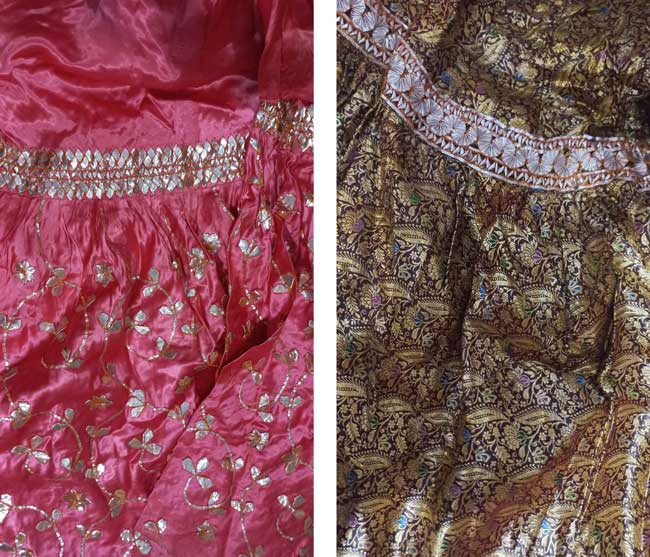
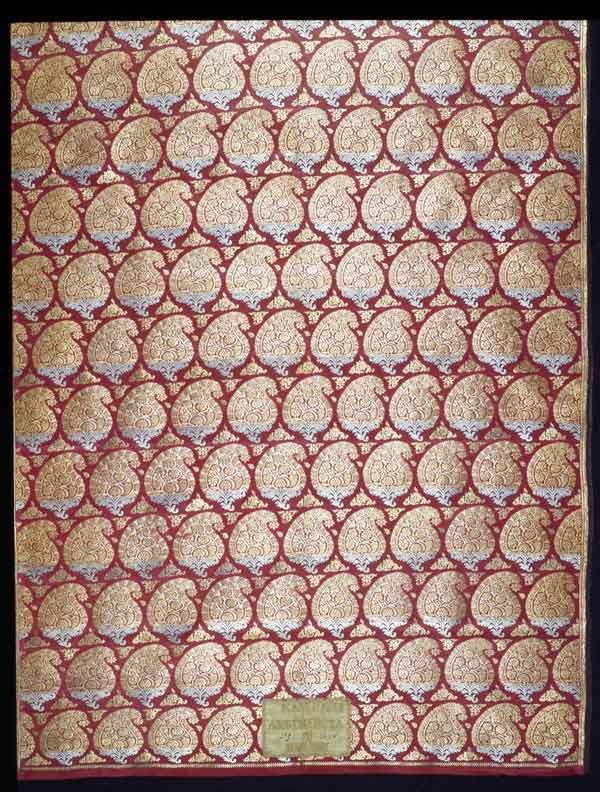
I believe that these ritual fabrics remind us of lived moments, as opposed to purchased moments. In my view, a multi-functional bujhki made by the bride’s family is not the same as a dowry package purchased from an Instagram wedding store. The labour of quilting a blanket for the bride conveys care more meaningfully than spoken advice ever could. A gharara stitched by one’s grandmother carries generational value that is beyond the price-tag of a designer boutique. These fabrics narrate those rituals once unfolded through time via hands and relationships. Performative displays of wealth, transactional dowry, and resulting post-wedding violence have soured the customs which are originally based in devotion and care. Coupled with the lack of time that craft requires in modern life, the disappearance or alternations to dowry rituals points towards the social and behavioural changes in society that must be observed.
Do also visit Fatma Shah’s essay ‘Textiles as Heirlooms’ on the following TKC link: https://thekarachicollective.com/textiles-as-heirlooms/ which was published on March 14, 2021.
Title Image: Closeup of posh showing the peacock and other talismanic symbols. “The Coat of Many Colours,” (2025), The Haveli Museum. Photo by the author.
Bibliography
Ali, Tazeen Saeed, Gunnhildur Árnadóttir, and Asli Kulane. “Dowry Practices and Their Negative Consequences from a Female Perspective in Karachi, Pakistan—A Qualitative Study.” Aga Khan University Repository. Accessed March 6, 2026.
Han, Byung-Chul. The Disappearance of Rituals: A Topology of the Present. Translated by Daniel Steuer. Cambridge: Polity Press, 2019.
Fournier, Lauren. Autotheory as Feminist Practice in Art, Writing, and Criticism. Cambridge, MA: MIT Press, 2021.
BBC Culture. “The Stories Hidden in the Ancient Indian Craft of Kantha.” October 20, 2022. https://www.bbc.com/culture/article/20221020-the-stories-hidden-in-the-ancient-indian-craft-of-kantha.
Devi, S., P. Punia, N. Pruthi, and N. Sisodia. “Development of Kantha Embroidery Motifs to Designs: Traditional to Contemporary.” International Journal of Current Microbiology and Applied Sciences 6, no. 7 (2017): 4479–4488.
Palit, S. “The Depiction of Socio-Cultural Change through Transformation in Motifs: A Case Study of the Kantha Embroidery of Bengal.” Universal Review 7 (2018): 631–643.
Encyclopædia Britannica. “Kimkhwāb.” Accessed March 6, 2026. https://www.britannica.com/topic/kimkhwab.
Marchese, Ronald T., ed. The Fabric of Life: Cultural Transformations in Turkish Society. Salt Lake City: Global Academic Publishing, 2005.
- Dowry purses
- Clothing, coverings, wrappings
- Tazeen Saeed Ali, Gunnhildur Árnadóttir and Asli Kulane, “Dowry practices and their negative consequences from a female perspective in Karachi, Pakistan —a qualitative study,” Aga Khan University Repository, accessed March 6, 2026. https://ecommons.aku.edu/pakistan_fhs_son/160/
- Byung-Chul Han, The Disappearance of Rituals: A Topology of the Present, trans. Daniel Steuer (Cambridge: Polity Press, 2019), 1-2.
- Han, The Disappearance of Rituals, 11.
- Ronald T. Marchese, ed., The Fabric of Life: Cultural Transformations in Turkish Society (Salt Lake City: Global Academic Publishing, 2005), 201.
- Han, The Disappearance of Rituals, 25.
- BBC Culture, “The Stories Hidden in the Ancient Indian Craft of Kantha,” October 20, 2022, https://www.bbc.com/culture/article/20221020-the-stories-hidden-in-the-ancient-indian-craft-of-kantha.
- BBC Culture, “The Stories Hidden in the Ancient Indian Craft of Kantha,” October 20, 2022, https://www.bbc.com/culture/article/20221020-the-stories-hidden-in-the-ancient-indian-craft-of-kantha.
- S. Devi, P. Punia, N. Pruthi, and N. Sisodia, “Development of Kantha Embroidery Motifs to Designs: Traditional to Contemporary,” International Journal of Current Microbiology and Applied Sciences 6, no. 7 (2017): 4479–4488.
- S. Palit, “The Depiction of Socio-Cultural Change through Transformation in Motifs: A Case Study of the Kantha Embroidery of Bengal,” Universal Review 7 (2018): 631–643.
- Han, The Disappearance of Rituals, 68.
- “Kimkhwāb,” Encyclopædia Britannica, accessed March 6, 2026, https://www.britannica.com/topic/kimkhwab.
- “Kimkhwāb,” Encyclopædia Britannica, accessed March 6, 2026, https://www.britannica.com/topic/kimkhwab.
- Han, The Disappearance of Rituals, 2.
Jabeen Qadri

Jabeen Qadri is a Karachi-based artist, writer and lecturer. Her creative practice is rooted in existential inquiry and sensory meaning-making, stemming from modern-day alienation. Through drawing and expanded drawing, she explores symbolic imagery across literature, visual culture, myth and esotericism. She has facilitated multiple workshops engaging community through her intuitive drawing process. Jabeen has contributed to ArtNow Magazine, Femme Art Review and Pencil Magazine, and serves as an Art Editor for The Missing Slate. As a lecturer, she teaches art history and research at the Textile Institute of Pakistan, Karachi.
Excellent 👍