
As a platform committed to critical cultural production from and about the Global South, The Karachi Collective creates space for connecting struggles across geographies through art, testimony, and collective memory. Presented alongside the conversations taking place, on social media and mainstream media around the Global Sumud Flotilla1, this essay reflects on acts of witnessing, survival, and resistance against erasure, situating these encounters within broader histories of displacement, colonial violence, grassroots resistance, and the ethics of representation.
In 2006 I participated in a photography workshop in Jerusalem to kickstart what would become my project Strike a chord, where I used music to show daily life in Palestine. Curious by nature and interested in news, photography had slowly become my way to explore the world around me. Having lost both of my parents at a very early age, photography helped me discover my identity, as it became the tool to satisfy my curiosity and fulfil my urge to travel. I was inspired by Belgian photographer Stephan Vanfleteren, the late Iranian born and Paris based political photographer Abbas, and French photojournalist Alexandra Boulat. Their photographs of faraway and “complicated” places like Afghanistan, Iran or Palestine captivated me, wanting to learn more. So, when I had the opportunity to be guided by Boulat in a masterclass in Palestine, I jumped at the chance.
I wanted to know how people lived in a place where violence is rampant and daily situations are highly precarious. As a photojournalist, I spoke to senior news correspondents of the Belgian national television, photographers, and journalists who had vast experience working in Israel and Palestine, including Bruno Stevens and Maria Fiahlo. I read one book after another on the history of the Palestinian land, the Nakba, and the two Intifadas.
Nakba means ‘catastrophe’ in Arabic and refers to the mass displacement and dispossession of Palestinians from their land during the 1948 Arab-Israeli war.2 Already in 1917, when Britain publicly pledged to establish “a national home for the Jewish people,” the infamous Balfour Declaration turned the Zionist aim of establishing a Jewish state in Palestine into a reality. The UN General Assembly passed a resolution in November 1947 to partition Palestine into two states— one Jewish and the other Arab, with Jerusalem under UN administration. The Arab political world rejected this plan and Jewish militias responded by attacking Palestinian villages, forcing thousands of people to flee their homes. The situation escalated and ultimately resulted in the 1948 war that ended the British Mandate and officially established the State of Israel, which permanently displaced more than half of the Palestinian population.
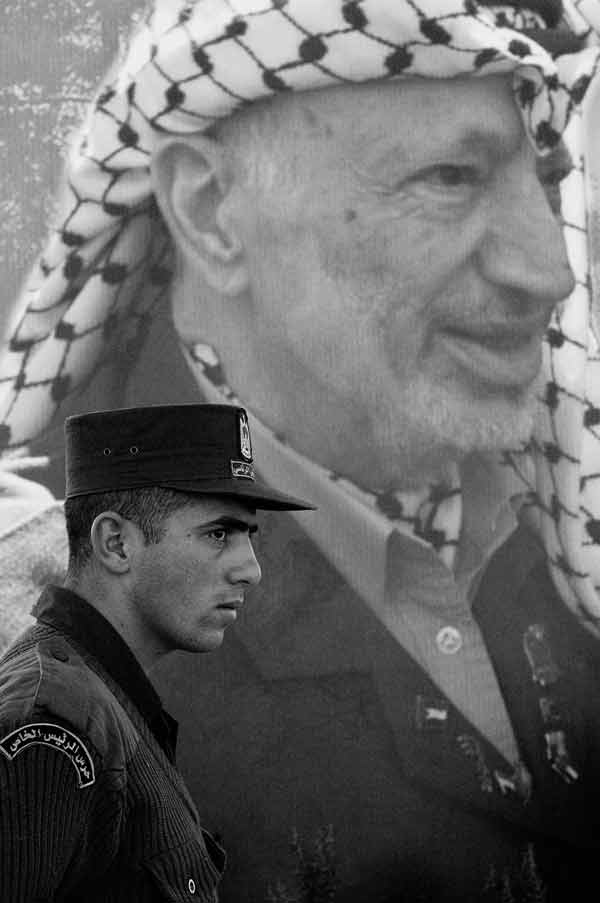
The Six-Day War in 1967 marked a second major turning point, after which Israel occupied the rest of Palestine (West Bank, Gaza and East-Jerusalem) resulting in a massive exodus of half a million Palestinians. The UN tried to step in with the Resolution 242, essentially suggesting a “land for peace” deal, linking Israeli withdrawal to mutual recognition and peaceful borders. However, the conflict continued. For Palestinians it became a struggle for self-determination. Yasser Arafats’ Palestine Liberation Organization (PLO) grew and in the capacity of observer, was invited to participate in sessions of the United Nations General Assembly.
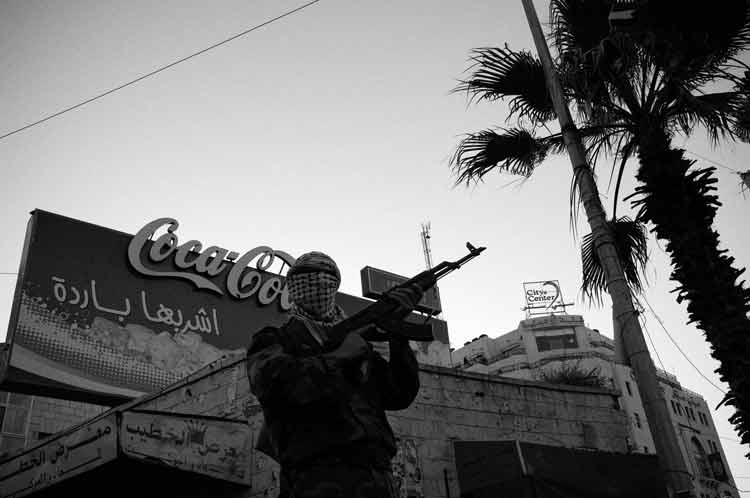
In 1982, Israel invaded Lebanon and committed the Sabra and Shatila Massacres, killing over 3,500 Palestinian refugees in both camps.3 Then Israeli Defence Minister Ariel Sharon, who in 2001 would even become Prime Minister, faced no accountability. In 1987, frustration among Palestinians reached a breaking point resulting in the First Intifada. 4 Intifada, meaning ‘shaking off’ in Arabic, describes the large-scale popular grassroots uprising by Palestinians against Israel’s then 20-year-old oppressive military occupation. This resistance was met with heavy Israeli repression that left thousands of Palestinians dead and injured. Israel also imprisoned approximately 120,000 Palestinians before moving toward political negotiations resulting in the 1993 Oslo Accords. 5
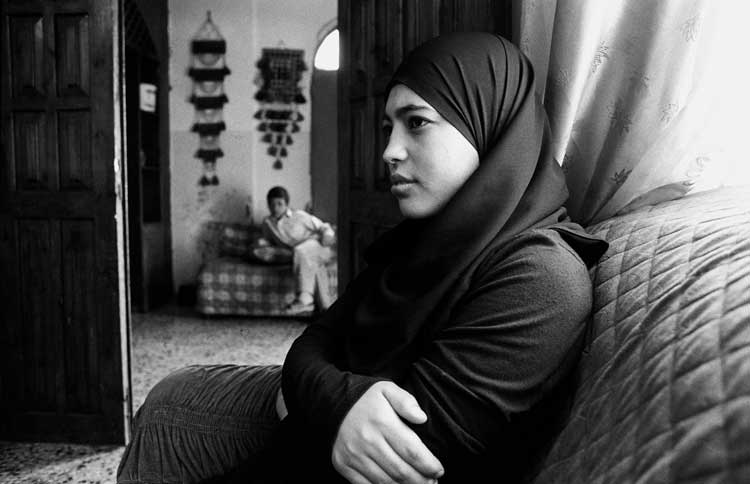
In 2007, I met with Palestinian women and minors who were among 250 Fatah prisoners released in a prisoner exchange. These young girls had already been stripped of any hope for a future. One of them was Reham from Hebron, a city that was already unhabitable by then. Her desperation at the age of 17 was so profound that it led her to the drastic act of attacking a soldier at a watchtower in Beit Ommer.
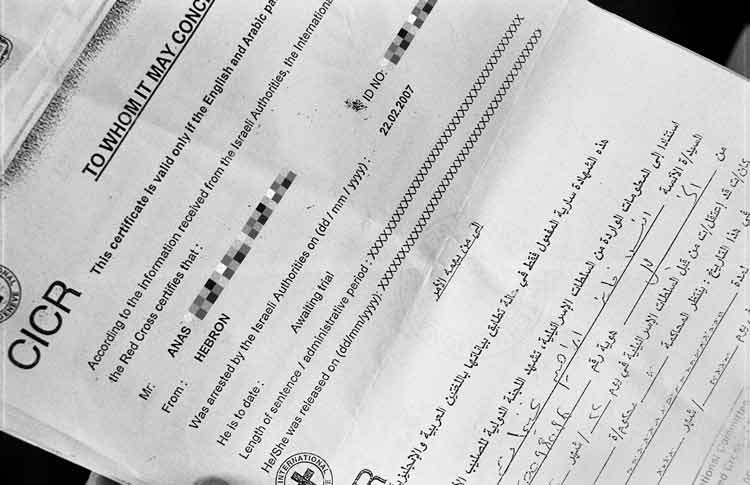
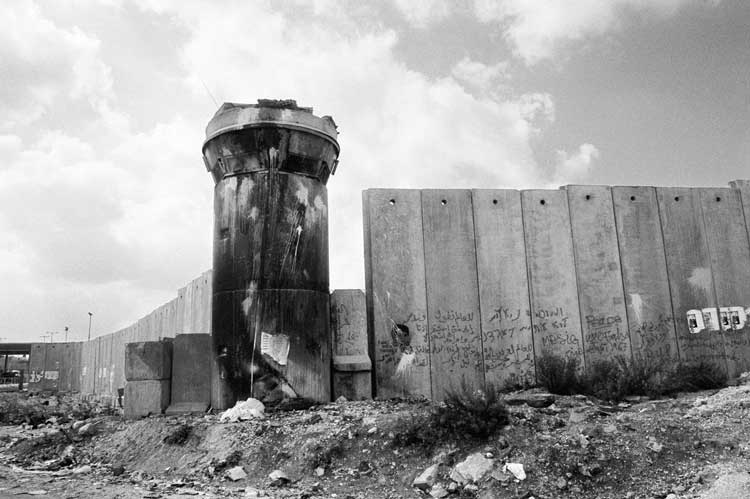
The harassment of the occupation is clear from the moment you cross a side from a checkpoint. According to Israeli Human Rights organization B’tselem, approximately 85% of the Separation Barrier is built inside the West Bank.6 The Barrier has carved up once-connected Palestinian towns and villages, breaking apart communities that had been linked for generations. It forced a redesign of the Palestinian landscape and prioritised illegal Israeli settlements. Hope during the peace process following the Oslo accords halted and eventually resulted in the Second Intifada in the early 2000s. Since then, the situation has only worsened year by year with cycles of blockades and bombardments of Gaza, large numbers of illegal settlements and settler violence in the West Bank.
Documenting both sides, I wanted to observe without judgement and be open to whatever would unfold in front of my camera. I chose to look for the subtle ways in which this conflict ensued. I met a young boy who loved playing the guitar but whose ability to attend music lessons depended entirely on the whims of IDF soldiers. The checkpoints he had to cross determined whether he would arrive on time, make it there at all, or even be able to return home afterward.
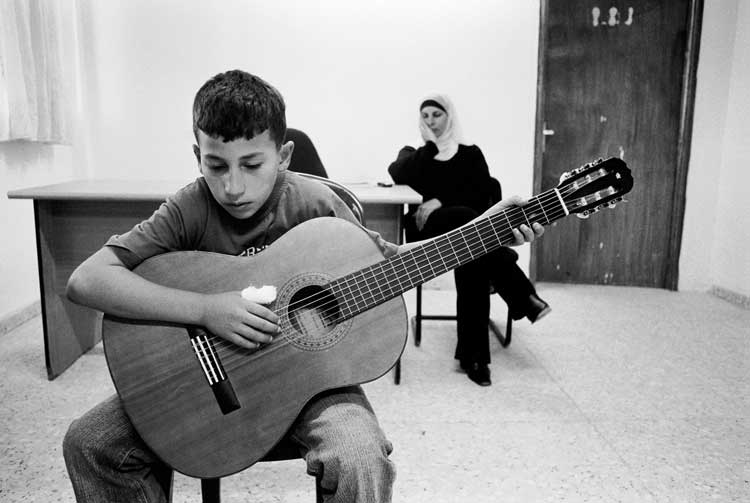
As photographers working in the media, we are taught to report reality and document objectively. This notion of objectivity is rooted in the eye-witness role inherent to journalism. Unlike other fixed images, photography maintains a connection to what once happened in front of the lens. As historian Daniel Foliard states, this can make it appear as if a photograph is a direct and truthful trace of an event that occurred in front of the camera. 7 Yet this apparent immediacy is misleading: we might lose sight of the fact that photography is not simply an objective recording of reality, but rather an intentional act shaped by the choices, position, and ideas of the photographer. “Photographs had the advantage of uniting two contradictory features. Their credentials of objectivity were inbuilt. Yet they always had, necessarily, a point of view,” writes Susan Sontag in her groundbreaking essay Regarding the pain of others.8
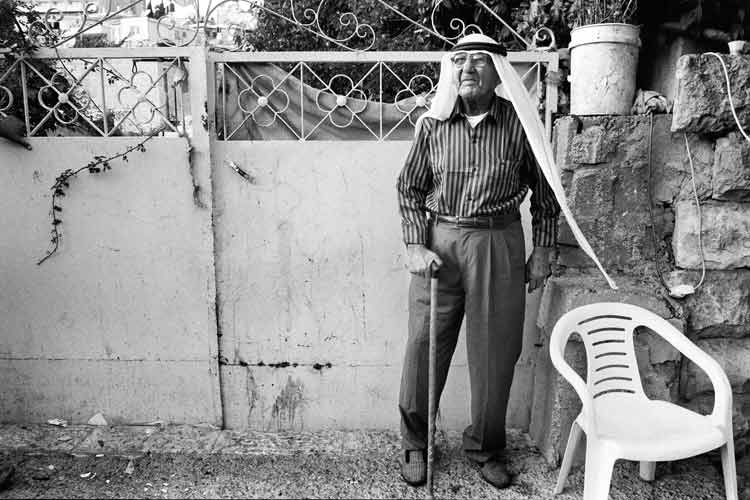
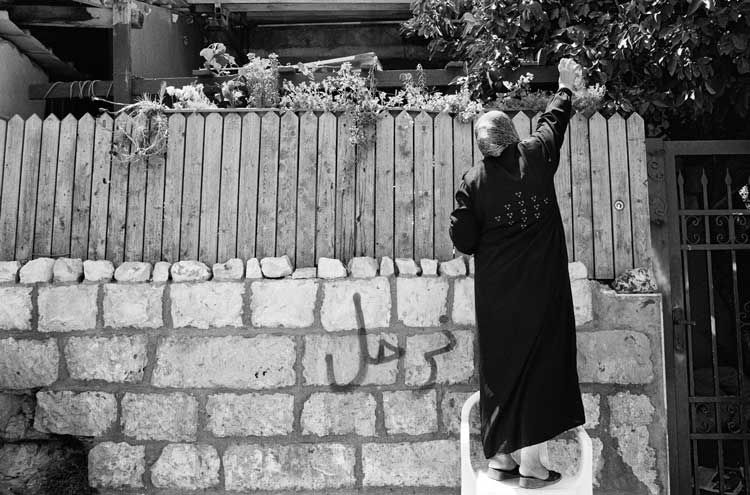
In 2009, while waiting for permission to enter Gaza for Rolling Stone Magazine to document its hip-hop scene, I decided to photograph two families living on the streets of East-Jerusalem. Over the weeks, I saw Israeli settlers, who had forcefully occupied Palestinian homes, live in total impunity, protected by the Israeli police. I photographed Mrs. Al-Ghawi standing on a chair outside the gate of her own home, now occupied by violent colonial settlers, carefully watering her plants. It was a tender gesture—an act of care for a garden she had likely cultivated for years. Moments later, settlers shoved her off the chair and violence erupted. The Israeli police intervened, not by picking up the instigators of the incident, but by arresting the young Palestinian men coming to Mrs. Al-Ghawi’s aid. By choosing the image of her watering the plants, rather than the brutality that followed, I chose to foreground her humanity instead of her victimhood.
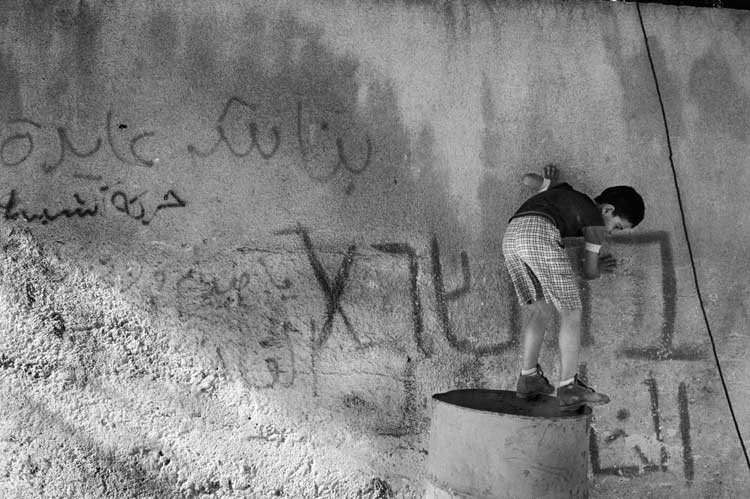
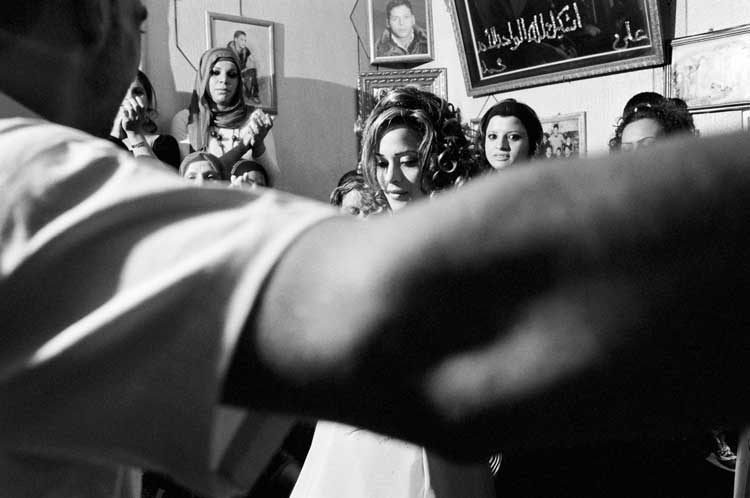
For the last three years, the world has been watching a live-streamed genocide, resulting in the destruction of Gaza, and large attacks on Lebanon and Iran. This relentless cycle of global witnessing makes me think of Algerian Palestinian author and theorist of photography and visual culture Ariella Aïsha Azoulay. In her book The Civil Contract of Photography (2006), she argues that viewing images is never neutral act.9 Photographs can commit violence not only in the moment they are captured but also when we consume them carelessly; without context; without acknowledging the people in it as living, dignified beings. As viewers, we are not simple bystanders. We also bear a responsibility for how we engage with those images.
Azouley’s warning about our responsibility as viewers becomes painfully clear when looking at Lahore-based Pakistani artist and educator Aroosa Rana’s exhibition The Golden Ratio—Math of Beauty (2026), held at Canvas Gallery in Karachi.10 In this series, Rana overlays classical geometric proportions onto press photographs of bombings and starvation in Palestine and Lebanon. The artist claims this camouflage of divine spirals is meant to question how beauty can soften the sight of devastation and speaks of the photographs as examples of how our world glorifies and aestheticizes violence. She frames her practice as a critical inquiry, yet her method reproduces the very effects that are questioned. The horrific scenes out of Gaza are used as a mere background and altered to fit a theoretical concept.
A photograph by Palestinian photojournalist Ali Jadallah depicting desperate women and children lining up with empty pots to receive food, is cropped to fit Rana’s chosen proportions and blurred around the edges. The manipulation shifts our gaze and alters the photograph’s original journalistic intent of documenting famine. This intervention raises serious ethical questions regarding authorship, consent, and context. Rana’s appropriation of the press photographs, taken by local photographers working under extremely dangerous conditions, invites scrutiny: did the artist have permission to do so? Jadallah’s photograph is retitled The Golden Rules of the Thirds and his name omitted; a decision that could possibly suggest copyright infringement. The photographed individuals stripped of their agency and dignity, their suffering anesthetized, rendered commercial, and consumable. The result is a form of dehumanization that produces a violent gaze and fails the ‘civil contract’ of bearing witness.
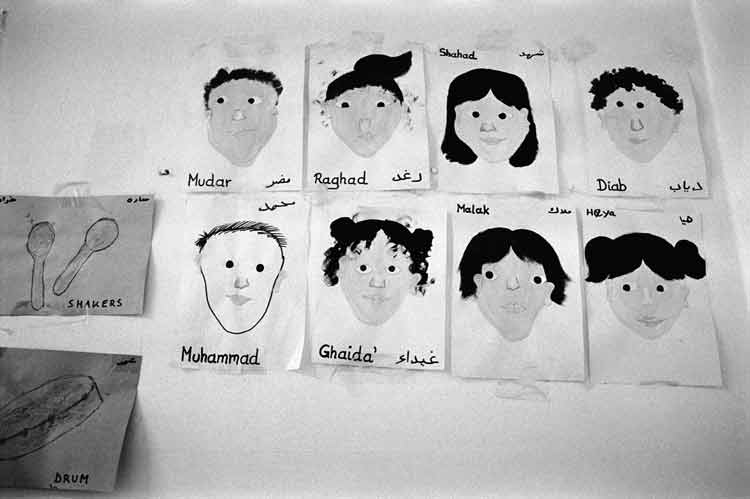
During a recent masterclass at Antwerp University, I had the privilege once more to hear Francesca Albanese speak, where she was honoured by three Belgian universities for her work as the UN Special Rapporteur for Palestine. She quoted feminist writer Audre Lorde, saying, “Hope is not optimism. Hope is a discipline, and it’s a discipline that we must practice together standing in solidarity.” Albanese traced the word solidarity to its Latin root solidum, meaning the entire sum or togetherness. She challenged us to see it as a collective responsibility, which in the case of Palestine means a definitive end to the ongoing occupation and genocide. By sharing my work here again, I continue to make that choice to not be neutral. As a photographer, I was allowed to get to know these wonderful people—I was a witness. Re-telling their stories, showing them as human being with names, hopes, and dreams becomes my small act of resistance and solidarity. They are Mudar, Muhammad, Ghaida, Raghad, and Diab. They are Enas, Tanya, Shadi, Iman, Essa, Bayan and…
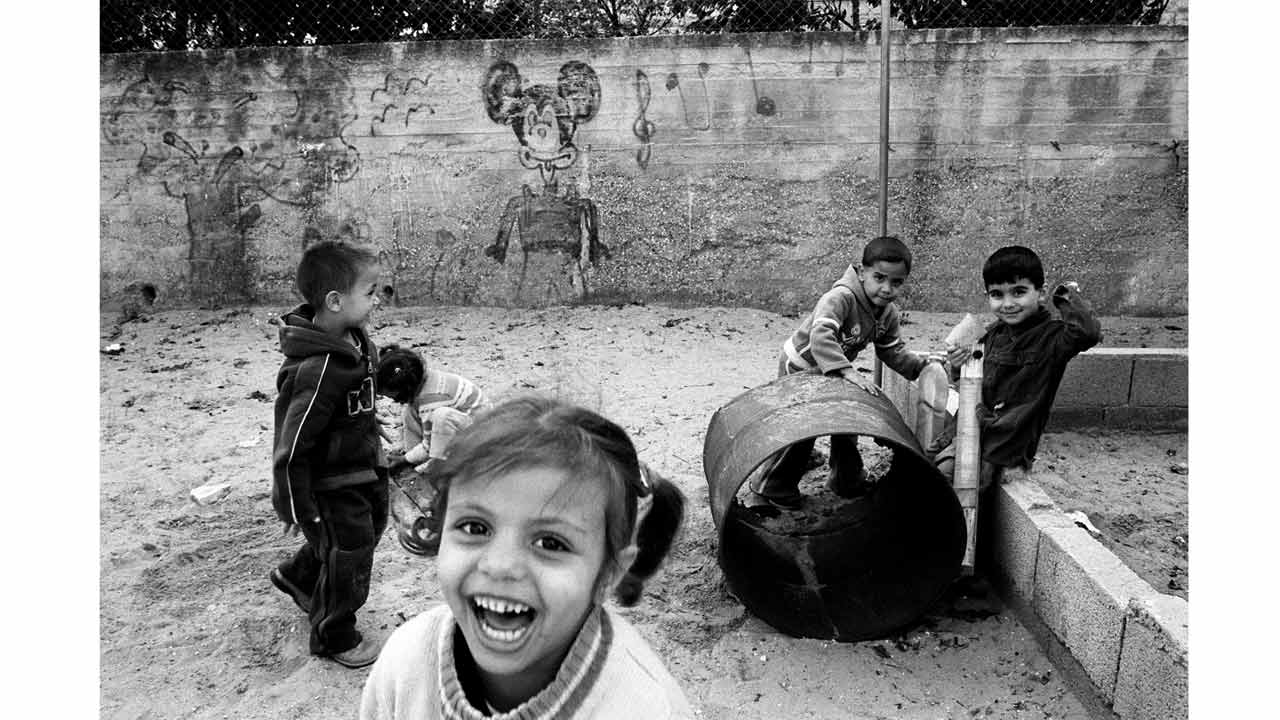
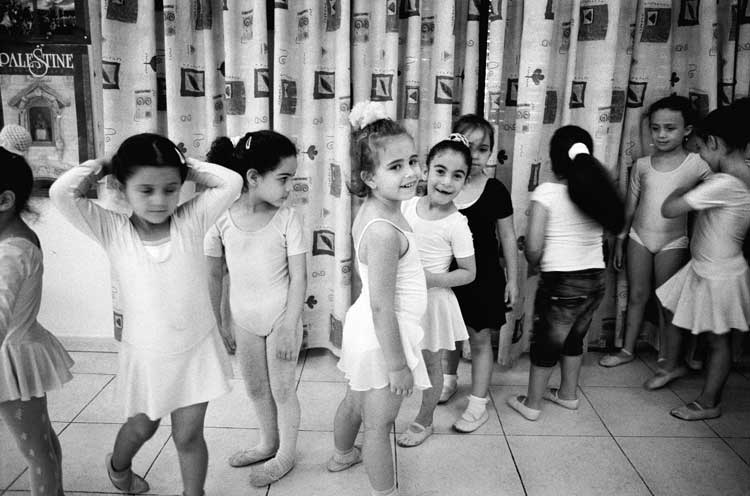
Title Image: Ramallah, Palestine, 2006. Palestinian children playing in the backyard of the Edward Said Musical Kindergarten in Ramallah. The kindergarten is a part of the Barenboim-Said Center for Music. It aims to build an informed and vibrant Palestinian society where music plays an integral part in educational development and shapes the identity of children and young adults. Besides normal daycare and play, the children are introduced to music through listening, rhythm, and collective sound-making.
All images are © Wendy Marijnissen.
Note: The author has contacted Getty Images regarding the alleged copyright infringement of Ali Jadallah’s photograph, as exhibited in The Golden Ratio — The Math of Beauty. Getty Images has responded that its review is ongoing and will take longer than expected.
Bibliography
Al Jazeera. “Explainer: The Oslo Accords.” Al Jazeera: The Oslo Accords
Azoulay, Ariella Aïsha. The Civil Contract of Photography. Cargo Collective: The Civil Contract of Photography
Barenboim-Said Center for Music. “Barenboim-Said Center for Music.” Barenboim-Said Center for Music
B’Tselem. “Separation Barrier.” B’Tselem: Separation Barrier
Canvas Gallery. “Statement, Profile, CV: Aroosa Rana.”
Defence for Children International – Palestine. “Palestinian Child Political Prisoners 2006 Report.” DCI-Palestine Report
Foliard, Daniel. The Violence of Colonial Photography. Manchester: Manchester University Press, 2020.
Institute for Middle East Understanding. “Resources.” IMEU Resources
Sontag, Susan. Regarding the Pain of Others. New York: Farrar, Straus and Giroux, 2003.
United Nations. “History of the Question of Palestine.” UN: History of the Question of Palestine
- The Global Sumud Flotilla, carrying hundreds of activists and humanitarian aid for Gaza, was intercepted by Israeli forces. All 428 detainees have since been deported to Turkey. Following their release, activists and rights groups have leveled severe allegations against Israeli forces regarding physical torture, abuse, and sexual violence while in custody. https://www.aljazeera.com/news/2026/5/22/
- United Nations, “History of The Question of Palestine,” UN.org https://www.un.org/unispal/history/.
- Institute for Middle East Understanding, “Resources,” https://imeu.org/resources/.
- Ibid.
- Aljazeera, “Explainer. The Oslo Accords,” https://www.aljazeera.com/news/2023/9/13/what-were-oslo-accords-israel-palestinians.
- B’Tselem, “Separation barrier,” https://www.btselem.org/topic/separation_barrier.
- Daniel Foliard, The violence of colonial photography (Manchester: Manchester University Press, 2020) 5.
- Susan Sontag, Regarding the Pain of Others (New York: Farrar, Straus and Giroux, 2003).
- Ariella Aïsha Azoulay, The civil contract of photography, Cargo Collective, https://cargocollective.com/AriellaAzoulay/filter/Books/The-civil-contract-of-photography.
- Canvas Gallery, “Statement, Profile, CV Aroosa Rana,” https://canvasgallery.net/wp-content/uploads/2026/03/Statement-Profile-CV.pdf.
Wendy Marijnissen

Wendy Marijnissen is a Belgian documentary photographer, curator, and educator whose practice is rooted in socially engaged storytelling. For over 16 years, she has explored themes of reproductive health, motherhood, and gender-based vulnerabilities in Pakistan. Her work, including the intimate monograph Always the Guest, rejects spectacle in favour of a contemplative, diaristic approach that emphasizes empathy over the detached gaze of traditional photojournalism. Wendy has expanded her practice into curation and education, co-founding the Pakistan Documentary Photography Initiative (PDPI). Through this platform and her non-profit Bending The Frame, she nurtures emerging voices and champions ethical representation. Currently pursuing a Master’s in Art and Cultural Sciences, her research focuses on decolonizing visual culture---a lens she applies to her photographic and curatorial work to challenge dominant visual frameworks. Her work can be found at her website www.wendymarijnissen.com and Instagram @wemarijinissen
There are no comments