The Aurat March is a space where art meets activism. Here song and dance, talks and posters communicate the struggles of women: for control over their body, escape from abusive marriages, demands for basic rights like justice, security and education.
Aurat March which is organized by a coalition of women’s rights defenders since 2018, was hurled into the limelight a few years ago when its blunt and defiant posters generated a backlash by misogynists. In some cities the participants of Aurat March were even physically attacked.
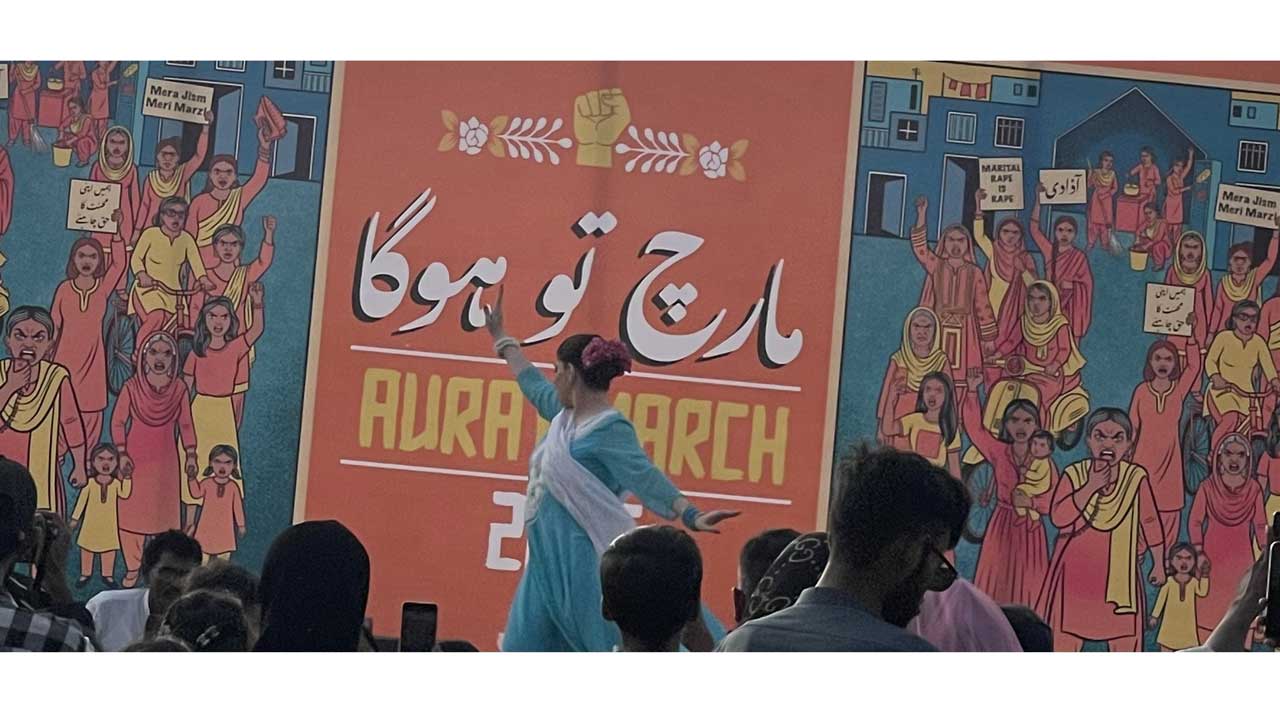
Despite all the controversies and intimidation, the 2026 Aurat March was held. Women and men participated in thousands, from all over the city and beyond. Among the placards they carried, the one that caught the most attention, stridently announced ‘I feel fahash and badmash’ loosely translated it means I feel like being obscene and immoral. With humour, its author subverted fahash and badmash, the two words that are often hurled indiscriminately at all defiant women in our society. It also challenged those who weaponize verbal abuse.
Artists of Pakistan have always asked difficult gender questions in their art, after the Nawabpur incidents in the 1980s, where nudity was instrumentalized in the name of honor, to humiliate an entire village, Zahoorul Akhlaq did a series of prints and drawings to register the agony of unclothed women who were forced to march publicly. It was around the same time that Nahid Raza painted the pregnant nude to defy the silence around the body and its transformation during the miracle of gestation. The controversy around the burqa under Zia ul Haq’s Islamization policies, was given monumental form by Jamil Baloch. His tall sculptures of faceless women shrouded in anonymity were so powerful that it made the State uncomfortable and they were censored at the inaugural of the National Art Gallery in the Capital.
Domestic abuse and violence have been referenced by artists who are either survivors themselves or have known the victims. Often seen at graduate shows, here young artists feel secure to lay bare biographies of trauma. Sometimes memory of violence manifests itself in cathartic visuals of raw wounds and dead animals, to deal with deep pain.
This year Aurat March focused on the growing sexual violence within marriage. The case of Shanti, the young bride who died recently due to the horrific rape by her husband, was shared from the podium as a reference to all the inhuman marital rape incidents without redress, that have been documented across the country. Farida Batool’s digital mural of a collage of eyes captures the piercing persistence of the male gaze. Displayed on streets and public transport, it serves as a reminder, that this is where the objectification of women starts to dehumanizes them. Statistics show a growing suicide rate of women trapped between familial conformism and a patriarchal society. Aisha Khalid ‘s early miniature series in which the female figure in a burqa, merges into the pattern of the drapes, was a commentary on widespread physical and emotional disenfranchisement.
The art of Roohi Ahmed and Sumera Tazeen underline the socially vulnerability spawned by dowry demands because there is no political will to implement the anti- dowry laws. Indian artist Nalini Malini’s haunting series on the life of a child bride and her subsequent dowry death, is yet another testament to unimplemented laws.
A group of artists with Sofia Balagamwala have been working closely with the Aurat March organizers to visually strengthen the voice of women and the transgender community. The placard art at Aurat March has become a catalyst for public conversations as they call out for attention with humor and defiant messages like the ones seen in 2026: ‘Izzat nahin, insaan hai aurat, Aurat bachay peyda karni ki machine nahin hai, Aurat ka Haq e mehnat and Mera jism, meri marzi. For the artist community, used to working within the confines of the studio and the gallery, it means physically stepping out to stand with the sisters, whose stories they have been telling for a long time.
Title Image: Taken at the event ‘The Aurat March 2026’ which took place in Karachi on Sunday, May 10, 2026, commemorating Mother’s Day. The gathering and march were held at Beach View Park, Sea View, after the Sindh government issued a No Objection Certificate (NOC) with specific conditions for the event.


There are no comments