
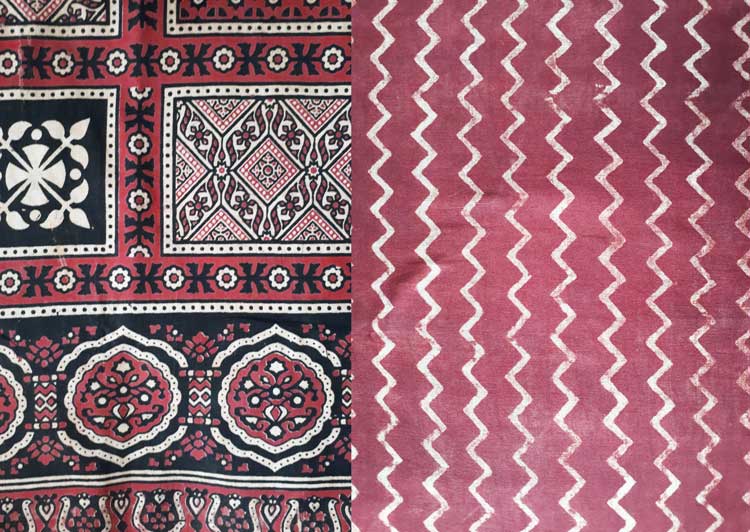
Several craft makers migrated from Sukkur and Bhawalpur to cities like Karachi and Lahore for more opportunities in the last few decades. To counter the fast-paced manufacturing in the transformed cottage industries, non-profits and private patrons introduced a separate stream of craft-based items which offered subpar quality products. Apparel made with Hunzai phulkari and ralli sold through non-profit outlets like Sungi in 2000s and Khazana in 2010s were examples of this initiative. Though well intentioned, the strategy commercialised these items due to monetary challenges or a lack of understanding of making processes.
Some rural artisans now prefer to practice in cities which provide consistent sources of income rather than waiting for commissions of rallis and ajraks. Urban centres in Karachi have several communities like Dalmia, Rustom Zikri Goth, and Neelam Colony, in which women originating from rural areas and now working in mainstream cities for better income, produce craft-based products for urban customers. These artisans work with different techniques of embroidery, crochet, or sewing learnt from older women in their family. However, their handmade manufacturing methods may still qualify as industrialized production, as they are making with the objective of selling to consumers who disconnected from the craft and/or its environment.
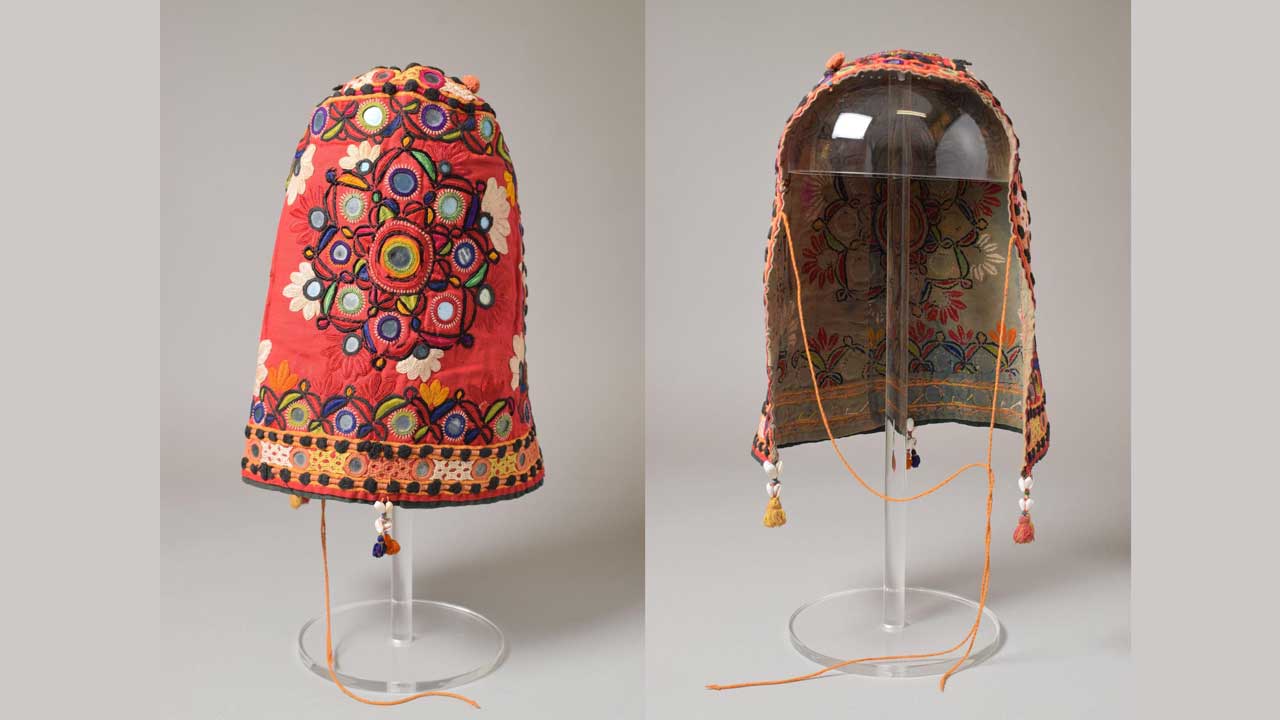
Indigenous craft-making practices are about meaning-making; there is usually a co-existence between form, function, and environment. Traditional textiles were produced in rhythm with the cycles of nature. The time it took to make was an indicator of the slow and measured lifestyle of its people. David Pye refers to craft as workmanship of risk as opposed to workmanship of certainty. “In workmanship the care counts for more than the judgement and dexterity, though care may well become habitual and unconscious”.19 For instance, a topla, from Sindh, is a traditional child’s hood which used to be made by women in the family to protect the child from illnesses and the evil eye. It is made of soft cotton or silk and is a laborious undertaking due to the heavy embellishment. The care that goes into making a topla is not found in crafts made for commercial sale because the artisan’s role is to maintain tradition and preserve the identity of the craft and the community.
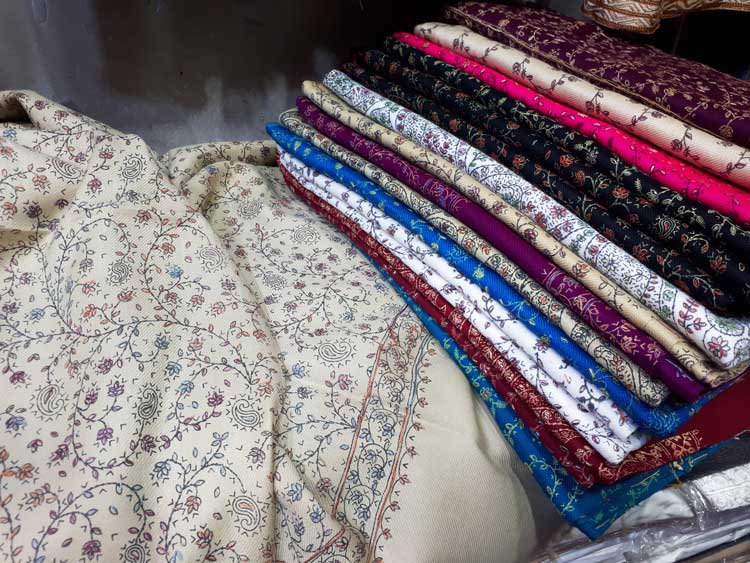
Crafts changed into faster and cheaper versions as the world embraced industrialization, post-World War II. The standardization of textile handicrafts for commercial manufacturing has turned the owner into a simple consumer who ditches authentic handmade items for fast fashion-like consumption. The lack of individuality also results in detachment from traditional practice, that advantages the urban retail markets but not the sustenance of local heritage. A three-pronged detachment is witnessed here—between the craft, the craft and the consumer, and the artisan. However, in many cases, the visual identity of craft is preserved to make the consumer identify with the product as authentic handicraft.
For instance, it can take an artisan a few weeks to complete Sozni embroidery on Kashmiri shawls. However, the replicas sold in the markets in Karachi during the winters are machine printed versions on polyester and viscose instead of labour-intensive handmade embroidery on fine wool and silks. These industrially manufactured shawls are cheaper to produce and affordable and manage to retain some visual elements of the original. Due to the change in the method of manufacturing, these are made by anyone but Kashmiri artisans in urban cottage factories. The craftsperson who develops these products maintains a level of detachment to fulfil the consumer’s wish-list. Motifs, colours, materials, and techniques are chosen carefully to attract wider clientele to guarantee higher sales. The dilemma of fast-manufactured craft products thus removes the element of identity and social customs associated with the meaningful practice of making.
As for developmental projects, the primary aim of the non-profit organisations is to generate livelihood for skilled workers and bring women into the active workforce. Once the non-profit project is over, some artisans connect with urban retailers producing ralli and block prints, owing to their sizeable clientele. Hand embroideries from different parts of Pakistan are amongst the most time consuming and costly but earn less in mass markets despite the efforts of non-profit organisations.
Non-profits with outlets in cities generate greater sales than rural skill development projects. Urban outlets usually sustain longer relationships between the artisan and the customer. Standardization of product development methods, consumer needs, and procurement of materials through reliable vendors helps artisans in securing higher profit margins, resulting in the continuity of production. However, this type of production once again falls in the arena of commercial manufacturing. This should not discourage non-profits and patrons from exploring new ways to incorporate crafting methods and visuals to preserve visual heritage.
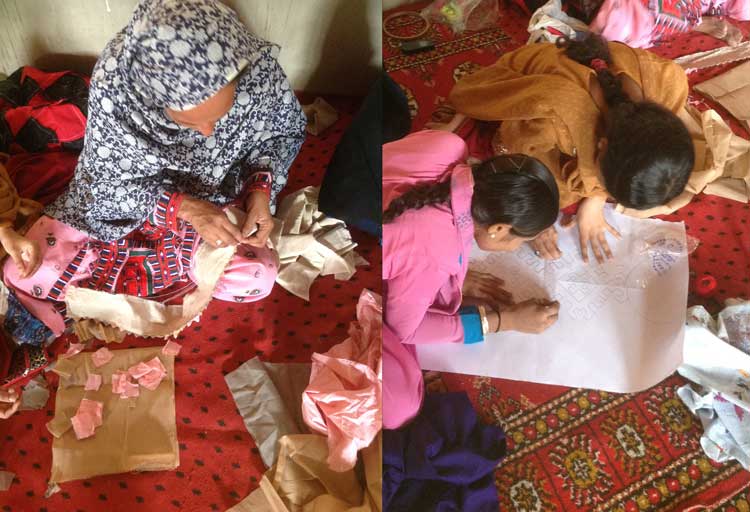
As preservers of craft, the artisans must be facilitated and included in development programs and decision-making. Questions such as “do rural artisans want to remain producing craft, and do urban artisans want to remain in touch with regional crafts?” are abound. Considering the precarious economic situation and market upheavals, artisans who choose to continue their legacy need consistent income streams. Training artisans for entrepreneurial pursuits and providing avenues for regular livelihood might be the key to building a stable foundation for the sustenance of artisans and their skills, subsequently preserving the craft in some form. As long-term goal for organizations and the government, these require urgent viable planning, capital, and informed objectives. Non-governmental organisations such as the CWSA20 and TRDP21 in Sindh, and Sungi in KPK have attempted such projects, but the results have been sluggish and sustenance of craft in its original context seems unlikely despite the incentives.
Social advocacy through digital media allows for a possibility of reshaping our behaviour towards ethnic practices and traditional craftmaking alongside the commercial craft industry. SMEDA (Small and Medium Enterprise Development Authority)22, and brands promoting authentic textile handicrafts can employ rebranding strategies and educate audiences about responsible consumption through workshops, seminars, social media platforms, and viable international collaborations. Independent patronage can initiate practices that can facilitate artisans socially and financially.
Objects crafted with indigenous materials and techniques evoke a sense of ownership and association that machine-made products do not.23 This recognition powerfully liberates individuals and society from sales-driven competition and contribute to individual and collective identity. However, this ownership cannot be expected of artisans only but from crafters, makers, DIY artists, and consumers, equally. The collective responsibility must commit to a broader preservation that refuses to hold the artisan back by demanding they adhere to the stagnant authenticity standards. Instead, we must find new ways to reinvent craft in emerging socio-economic contexts, ensuring its survival as a living and breathing expression of social legacy.
Title image: (Sindh) A child’s hood embroidered in traditional colours and stitches of Tharparkar region. V&A Museum London.
Bibliography
Askari, Nasreen, and Rosemary Crill. Colours of the Indus: Costumes and Textiles of Pakistan. London: Victoria and Albert Museum, 1997.
Askari, Huma, and Nasreen Askari. Flowering Desert: Textiles from Sindh. London: Paul Holberton, 2019.
Cohen, Erik. “Commercialization of Ethnic Crafts.” Journal of Design History (1989).
Community World Service Asia. “What We Do.” Accessed April 5, 2026. https://communityworldservice.asia/what-we-do/livelihoods/.
Costin, Cathy L. “Introduction: Craft and Social Identity.” Archaeological Papers of the American Anthropological Association (1998).
Dant, Tim. Material Culture in the Social World: Values, Activities, Lifestyles. Buckingham: Open University Press, 1999.
Feng, Zhihui, and Jian Luo. “Glass Art: A Discussion of the Impact of Digital Manufacturing Processes on Craft Practice.” SHS Web of Conferences (2023).
Greenhalgh, Paul. The Persistence of Craft: The Applied Arts Today. New Brunswick, NJ: Rutgers University Press, 2003.
Harvey, David. The Condition of Postmodernity: An Enquiry into the Origins of Cultural Change. Oxford: Blackwell, 1990.
Hodder, Ian. The Meaning of Things: Material Culture and Symbolic Expression. London: Routledge, 2004.
Kouhia, Anna. “Categorizing the Meanings of Craft: A Multi-Perspectival Framework for Eight Interrelated Meaning Categories.” Techne Series A 19, no. 1 (2012).
Kuldova, Tereza. Luxury Indian Fashion: A Social Critique. London: Bloomsbury Academic, 2016.
Luckman, Susan. Craft and the Creative Economy. London: Palgrave Macmillan, 2015.
Paige, Robert C. “Craft Retail Entrepreneurs’ Perceptions of Success and Factors Affecting Success.” Iowa State University, 1999.
Pye, David. The Nature and Art of Workmanship. Cambridge: Cambridge University Press, 1968.
Riello, Giorgio, and Tirthankar Roy. How India Clothed the World, 1500–1850. Leiden: Brill, 2009.
Robshaw, John. John Robshaw Prints: Textiles, Block Printing, Global Inspiration, and Interiors. San Francisco: Chronicle Books, 2012.
Robb, John E. Material Symbols: Culture and Economy in Prehistory. Carbondale: Southern Illinois University Press, 1999.
Small and Medium Enterprises Development Authority. “Completed Projects, Projects Menu.” Accessed April 5, 2026. https://smeda.org/index.php?option=com_content&view=article&id=678&Itemid=1605.
Murtaza, S. Y. “The Cottage Industry, a Neglected Sector in Pakistan.” Daily Times, July 9, 2019. https://dailytimes.com.pk/427019/the-cottage-industry-a-neglected-sector-in-pakistan/.
Mirza, Sara. Threads of the Indus: The Subtle Forms of Power in Craft Development in Sindh, Pakistan. PhD diss., Royal College of Art, 2020.
Thardeep Rural Development Program. “About Us.” Accessed April 5, 2026. https://thardeep.org/about-us/.
Watt, James C. Y., and Anne E. Wardwell. When Silk Was Gold: Central Asian and Chinese Textiles. New York: Metropolitan Museum of Art, 1997.
Zhiyan, Wang, Janet Borgerson, and Jonathan Schroeder. From Chinese Brand Culture to Global Brands. London: Palgrave Macmillan, 2013.
- Cathy Lyne Costin, “Why Craft and Social Identity” in Introduction: Craft and Social Identity (Archaeological Papers of the American Anthropological Association, 1998), 4.
- Rosalind Corieri Paige, “Definitions” in Craft retail entrepreneurs’ perceptions of success
and factors affecting success (Ames, Iowa State University, 1999), 10.
- Anna Kouhia, “Experiential meanings” in Categorizing the meanings of craft: A multi-perspectival framework for eight interrelated meaning categories, (Techne Series A: Vol 19, No 1, 2012), 32.
- Tereza Kuldova, “Intense Encounters with the World of Luxury Fashion and the Rich” in Fatalist Luxuries Of Inequality, Wasting, and the Antiwork Ethic in India (Cultural Politics, 2016), 116.
- David Harvey, “Modernization” in The Condition of Postmodernity: An Enquiry into the Origins of Cultural Change. (UK: Blackwell Publishers, 1990), 100
- Paul Greenhalg, in Persistence of Craft: The Applied Arts Today. (Rutgers University Press, 2003)
- Erik Cohen, Commercialization of Ethnic Crafts (Journal of Design History, 1989), 161.
- David Pye, The Nature and Art of Workmanship. Cambridge University Press 1968.
- “What we do,” CWSA, accessed April 5th, 2026, https://communityworldservice.asia/what-we-do/livelihoods/
- “About Us,” Thardeep Rural Development Program, accessed April 5th, 2026, https://thardeep.org/about-us/
- “Completed Projects, Projects Menu,” SMEDA, accessed April 5th, 2026, https://smeda.org/index.php?option=com_content&view=article&id=678&Itemid=1605
- Seher Mirza, “Standardisation and Commoditization” in Threads of the Indus: the subtle forms of power in craft development in Sindh, Pakistan (UK: Royal College of Art, 2020), 52.
Faiza Habib

Faiza Habib is a textile designer and design educationist with over fourteen years of experience in practice-based design education, curriculum development, and studio research. Her work explores art, design, and their role in society, with a focus on youth-centric and socio-cultural issues. She has developed interdisciplinary academic and industry projects for universities, private organizations, and NGOs. In 2023, she founded Instructional Design Systems, offering education and upskilling solutions to corporate clients in STEM and creative industries. She now enjoys devising learning and training solutions for professionals adapting to the demands of an increasingly AI-driven world.
There are no comments