
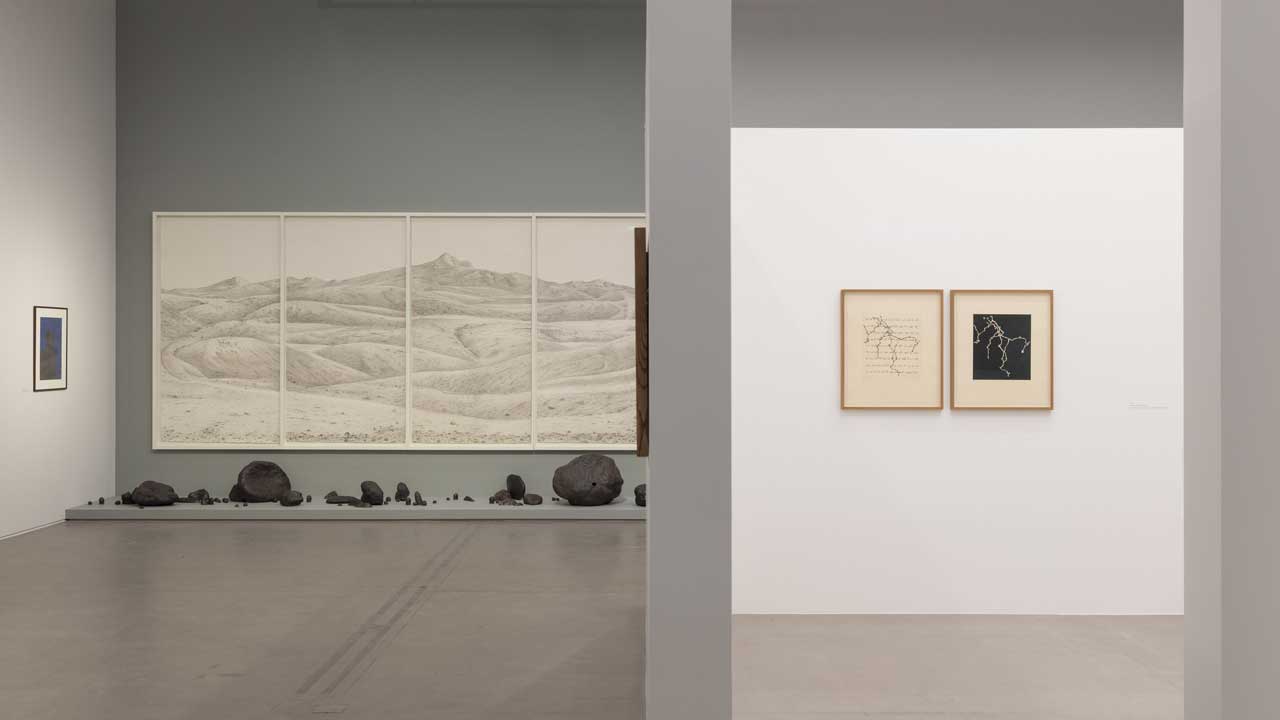
The British philosopher Ludwig Wittgenstein once wrote that “the logical picture of a fact is a Gedanke”.1 Simply put, Wittgenstein considered the act of thinking as a kind of a pictorial operation. Thoughts, sentences, and images represent reality by arranging elements in a relationship between themselves. Wittgenstein elaborates by taking the example of the gramophone. “The gramophone record, the musical thought, the score, the waves of sound… all stand to one another in that pictorial internal relation which holds between language and the world”.2 These reflections about how representation and translation inform pictorial, textual, symbolic or sensorial form, hover over the exhibition titled Urdu Worlds at Ishara Art Foundation in Dubai, where the curator Hammad Nasar brings Indian printmaker Zarina Hashmi (d. 2020) and Lahore-based contemporary Pakistani artist Ali Kazim, under one roof.
Zarina often incorporated Urdu poetry by South Asian visionary writers, including Faiz Ahmad Faiz, Mirza Ghalib, and Muhammad Iqbal, in her works. Kazim’s works have also been informed by Indian writers such as Naiyer Masud and Gopi Chand Narang, and Pakistani poet Muneer Niazi. 3 Demanding careful viewing, this appreciation for text, paper, and image is visible in the thoughtful curation of the exhibition.
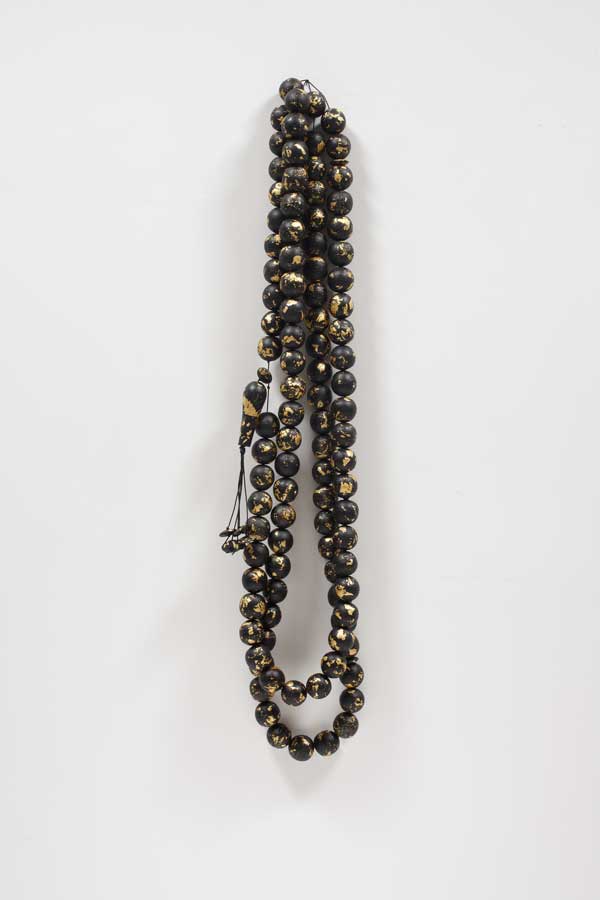
Walking through the display is like gliding into a time warp that traverses across civilizations and cultures. Zarina’s large, gold-flecked string of oversized prayer beads titled Tasbih (2011) evokes a lament for a rich and textured lost Lebenswelt (lifeworlds)4. The sculpture may represent themes of the sacred, memory, and exile built through repetition; it suggests a devotional act where each bead marks the completion of a sacred recitation. In comparison, Kazim’s cluster of toy-like miniature sculptures, Votive Objects, (2022) echoes the same sentiment, with an austerity of form and material. Like Zarina, Kazim also uses a signifier of devotion. He creates various iterations of the form in terracotta that are placed together to function as a harmonious collective.

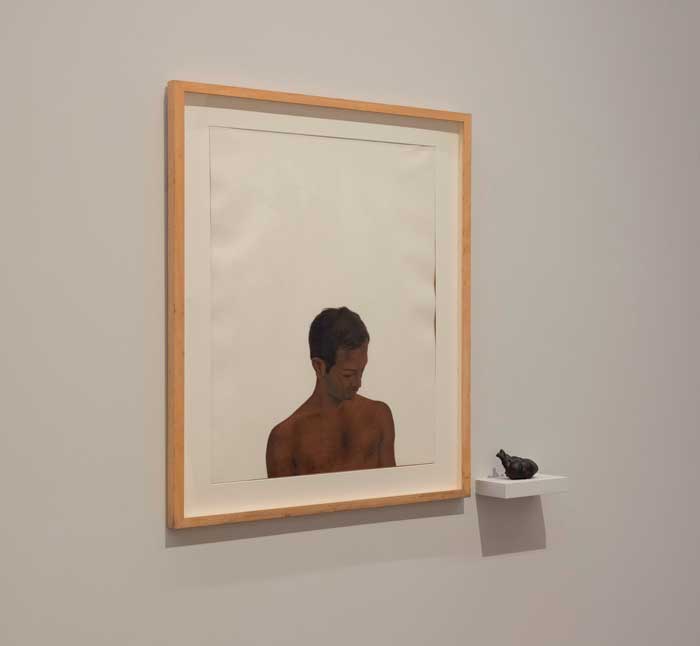
Some works will have the viewers pause and intrude upon the artist’s inner world. Ali Kazim’s self-portrait titled Untitled (2013) is on display, illustrating him with a bare torso, as the figure appears pensive and vulnerable. This emotion is bolstered by a miniature sculpture of a heart placed on a tiny pedestal, just below his portrait. The work is adjacent to Zarina’s thirty-six woodcuts, collectively titled Home is a Foreign Place (1999), where varied geometric shapes and grids act as parts of an obscured house. There is an irony in viewing Kazim’s self-portrait, sometimes obscuring our view of Home is a Foreign Place. Zarina’s woodcuts mimic diagrammatic representations and their dismantling of lived spaces is balanced by Kazim’s melancholic expressions. However, Zarina, through her work, shies away from such telling self-representations. It is an unexpected moment where images and stories collide; but the proximity of their inter-generational concerns becomes more visceral and stretches beyond a curatorial coincidence.
Just as Wittgenstein describes moving from score to sound, the exhibition also translates various languages—both textual and pictorial—into space and image. Kazim’s artworks featuring drawings, sculptures, prints, and videos created over the last two decades form the outer skin of the exhibition, as it shows on the ground floor. But it is the “island” in the centre, on the first floor, that emerges as the beating heart of the exhibition.
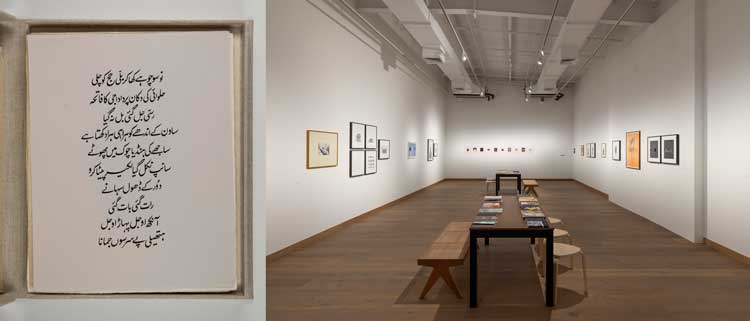
Works exhibited within this cube-shaped space explore the slippage of meaning and interpretation between text and image. Encased in a glass case, books by both artists bring our focus to the cultural significance of languages that bridge gaps between generations and art trajectories. Zarina’s lean, hard-bound book titled Urdu Kay Aik So Aik Mahavray (101 Urdu Proverbs) (1991), is a collaboration with her sister, Kishwar Chishti, who also selected the proverbs. The wall space above the glass case displays two images from this series. Zarina’s book is placed next to Kazim’s Urdu Qaida (Alphabet Book of Urdu letters) (2025), a collaboration between him and the curator, responding directly to Mahavary. Wittgenstein might call a picture “a model of reality,” 5 and by this logic, the text-based works displayed by both artists in this space map possible worlds of memory, language, and belonging.
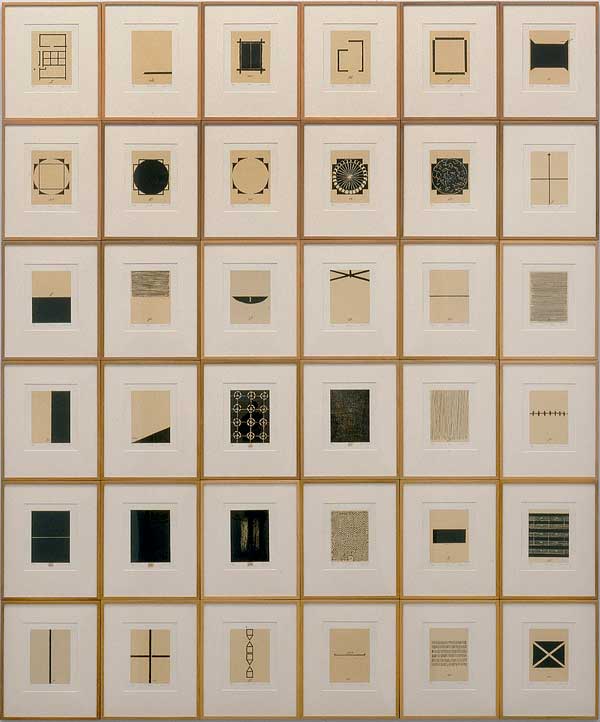
Two tables lined with more artists’ books greet viewers on the second floor of the gallery. The walls display works from Kazim’s Urdu Qaida, which are like the wordplay of Zarina’s Home is a Foreign Place. In the latter, each small woodcut in the series by Zarina has individual titles in the Urdu language. These range from words like “Door,” “Entrance,” and “Wall,” to the loaded words like “Border,” “Language,” and “Nation”.6 Kazim’s works emanate a similar dynamic between text and image. Tiles in Urdu and Persian languages such as Takht (throne), “Ajaaib Ghar” (museum), and Kohinoor (mountain of light) (2025) encourage us to think about the change in language and meaning.
The use of Urdu as a mnemonic marker of social and historical identity anchors the exhibition within the cultural landscape of Dubai. The city is a transatlantic hub, owing to waves of migrants, labourers, and professionals arriving from South Asia and other parts of the world, who are actively contributing to its economy. Viewers appreciate the brief interludes where Zarina and Kazim’s voices intermingle, as the act of slow looking in the gallery is rewarding and cathartic. Yet, such moments are brief, and one longs for more. The exhibition is curated as an “island of Zarina within a sea of Ali Kazim,” with fewer works by Zarina than Kazim. Curator Hammad Nasar explains that the layout has been arranged so that the outside walls of the central island and walls of the gallery can feature Kazim’s works.7
Whether in its premise or curation, Nasar acknowledges the difference in the number of works shown by each artist. However, viewers recognize that both artists pair remarkably well, complimenting in technique and visual language. Urdu Worlds succeeds in bringing together image, text, language, region, and history with a striking coherence. But with such finesse comes expectations—perhaps more of Zarina’s rich body of work could have further enriched the experience.
The exhibition titled “Urdu Worlds” was curated by Hammad Nasar and exhibited at Ishara Art Foundation in Dubai. The exhibition is on view from 16 January 2026 – 8 June 2026.
Title Image: View of Gallery featuring works by Ali Kazim, 2026.
All Images are credited to the Ishara Art Foundation
Bibliography
Nasar, Hammad. “‘From Z to A: Zarina and Ali Kazim’s Linguistic Co-Habitation.’” Ishara Art Foundation. Last modified January 26, 2026. https://www.ishara.org/ishara-online/from-z-to-a-zarina-and-ali-kazims-linguistic-co-habitation-by-hammad-nasar/.
Wittgenstein, Ludwig. Tractatus Logico-Philosophicus. London: Anthem Press, 2021.
- Ludwig Wittgenstein, Tractatus Logico-Philosophicus (London: Anthem Press, 2021), 41.
- Wittgenstein, Philosophicus, 41.
- Hammad Nasar, “‘From Z to A: Zarina and Ali Kazim’s Linguistic Co-Habitation’,” Ishara Art Foundation, last modified January 26, 2026, https://www.ishara.org/ishara-online/from-z-to-a-zarina-and-ali-kazims-linguistic-co-habitation-by-hammad-nasar/.
- Wittgenstein, Philosophicus, 76.
- Wittgenstein, Philosophicus, 76.
- Nasar, “‘From Z to A:”
- Hammad Nasar, Interview for GQ Middle East, 2026.
Zohreen Murtaza

Zohreen Murtaza is a visual artist, writer, and Lecturer in Cultural Studies at NCA Lahore. She earned her BFA and MA (Hons.) in Visual Art from NCA. Since then, she has extensively taught, researched, and written on art. Her articles and reviews have been published in Dawn (2017-2021), Friday Times, Artnow, ADA Magazine, and The Karachi Collective. She received the Nigaah Art Award for Art Critic in 2022. Her work has also appeared internationally in Canvas Dubai and TAKE on Art Magazine, India. Recent notable publications include an essay in ‘A Man with the Pen’, a limited-edition book on Pakistani artist Waqas Khan, and archive-based research leading to an exhibition and academic essay on master draughtsman Ustad Bashir-ud-din from Mayo School of Industrial Arts, Lahore.
There are no comments