
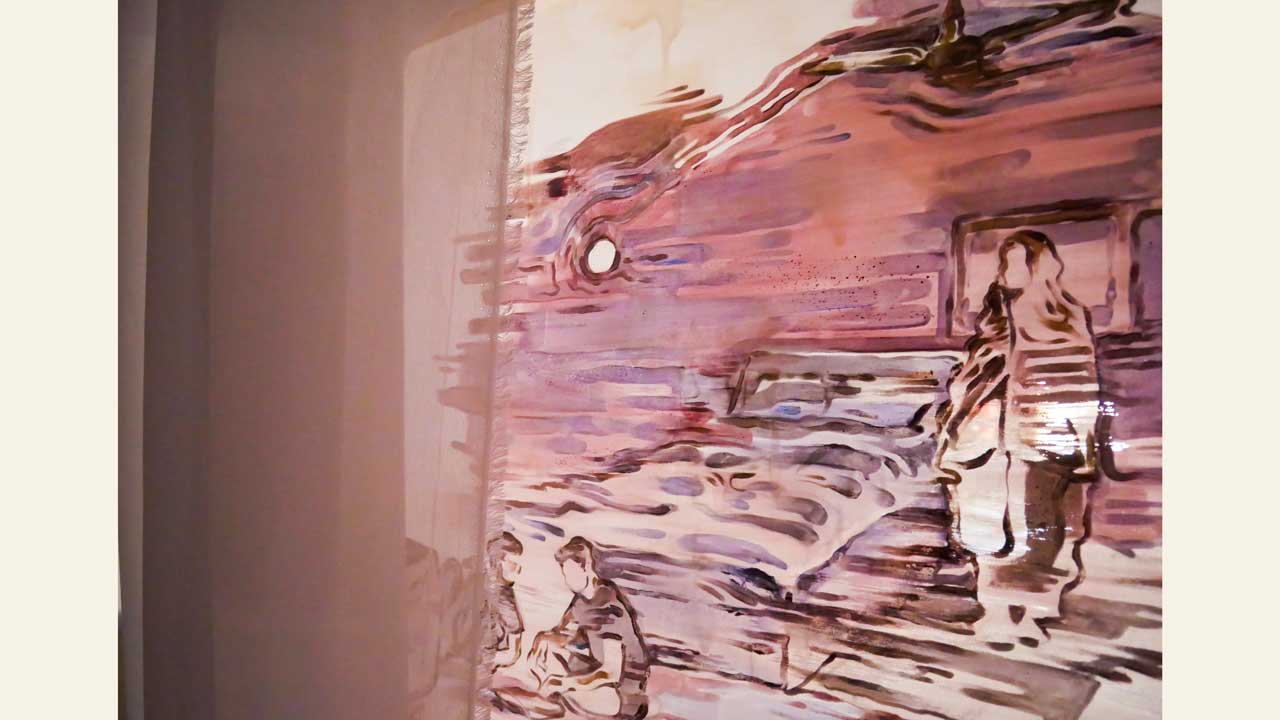
To be nostalgic is to exist between fragments of a memory and its imagined idealization. Curated by Noor Ahmed, the exhibition fanaa is the eclipse at Sanat Initiative presents works by the artist Zahra Mansoor where it navigates the domestic interior and nostalgia as a site of coming of age and desire. Here, fourteen paintings, a publication which acts as both a catalogue and an artwork, and a video installation depict Mansoor’s visual language, inspired by a Parisian experience, but inevitably reminiscent of an inter-generational Karachi.
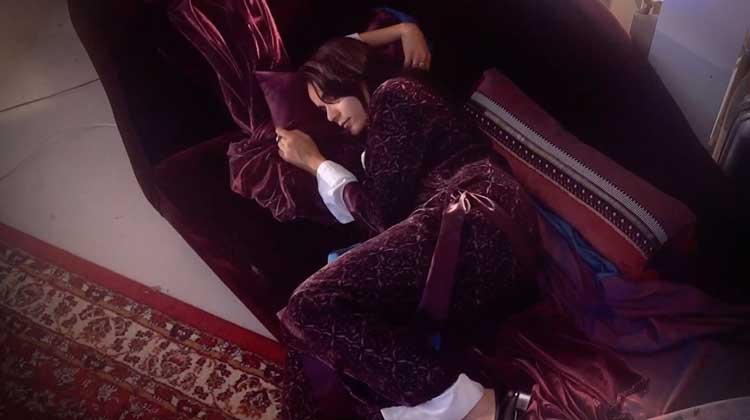
Mansoor’s short film Doomed Love Trope (2025) moves between performance, objects, and storytelling. The film shows an absurdist love story between the artist and her couch, where their one-sided relationship cannot be legalised under marriage laws of any kind. With an atmospheric ghazal by Mehdi Hasan playing in the background, the seating becomes a metaphor for fanaa, or the loss of the self, as the story pushes against familiar romantic clichés of yearning. The artist describes her studio practice as a form of research where the film and the paintings emerge as outcomes.
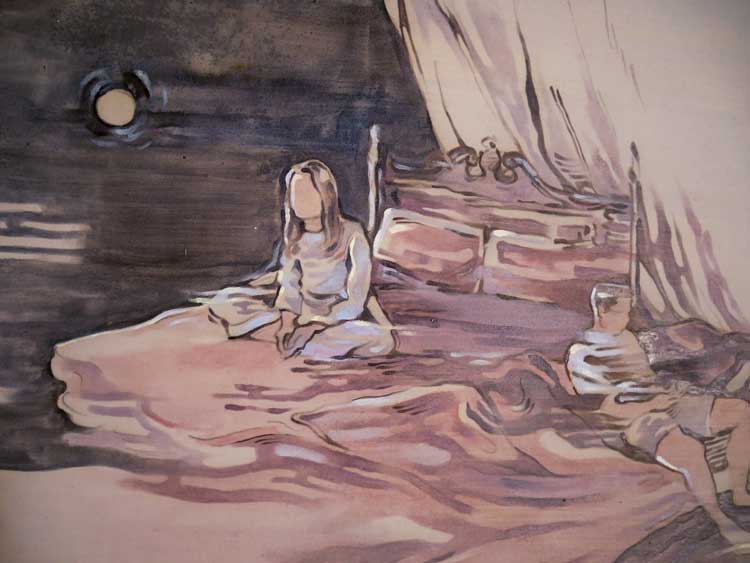
The notion of the “feminine belonging”, which may be interpreted as a sense of being tethered to people and places, extends into the paintings. With recurring purple and lilac motifs of the sofa and the moon, Mansoor’s chromatic language can be loosely situated alongside that of Pakistan born American painter Salman Toor whose use of green detaches space from realism to explore interiority. In contrast to Toor’s tense interiors shaped by queer experiences, Mansoor’s work carries a quieter connection grounded in the female memory. Where Toor’s palette often produces a compressed psychological atmosphere, Mansoor’s colours soften the domestic interior, emphasizing growth and the passing of time, yet both artists share intimate interiors to navigate a longing for home.
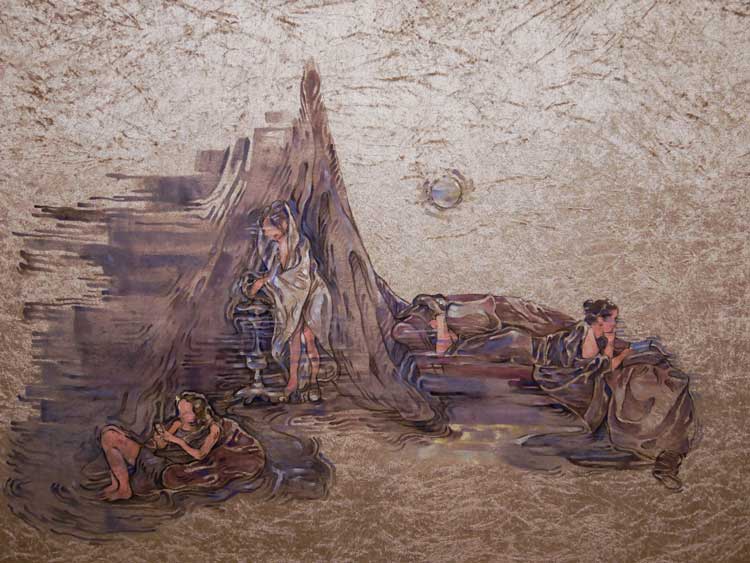
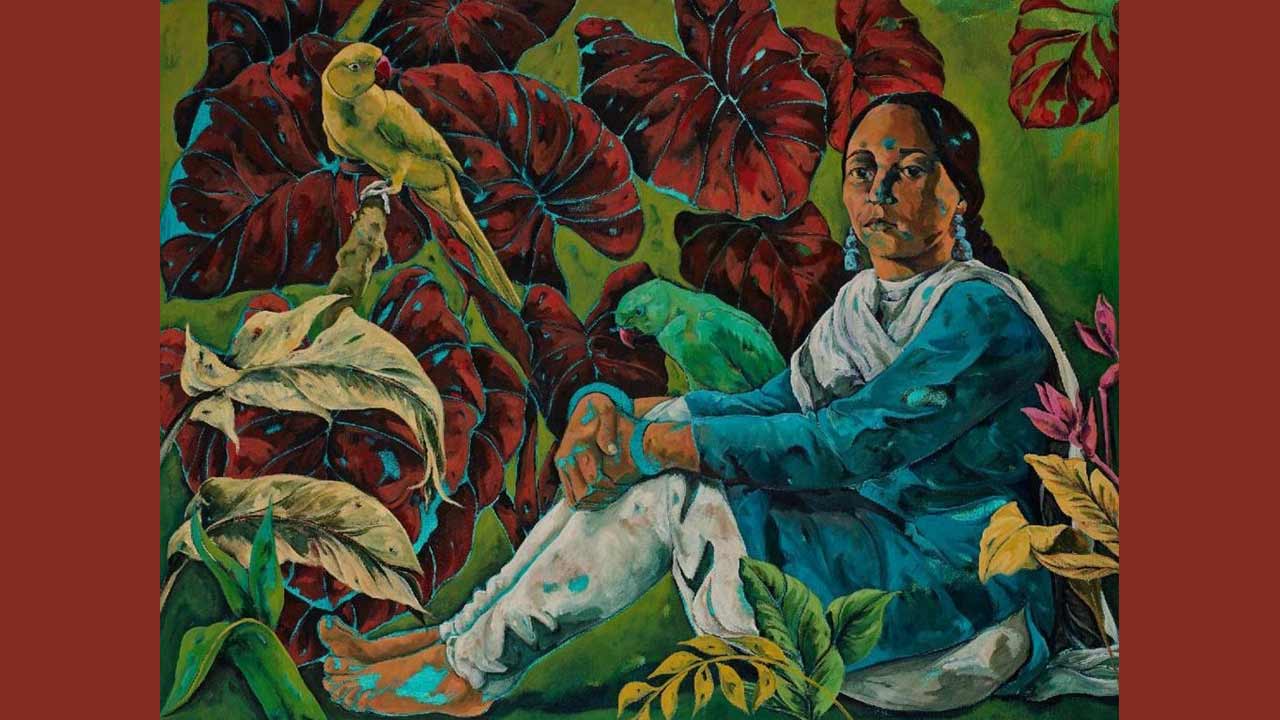
Another work, It Wasn’t Like This, I Just Wanted It to Be Like This (2025), painted on velvet, portrays women of varied ages. This composition reflects on womanhood as a continuum shaped by family structures and compromises rather than a fixed experience. The unidentifiable faces allow viewers to approach these figures as others or themselves. Even though Mansoor’s experience is global, with a lot of time spent in Paris, the recurring image of the couch, women with covered heads, gas burners, and peacocks in the works remind me of objects and stories widespread across Pakistan. I see the couch as an heirloom, akin to those in our local households, carrying emotional residue and generational continuity rather than modern urban detachment.
The artist works with fabrics like velvet, chiffon, and muslin. The white muslin is slightly translucent and mirrors the idea of existing between states, sanctity, and transition. Muslin’s materiality echoes the emotional register of the paintings, oscillating between memory and imagination. Muslin’s airy weave also recalls shrouds, devotional garments, and Sufi ideas of dissolving into the divine. Mansoor’s works suggest a state between presence, absence, and memory, as the exhibition affirms that home and selfhood are simultaneously shaped by repetition and change.
Umer Sheikh

Umer Sheikh bio: Umer Sheikh is a writer and photographer from Karachi with an interest in art,photography and the city. His work appears in Brown History, Dawn, Lakeer and other publications.
There are no comments