

In her solo show titled “Lines and Language” at Karachi’s Canvas Gallery, the artist Rabeya Jalil drills into gesture and asks: how do we move, strike, puncture, and scrape?
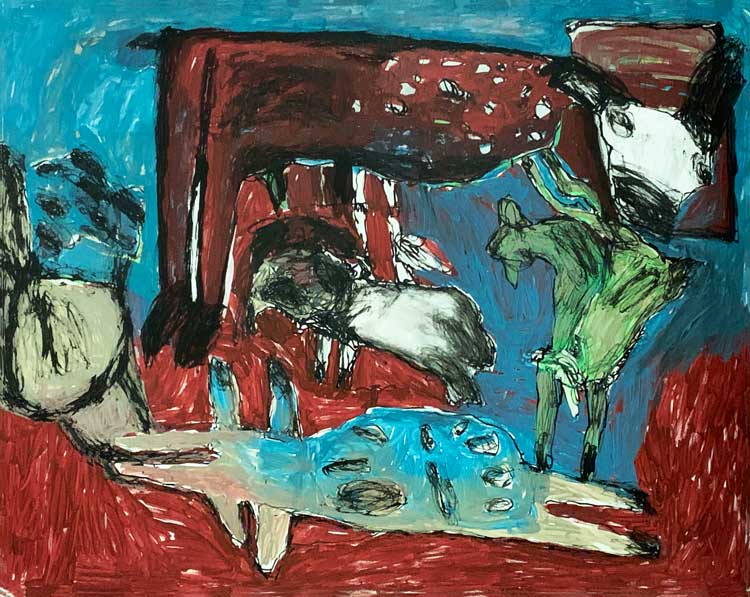
In Jalil’s paintings we may see amorphous blobs, strokes, and patches of colour from afar. But up close, silhouettes of animals contained within borders crawl out, revealing layers of paint. For instance, in the work Animal Play, four-legged figures circle closely around each other. Jalil’s work sets your imagination into a dizzying momentum of questions. “Could that be a dog? With its white and black head?” Dog or not, the mind starts to think about every four-legged animal it knows, just to associate.
Simplicity in Jalil’s forms is reminiscent of many things: a child’s drawings stuck on the fridge, make-shift pedestrian signs, or a hasty doodle. This simplicity does not diminish her method. The artist’s acts of mark-making exhibit an innate naivete and rawness that contradicts most perceptions of “trained” or “refined” marks. For Jalil, the medium is the subject. This simplicity of paint is such that it activates a domino reaction in the mind: the barest indication of two long arms can change an “animal” into a “person”.
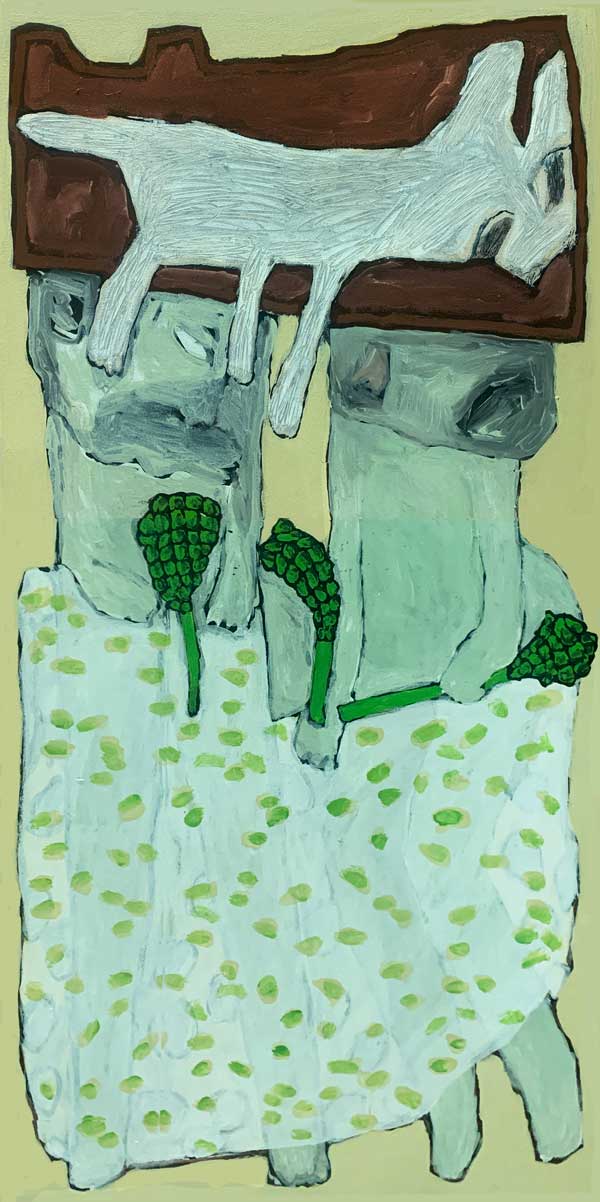
Jalil abstracts semi-representational forms of animals, human figures, and urban settings. For instance, stems of broccoli are stylized in Sleeping with Broccoli. The creatures clutching the vegetable in their limbs are not very identifiable, but she adds a resemblance of flesh in the paint strokes. She recognizes these decisions that signal restraint, choosing to flirt with two ends of a spectrum of recognizability. It is so human to want to see a face in everything. Psychologically, this phenomenon is termed “pareidolia”, and it is an evolutionary trait based on our need for pattern recognition in the wild for survival.1
As her work gravitates toward abstraction where paint itself becomes the artist’s primary concern, the trajectory reminds us of American Abstract Expressionism and Action painting of the 1940-s. Dutch American artist Willem de Kooning (d. 1997) once described flesh as “the reason oil painting was invented.” 2 However, Jalil’s preference for acrylic paint is closely tied to her interest in exploring the medium’s urgency and gesture. Acrylic dries quickly and can be diluted, peeled, or scrubbed away in mere seconds. It enables her to slip and scratch into wet paint and observe how time alters its residue. She describes this process as the “joy of painting”.
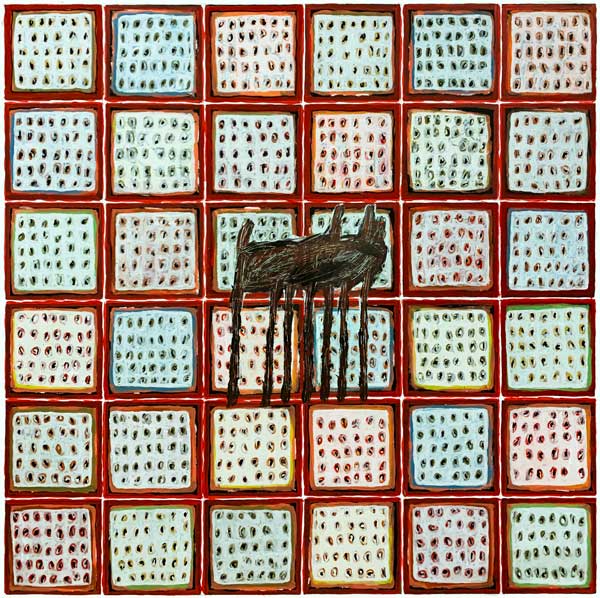
From recognizing a dog or a plant in one painting to being confronted by an ambiguous image as seen in Lipsticks II, the viewer is inundated with the possibilities of Jalil’s gesture. In this work, the grid situates the viewer at the bird’s eye that is reminiscent of a map. The forms that bloom against the edges of each grid compartment are obscure and monochrome. The ordering structure of the grid serves as a logistical method for Jalil to move from one quick gesture to the next. What immediately come to mind are Canadian American abstract painter Agnes Martin’s delicate and controlled grids or Dutch artist Piet Mondrian’s grids that signified the jazzy and geometric rhythm of New York City 3. I wondered if the grid was conceptually significant to Jalil, that somehow the order and rebellion would justify the elusiveness of her figures. The grid is only a tool and the real meaning of Jalil’s work is infinite because it will mean something different to each person.
Trained as a printmaker in college, attention to surfaces, matrices, chance, and intuition became her primary tools. Jalil tells me that she attempted to recreate the way a child draws and paints in the beginning of her practice. Mimesis, the act of representing reality, was futile, and that the approach itself was contrived. Observing the way children paint more than what they produce is a strategy that has aided her.
With scratches, dashes, and nibs that physically puncture through paint, Jalil’s gestures create raw warmth in her images which can be elusive or apparent. As French literary critic Roland Barthes explains in his book Camera Lucida (1980), the punctum of an image is a personal detail that “pricks” the viewer, evoking a private emotion.4 In Jalil’s work, it is her gesture that serves as the punctum. Jalil does not emulate naivete. Rather, she extracts a care-free intuition and displays marked fluidity in Lines and Language, thus, resisting a narrative closure.
Rabeya Jalil’s solo show, “Lines and Language” was showcased at Canvas Gallery, Karachi from 25th November 2025 to 4th December 2025.
Title Image: Lipsticks II, acrylics on canvas, 39 x 39 inches, 2025
All Images are courtesy of Canvas Gallery.
Bibliography
Barthes, Roland. “From Camera Lucida.” In Theatre and Performance Design, edited by Jane Collins and Andrew Nisbet, Routledge, 2012.
Lines and Language, catalogue, Canvas Gallery, 2025.
Martin, Agnes, and Anna Chave. On and Off the Grid. University of Michigan Museum of Art, 2004.
Rienzi, Greg. “The Science Behind Why We See Faces in Nature,” John Hopkins Magazine, Winter (2024): https://hub.jhu.edu/magazine/2024/winter/pareidolia-faces-in-nature/
Storr, Robert. “Passages,” ArtForum, Summer 1997. https://www.artforum.com/columns/willem-de-kooning-2-201773/
- Greg Rienzi, “The Science Behind Why We See Faces in Nature,” John Hopkins Magazine, Winter 2024. https://hub.jhu.edu/magazine/2024/winter/pareidolia-faces-in-nature/
- Robert Storr, “Passages,” ArtForum, Summer 1997. https://www.artforum.com/columns/willem-de-kooning-2-201773/
- https://www.centrepompidou.fr/en/pompidou-plus/magazine/article/focus-on-new-york-city-by-piet-mondrian
- Roland Barthes, “From Camera Lucida,” Theatre and Performance Design, ed. Jane Collins and Andrew Nisbet, (Routledge), 43-50.
Eman Farhan

Eman Farhan is a writer and artist from Karachi, Pakistan. They graduated from Indus Valley School of Art and Architecture with a BFA in 2024.Their work appears in Lakeer Magazine, The Blue Orange Project Magazine and other publications.
There are no comments