Young artists who feel disconnected with the past may ask why is institutional memory important? How does it help us individually and professionally? These are important questions because academics, historians and cultural institutions have only been able to offer a history full of erasures and manipulation. Institutional memory as a collective repository of past knowledge, which can be of people working in a professional field, discipline or institution, is a building block of social history that can empower people with a sense of continuity.
The highly politicized history that we have received, has not prepared us to see it as a living legacy that can help us to understand ourselves. As a critical lens, history can provide insights into mistakes and prepare us for its consequences. During the dictatorship of Ziaul Haq, and later, it was the overriding of institutional memory that allowed the marginalization and manipulation of culture. Artists who lived in the early decades recall how culture was seen as a cornerstone of nation building up to the 1970s. Artists, poets, writers participated in establishing the early institutions like Aiwan -e- Riffat, Arts Council and PNCA. In the 1950s Karachi saw a culture of dialogue and critical exchange take root at Aiwan e Riffat where cultural events were hosted by Attiya Fayzee and Fayzee Rahamin. Both internationally recognized intellectuals of the early twentieth century were gifted the Aiwan-e-Riffat by the State, to support the cultural development of a young Pakistan.
Pakistan National Council of the Arts, (PNCA) was a powerhouse of its time that took Modern Art to public audiences. Based in Islamabad with regional offices in provincial capitals, it was founded in 1973 with an ambitious network that supported the national vision to promote the Arts. It brought artists across the country together in annual National Art Exhibitions. This is where year after year, as an art student, I got to see the inspirational works of the masters up close. These museum quality shows in Karachi, were held at the Ahmed Perwaz Gallery and later it spilled over to the ground floor of the Arts Council. The city of Karachi had its own art collection of Modern Masters housed in the Arts Council. If you wanted to see the works by the first generation of artists from both wings of the country, all you had to do was walk into the A R Faridi Art Gallery. Shortly after Arts Council got its new building in the 1960s, Mr Faridi stepped forward with a gift of precious works of Shemza, Anna Molka Ahmed, Chughtai, Hanjra and Sadequain among others, to initiate a permanent collection for the city. This spirit also abounded in artists like Bashir Mirzä, Ahmed Perwaz, Maqsood Ali who made gratis contributions. The then Director, Irfan Hussain initially installed it on the top floor. In the early 1980s Rabia Zuberi, who was the chair of the Fine Arts Committee, raised funds to house a custom designed gallery space on the ground floor called the A R Faridi Gallery.
Much of the memory of these important institutions has not been archived and vital details of the early collections, exhibitions and dialogue that created the foundation, is sketchy and scattered. These Institutions, to this day do not have the capacity nor the will to consolidate its archives and document current history. This is where the art schools that are better equipped with faculty and students familiar with research and documentation can play an important role as partners. Any such collaboration can open new possibilities once historical documents become available to the historians of tomorrow.
Besides consolidating and building archives, the deeper problem lies in widespread skepticism due to the non-transparent ways in which history has been penned and taught. A template for inclusive art history that challenges the linear lens of authoritarianism can help bring back its legitimacy. I have always emphasized to the skeptics that the people of Pakistan, unlike the State, have remained resilient and dynamic. In the last few decades, they have stepped in where the State has not delivered. The personal initiatives of individuals and private institutions with philanthropic support have spearheaded development in the visual arts. All these diverse strands and dynamic sources are today’s art history testaments. However incomplete the documentation, we still have several hundred books from art history, monographs to catalogs that exist across the country and need to be brought together in an open access art archive.
In postcolonial countries, the documentation of the people’s memory is an act of foregrounding all that the gaps in narratives driven by Coloniality. Pakistan is 80 years old and we only have a finite amount of time as memory, a fragile membrane weakens with time. A transparent and inclusive history can be the direction we need today to consolidate and conserve institutional memory.
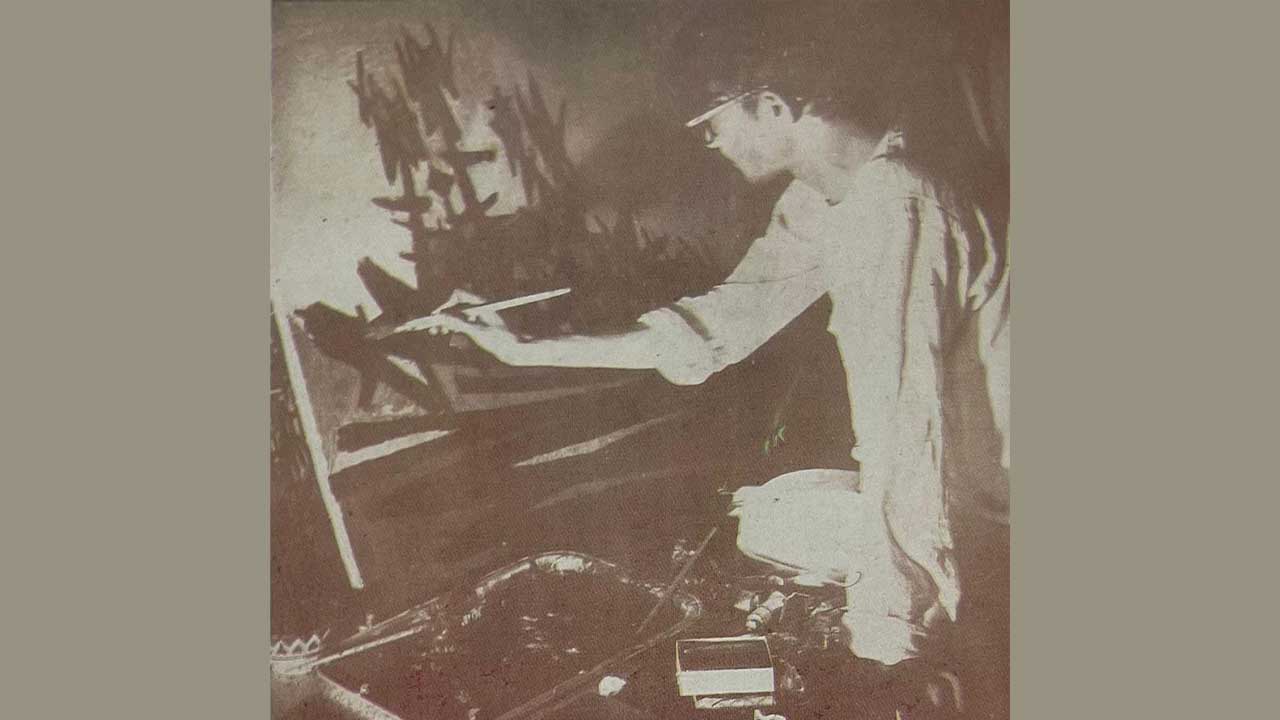
Image Credit: Bashir Mirza, The last of The Bohemians by Marjorie Hussain.
Michel Pance De Leon and a group of his students at the PACC
Standing: (Left to right) Gulam Rasul, Shahid Sajjad, Mohammad Iqbal, Naz Ikramullah, Michal, Marjorie, Ahmed Khan, Saeed Akhtar (Sitting) Mukhtar Ahmed, Bashir Mirza, Mustafa, Muzaffar A. Ghaffoor


There are no comments