
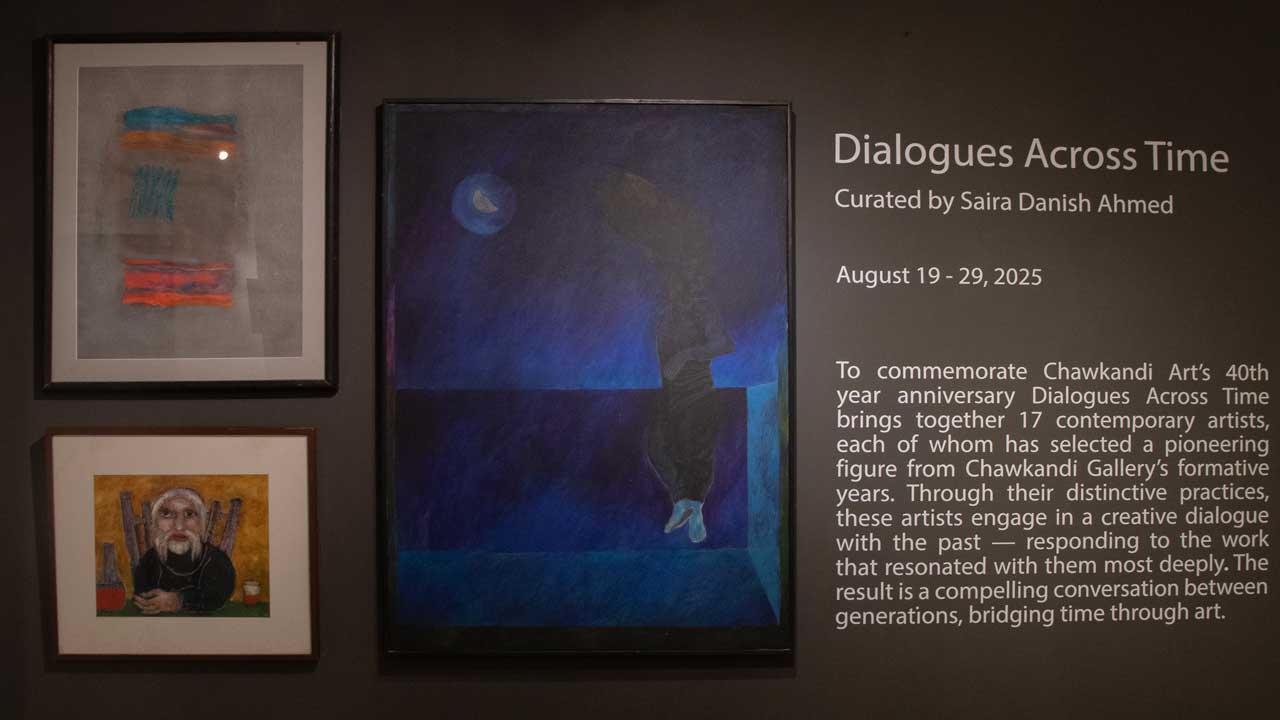
Karachi — On occasion of Chawkandi Art Gallery’s 40th anniversary, Dialogues Across Time invited seventeen practicing artists to come vis-à-vis with experienced veterans, who once shaped the gallery’s advancement in its early years.
Chawkandi’s founder Zohra Hussain recalls these initial years with fondness when artists were highly rigorous, but also laments the loss of interpersonal bonds between present-day creatives in an increasingly virtual world. One hears talk about the “baithaks,” when art galleries and artist studios were hubs of intellectual exchange that birthed collectives, collaboratives, and movements. Older accomplished artists were afforded a veneration, and the emerging professionals showed a passion to learn from the ustad. However, artists now often work in isolated spaces. Zehra Hamdani writes, “Zohra created this atmosphere, where there were conversations and historical contexts… Now, art often moves quietly through auctions, back rooms, changing hands without any interaction with the artist.”1
The exhibition’s curator Saira Danish Ahmed has been an academic for over twenty-five years and is cognizant of the pedagogical implications created by this gap. She believes younger artists must navigate the delicate balance between meaningful engagement and direct imitation, as they also juggle with the influence of social media and AI-driven tools. 2 The exhibition encourages a meaningful exchange between generations of artists. In doing so, it supports thoughtful work and echoes the kind of close-knit art world that the gallery once fostered.
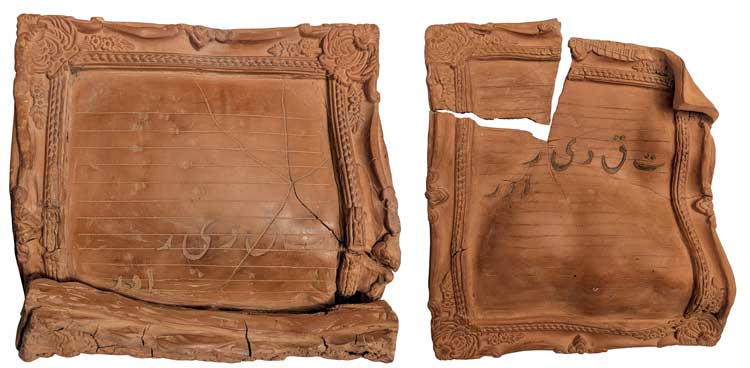
In Munawar Ali Syed’s series of four ceramic works, Khatoot-e-Mian (2025), plastic qualities of clay such as moldability and fragility allude to the vulnerabilities of the youth in a virtual world that stimulates from material excess. The artist takes inspiration from the works of renowned studio ceramist, Mian Salahuddin (d. 2006) and his philosophical engagement with the concepts of khudi (self), taqdeer (destiny), and shaheen (an imaginary falcon)—embedded in the writings of South Asian poet Muhammad Iqbal. In Syed’s clay plates, these Urdu words are bent and broken. The work also encourages reestablishing the ustad-shaagird (mentor-mentee) relationship for developing new practices and inspirations.
This meditation on material and form can also be observed in the works of Muzzumil Ruheel who contemplates the unfixed nature of memory and tradition. Responding to Zahoor ul Akhlaque’s works (d. 1999), Ruheel reimagines the modernist grid through geometric abstraction. In the work He Listens, I Ramble (2025), the artist makes his own minimalist border with a string and nails, allowing it to change form with every iteration. The purpose is to disrupt the idea that culture, tradition are rigid and unchanging—instead, making them seem fluid and responsive to present times.
Practices in disruption echo works of artists like Imran Mir (d. 2014) and Summaya Durrani, reinterpreted by Ayessha Quraishi and Danish Ahmed, respectively. Mir’s work often explored structure, control, and confinement through the grid, while Quraishi pushes against that rigidity. In What Is, Is as It Is (2024), she uses the grid not as a limit but as a point of departure. Through disruptions in the delicate lines and structure of the pattern, order and symmetry is loosened up and broken. Danish Ahmed’s responds to Durrani’s works in his Untitled (2025) series, where he introduces figurative imagery to her metaphysical approach to geometric abstraction. As both Quraishi and Ahmed engage with similar formal languages, Ahmed expands Durrani’s ideas with layered compositions rather than replicating them.
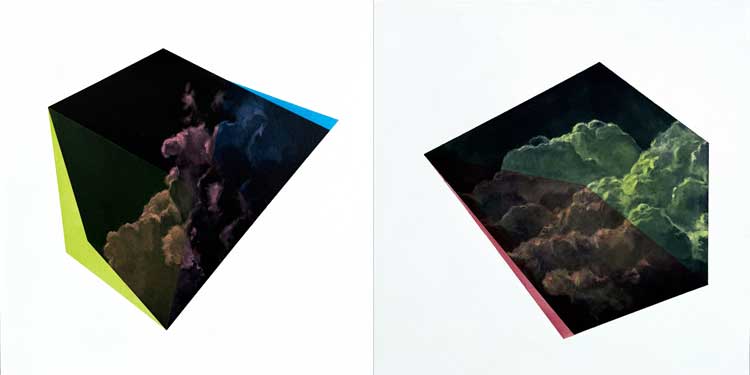
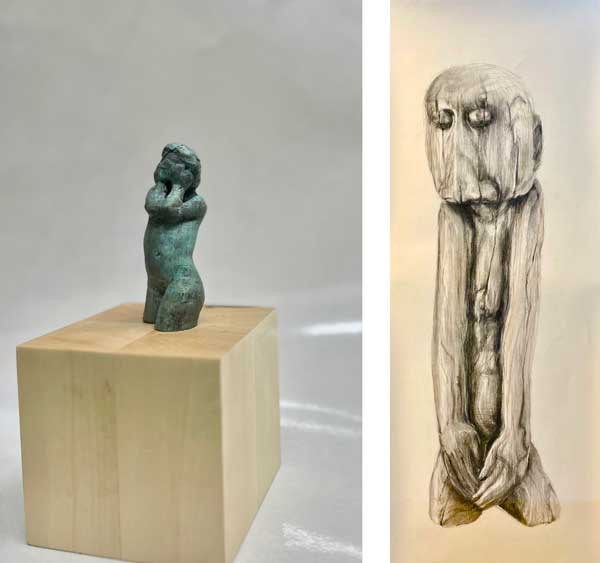
Exploring meaning as a non-linear process, Ruby Chishti’s responds to sculptor Shahid Sajjad (d. 2014) and her own artwork. In Sketch of “Prisoner” (2025), Chishty retrospectively draws parallels between her own work titled Shy Caryatid (2003)—a nude female bronze figurine hiding her face in shame—and Sajjad’s wooden sculpture Prisoner (1994). The sketch expresses as a poignant confession of shame, vulnerability, and physical and psychological constraint, despite the obvious visual contrasts of size, subject, style and gestures.
Some artists provided alternative perspectives on the practices of the veterans. Amna Rehman reworks a previous work of her own, too, while interpreting its narrative through the works of Anwar Saeed. In Staying in the Human World (2023), she emulates the subtleties of human relationships and the tension between personal desire and societal pressures through the female form, as they inspire from Saeed’s provocative male figurative works.
Marium Agha also takes a similar approach with Tassaduq Sohail (d. 2017), “mirroring Sohail’s theatrical brutality but through a feminist lens”3 as she recreates poised portraits of posh Victorian women donning fancy eye masks. The triptych, She Who Looks Back (2025) channels Sohail’s chaotic brushstrokes and colour palette through extensive thread work. However, the implied visual grotesqueness in the triptych is underwhelming and comes across as a visual gimmick. The contemplative and slow nature of thread work softens the absurdity and the mimicked surrealism, as seen in Sohail’s work, results in a more sanitized version in Agha’s rendition. The shift in material, from Sohail’s oil paints to Agha’s threads, allows for a contemporary reimagining, but it comes with the loss of the spirit that animates Sohail’s original.
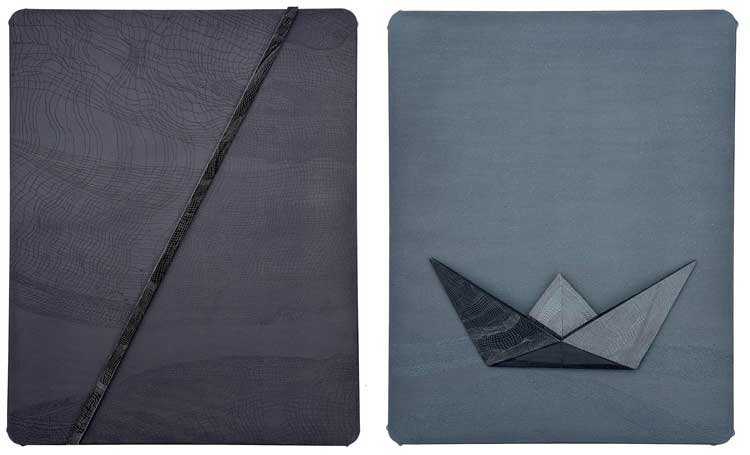
Adeel uz Zafar’s poetic artistic statement is an ode to Indian artist Zarina Hashmi (d. 2020). Written in Urdu, a language Zarina loved and often worked in,4 Zafar recounts his struggle to find common grounds of engagement between his and the veteran’s works but only sees dividing lines. His work in plexiglass and plastic vinyl, After Zarina Hashmi’s Dividing Line (2025), responds to her Dividing Line (2001). In Zafar’s version, the original undulating Indo-Pak border, as seen in Zarina’s Line, is reduced to a straight diagonal line across the vinyl. He incorporates his signature gauze-like textures—often associated with trauma, identity, and healing—to echo themes present in Zarina’s work. However, the result can feel like an oversimplification of complex histories and tensions.
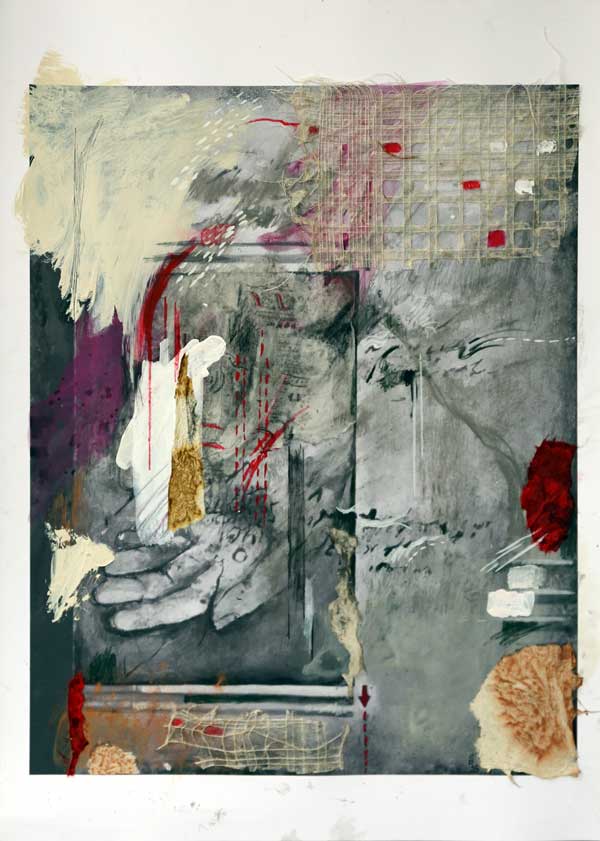
Salima Hashmi reproduces the work of her dear friend, Lubna Agha (d. 2012). She declares, “our shared passions cemented our friendship,”5 as their feminist ideals became a thematic point of convergence in their practices. In Secrets of the Palm – remembering Lubna (2025), she reworks one of Agha’s early works from the Hand (date N/A) series and builds a narrative around the central image of a woman’s hands. Visual elements borrowed from Agha’s abstract works are sifted through Hashmi’s own visual accent, making the work a sort of a palimpsest of memory and nostalgia.
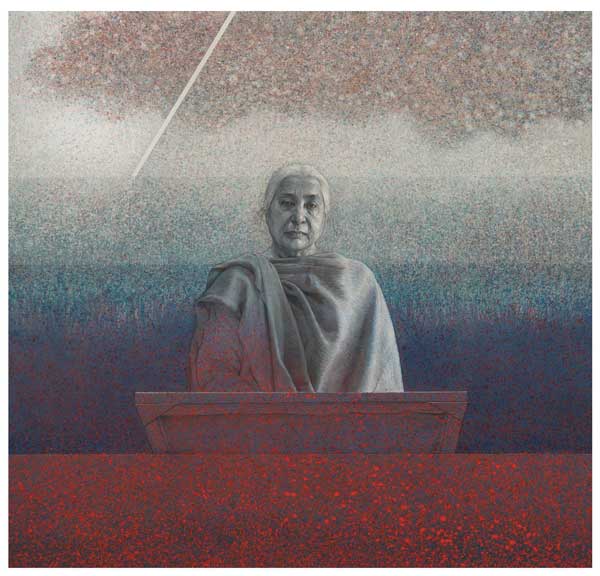
In Muqaam (2025), RM Naeem pays tribute to Meher Afroz by making a portrait of the artist. Instead of drawing on her visual motifs, he seeks to capture the spiritual essence of her work. Using hyper-realistic portraiture alongside fields of colour, texture, and abstract forms, Naeem presents Afroz as a seeker of divine knowledge and guidance. He depicts her as touched by the heavens, thus glorifying the sanctity of an ustaad.
However, we must be cautious when exalting the mentor, as it may hinder our constructive criticisms. In reviving the works that were made in the yester years, we must address the ways in which they may or may not remain relevant to the political and cultural climate of our time. While Munawar Ali Syed, Muzzumil Ruheel, Adeel uz Zafar, and Ruby Chishti have been able to achieve this through an open dialogue, others have had limited success in the exhibition.
Rather than confining the past to a limbo, the exhibition also demonstrates the relevance of practices from the previous decades, as they continue to impact new work. This is most effective when artists use their own distinct visions and connect it to current concerns. In the process, they open new directions, uncover alternative readings, and break stylistic boundaries. However, as Dialogues Through Time centralises Chawkandi Art Gallery, the narrative is incomplete due to the exhibition’s criterion for inclusion. This framework suggests that artistic value is tied to long-standing associations with a particular institution, overlooking other factors that shape artistic practice—an idea that should be approached with caution.
‘Dialogues Across Time’ was curated by Saira Danish Ahmed and displayed at Chawkandi Art Gallery, Karachi, between August 19 – 29, 2025. Participating artists included, Adeel uz Zafar, Amna Rehman, Ayessha Quraishi, Danish Ahmed, Farazeh Syed, Haider Ali, Laila Rehman, Marium Agha, Munawwar Ali Syed, Muzzumil Ruheel, Noman Siddiqui, Nurayah Sheikh Nabi, Razin Rueben, RM Naeem, Ruby Chishti, Salima Hashmi and Waseem Ahmed.
The show was also reviewed for DAWN News by Rumana Husain titled Exhibition: Artists in Conversation published on September 6, 2025.
Title Image: Installation view, concept wall of the exhibition.
All images are courtesy of Chawkandi Art Gallery.
Bibliography
Mirza, Zehra Hamdani, “Soft Power: A Profile of Zohra Husain,” The Karachi Collective, November 29, 2025, https://thekarachicollective.com/soft-power-a-profile-of-zohra-husain/
Agha, Marium, Artist Statement, Dialogues Across Time Catalogue, Chawkandi Art Gallery, August 2025
Zafar, Adeel Uz, “Zarina Hashmi Ke Naam,” Artist Statement, Dialogues Across Time Catalogue, Chawkandi Art Gallery, August 2025.
Hashmi, Salima, Artist Statement, Dialogues Across Time Catalogue, Chawkandi Art Gallery, August 2025
- Zehra Hamdani Mirza, “Soft Power: A Profile of Zohra Husain”, The Karachi Collective, November 29, 2025, https://thekarachicollective.com/soft-power-a-profile-of-zohra-husain/
- In-person conversation between the author and the curator, at the Chawkandi Art Gallery, 29th August, 2025.
- Marium Agha, Artist Statement, Dialogues Across Time, August 2025.
- Adeel Uz Zafar, “Zarina Hashmi Ke Naam,”, Artist Statement, Dialogues Across Time, August 2025.
- Salima Hashmi, Artist Statement, Dialogues Across Time, August 2025.
Nimra Khan

Nimra Khan is an independent art critic and curator. She graduated from the Indus Vallery School of Art and Architecture with a Bachelor in Fine Art in 2012. She contributes critical reviews and discourse on Pakistani art for various publications, including Dawn EOS magazine, ArtNow Pakistan, Youlin Magazine, The Friday Times, Newsline, and Nigaah Art Magazine.

There are no comments