
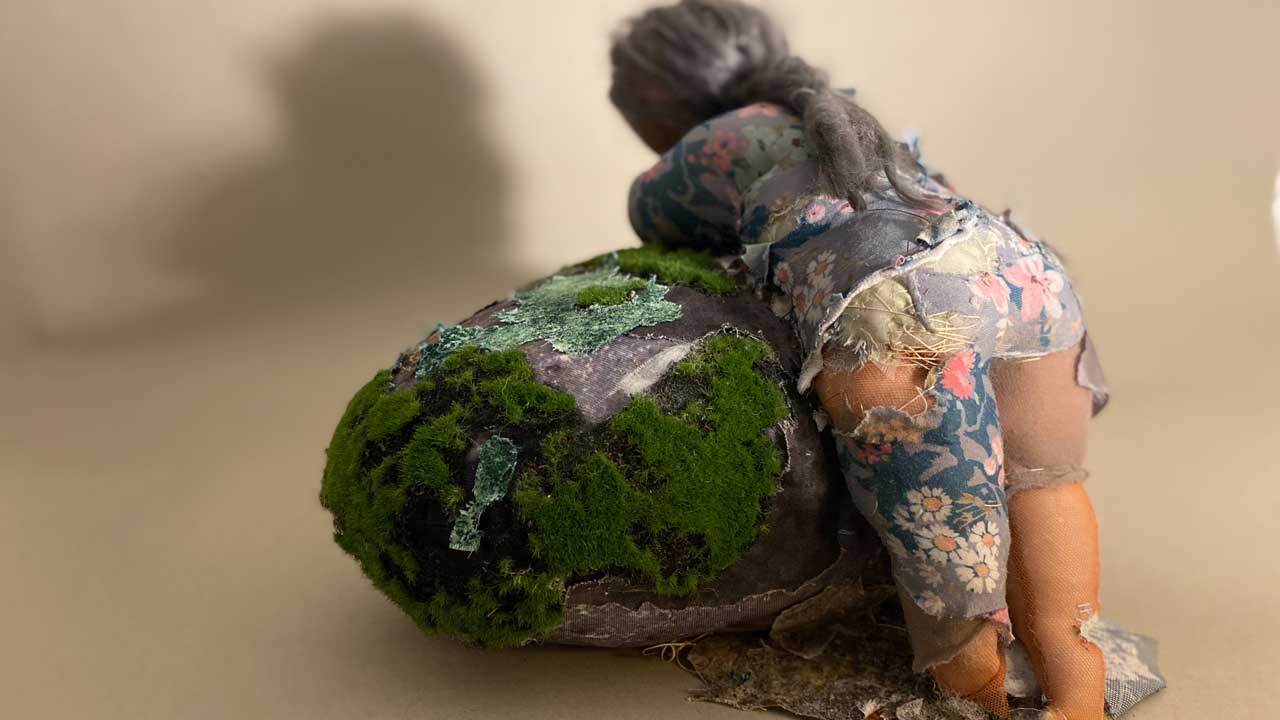
When the diverse quadrants of human experience convene in one show, it is an absorbing encounter that stays with the viewer and leads us to question reflexive paradigms of memory and social immersion. Ai Wei Wei says “Art has to be involved with moral, philosophical, and intellectual conversations. If you call yourself an artist, this is your responsibility”. He’s right, but Wei Wei tends to make most everything sound affectatious and didactic, phlebotomizing the soul of the argument. Four young artists (Canvas Gallery, Geography of Memory, May 5 -14, 2026) recently brought to the fore, issues and concerns of contemporaneous societal challenges; some in narratives that were more like epic dramas, some like snippets of memory. But together, as viewer and artist (all of them in absentia), we had a scintillating intellectual conversation about morality, philosophy, memory, about dislocation, leaving home, coming back, tradition, dysphoria, and feminism. It was quite an animated conversation.
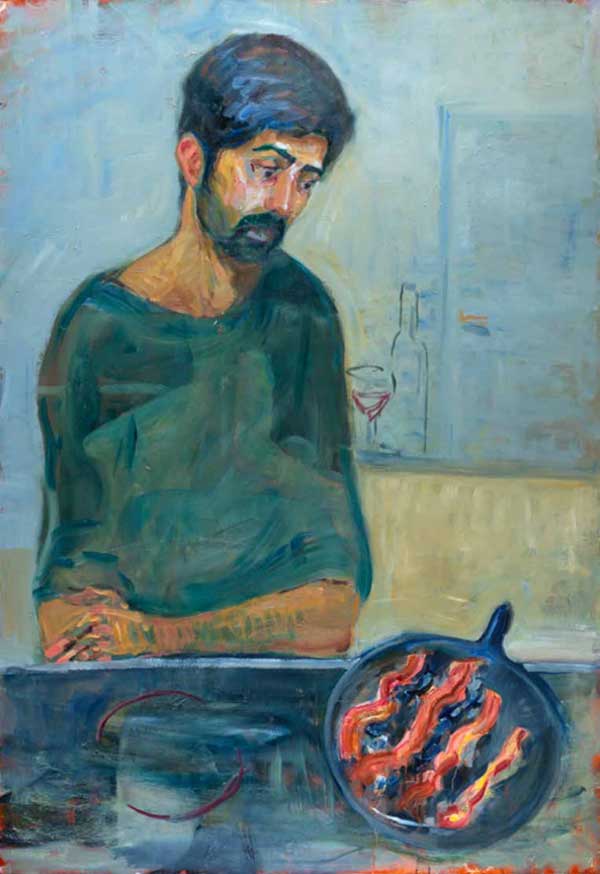
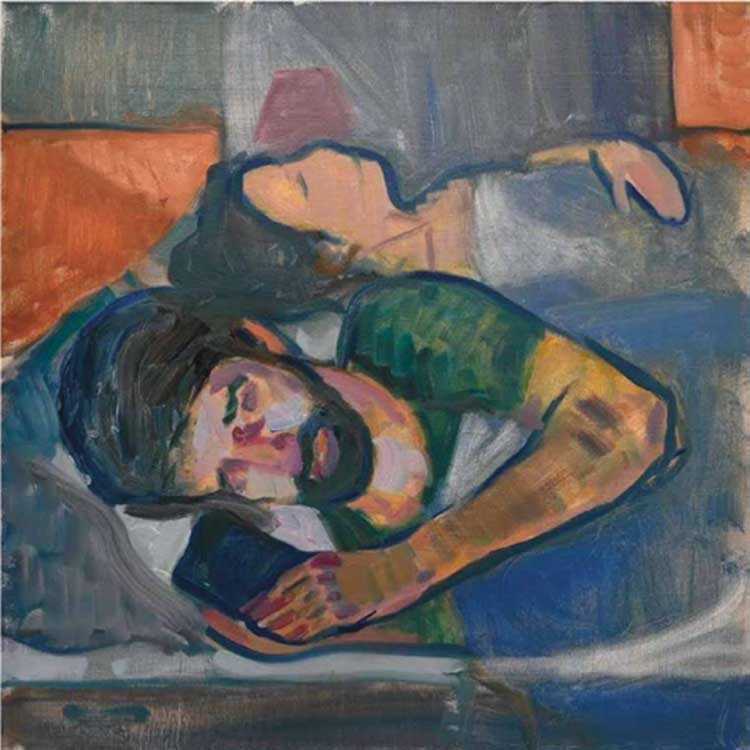
The four artists Usaydh Agha, Mustafa Mohsin, Ruby Chishti and Noormah Jamal compel us to introspect and confront social nuances, from the trivial to the weighty. Mustafa Mohsin is unapologetically and defiantly sacrilegious, frying bacon strips and enjoying his glass of red. His moments of frustration are shared by us all when we are trying to work in the studio only to be interrupted by frequent, and often irrelevant calls. It is the universal picture of the appendage cellphone that is a blessing and a bane which also becomes the emotional support teddy bear we take to bed at night. Mohsin, wittingly or otherwise, oscillates between embracing his audience, becoming warm and inclusive, then reminding us he is a diasporic artist and we do not quite belong within his coterie. It is a natural expression of circumstantial change of order for the diasporic artist, one they do not perhaps notice – the distance between us and them. Each artwork thus becomes a discourse on belonging and the encounter of locus. It presents moments of inevitable loneliness. Mohsin paints in the impressionistic style of quick bold impasto strokes that match the quintessential nature of the fast-moving city he lives in, New York.
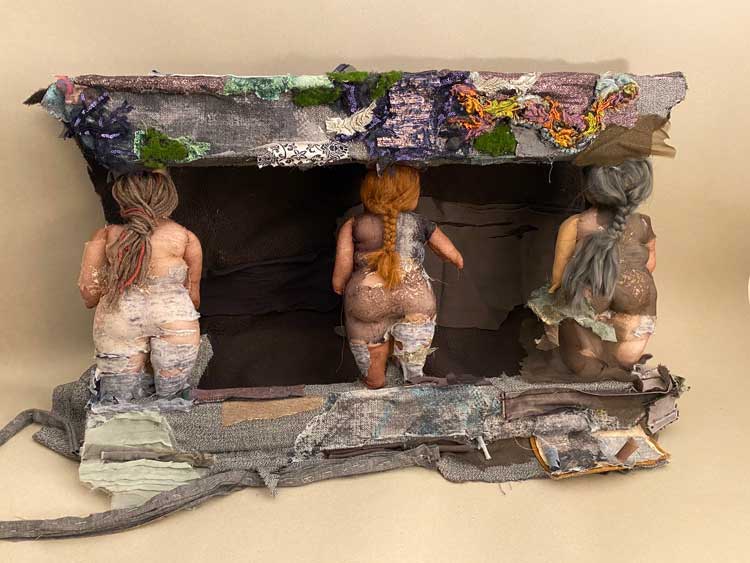
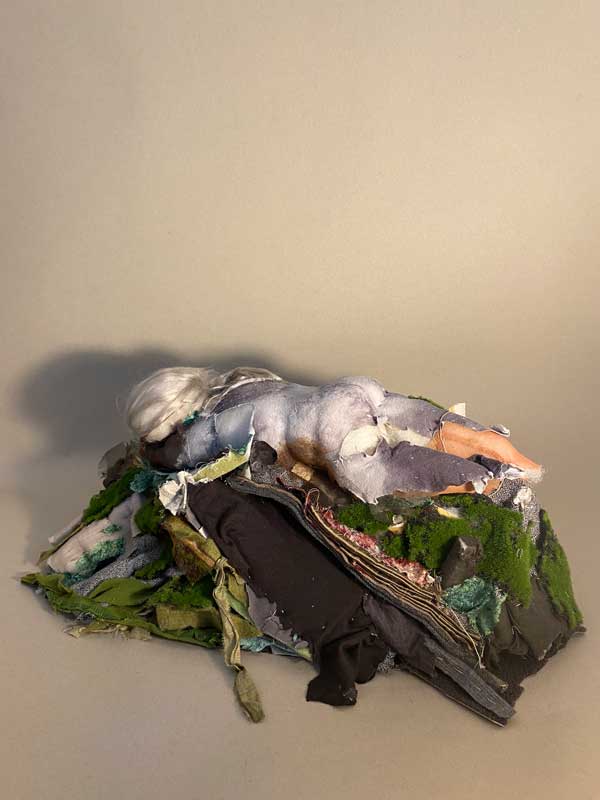
Ruby Chishti has been working with fabric most of her career and she builds upon the ‘little’ women in her work with much care and love. Mind you, they are not little, they are giants. Let us not underestimate the diminutive nature of Ruby Chishti’s ladies that she formulates to look as real as women, not like stuffed dolls or playthings. These women have seen bad times. They symbolize within them a cosmos of strength, power and autonomy that is implacable and inexorable as all of history is contained within them. Chishti uses scraps of discarded fabric, usually cast-off and reused multiple times, frayed and distressed, to layer her works. She cuts, sews, stitches by hand and constructs shelters, homes and monuments — structures of safe-keeping built for the women, to not only house them but contain their power. And collectively, the women become the proud, sturdy, durable columns that uphold these structures. Paradoxically, Chishti’s women, some with babies attached to their bodies as mitochondrial DNA that connect mothers and children eternally, are as vulnerable as the materials with which she generates them. They can surely come apart at the seams and rip like the panty hose that they are made of, resembling soft flesh, when confronted by an immeasurable predicament. But they keep it together with faith and strength. Through these women, Chishti represents narratives of personal loss and fortitude of finding identity, individuality and belonging in inexplicable, new worlds.
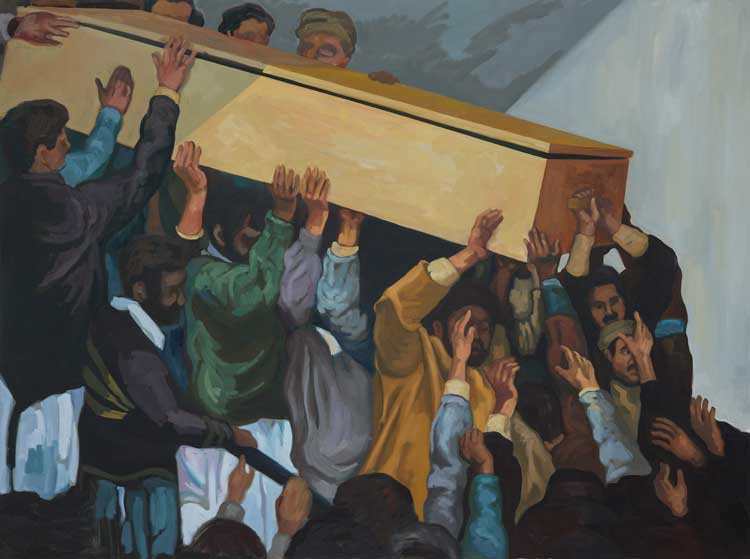
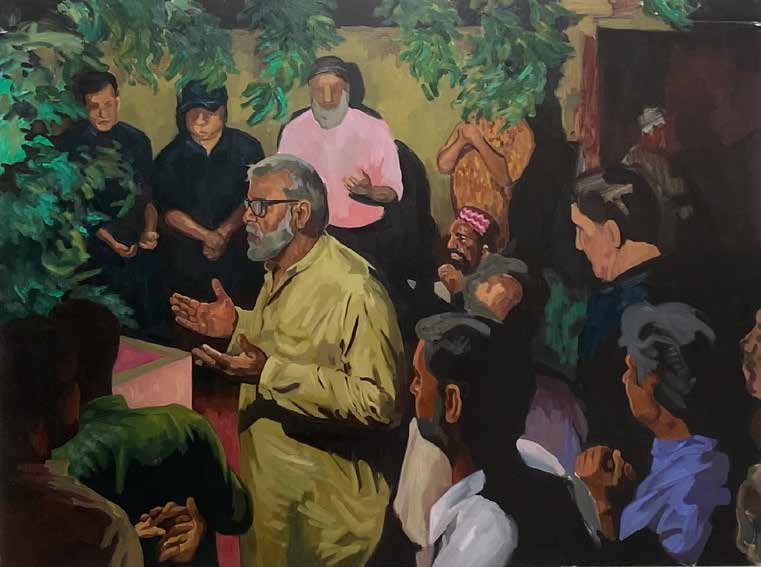
Usaydh Agha’s large dramatic canvases are akin to watching an epic movie of theatrical proportions. Like Caravaggio’s mesmerizing use of tenebrism to highlight critical emotional and physical moments in biblical sagas, Agha uses backdrop and crowds of people and a palpitating aura to set the stage without sensationalizing –any hint of trying to extract emotion would have whitewashed the subversion from the narrative. Each unfolds a narrative of several acts and multiple scenes and we almost expect an accompanying screenplay. The images Agha constructs are not anomalous to our societal culture and they speak of unnecessary death as the culmination of an altercation and the associative pictorial enactment– the collective prayer for the soul of the departed after the person in question is gone; the careful hoisting of the coffin; and of course the enticing spectacle of murder while the bodies are still warm. Agha confronts traditions that are deeply inscribed in the social and spatial history of the rural and semi-urban feudal fabric of the country. These traditions are held in a sacred strata above the law, in the unyielding clutch of all-knowing elders. But it is also a commentary on the wider ignorance that prevails in passing arbitrary judgement specially in terms of illicit acts of homosexuality, for which the verdict is always death. Agha is not passing judgement himself. He is prompting us to reflect.
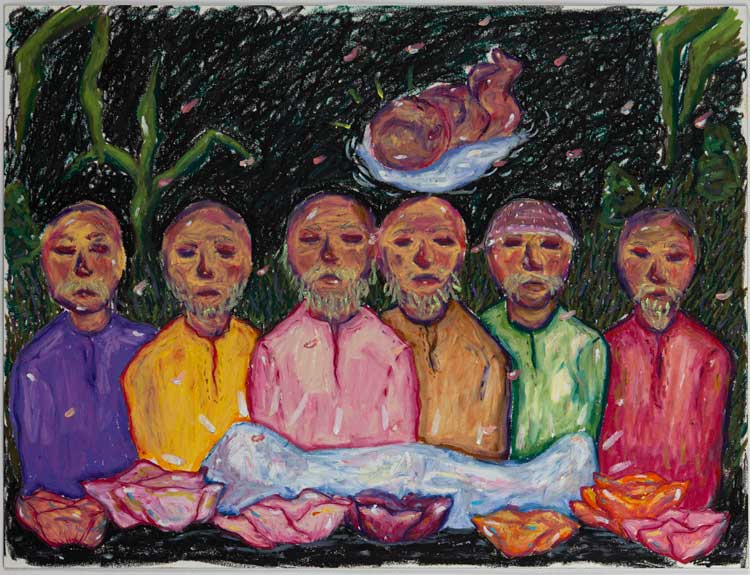
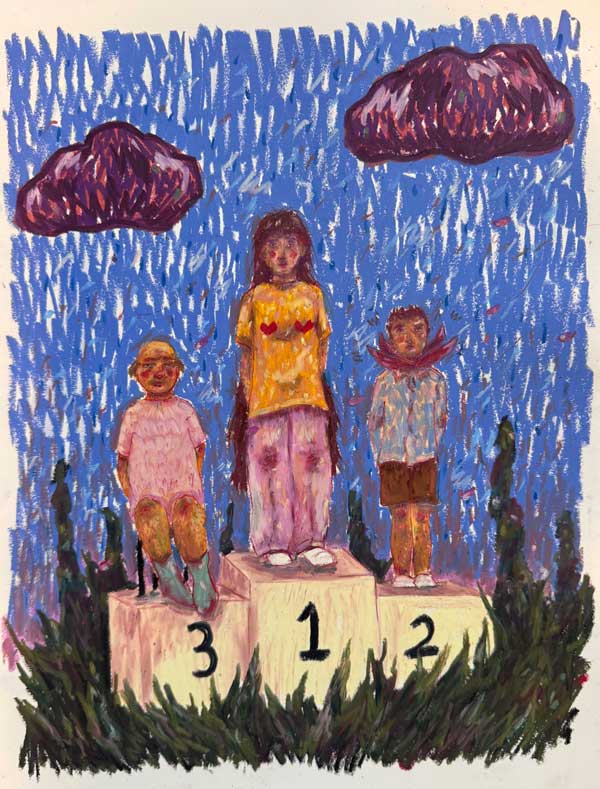
Noormah Jamal’s fearless individuality prompts her to create small visual narratives that are filled with her ability to translate her memories and life experiences into a child-like pictorial language with a strong evocative power. She says much of her work stems from her memories of her family and her cultural mores based on oral traditions of storytelling, which are imperfect and get lost in the telling. While adults are stymied by the norms of societal constraints, children have the license to get away with so much due to the innocence of their years. Jamal’s Pashtun’s influence is felt immediately in the landscape of the towering snowcapped mountains, and collection of Gardana bowls that seem to lie carelessly almost as part of the flora. The thick oil pastel dotted surfaces help to constitute whimsy and a dreamlike aesthetic in which there are unrelated fragments of a narrative where we are not told the full story. So while we catch a glimpse of humor, there is profound darkness and loss. The rain spoils a win, the naughty friend, ruins the warm cozy sleeping bag by hosing it down, the figures are portrayed as flower buds sprouting from leaf buds. But in the backdrop there is the sorrowful specter of a dead child, the guns are pointing to the old man while he is vociferously attesting to his faith. There is a dimension of form and narrative suspended between the real and the metaphorical, the here and the hereafter. Jamal leaves a lot for us to navigate.
It is interesting that all four artists are diasporic and they address concerns that are universal, no matter what their pictorial vocabulary or mode of questioning. And we have to begin to view cerebral art like the art shown here in the larger scheme of things. Some art critics believe art has a wider pluralistic and global role which is diversification and heterogeneity so that it may be absorbed into mainstream culture. Artists could work towards this goal.
Title image: Ruby Chishti, I Step Away, 2026, Recycled cloth, polyester fiber, synthetic moss, archival glue, 14 x 10 x 10 inches
Nafisa Rizvi
Nafisa Rizvi is an art writer and independent curator. She has curated shows of Pakistani artists in Dubai (Stop Play Pause Repeat in 2012) and Philadelphia (They Really Live the Real Reality in 2015). She has edited and contributed to the book on artist Imran Mir What you See is What you See, and likewise to the monograph on artist Asim Butt, Rebel Angel. Nafisa Rizvi has contributed an essay in the popular book on Pakistan’s contemporary art The Eye Still Seeks edited by Salima Hashmi and published by Penguin India. She writes continually for newspapers and magazines internationally and in Pakistan.
There are no comments