
At first glance, Eternal Imprints appears to be an exhibition about ancient rock art. Not quite. Moving through the galleries of The Barracks Art Museum in Lahore, it becomes clear that the show asks a crucial question: what happens when the landscapes that hold our collective memories disappear? Conceived by Canadian Pakistani hybrid artist and curator Faisal Anwar, in collaboration with researchers Murtaza Taj and Jason Neelis, the exhibition reflects on the transformed archaeological records of the upper Indus River as an urgent intervention on climate change. The show foregrounds the uncertain futures of humanity while weaving together histories of displacement, cultures, and memories uprooted by ecological change and human intervention in the region.
The exhibition foregrounds the thousands of petroglyphs carved along the upper Indus River, a vast visual archive of human presence stretching across millennia. These ancient petroglyphs along the river were created as durable marks and inscriptions were intended to outlive their makers. But even stone is not immune to eradication. These carvings are being increasingly threatened by environmental transformation and infrastructure invasions. Rising waters have altered river systems and development projects such as the Diamer-Bhasha Dam and expansions along the Karakoram Highway in Gilgit-Baltistan place centuries-old rock carvings and petroglyph sites at risk of gradual disappearance. The decision to reposition these static historical artifacts as living data set in the show created a hybrid space for archeology and environmental reports as they intersect with the curator’s interpretation.
The exhibition emerges from a decade-long interdisciplinary research-led practice exploring climate data, ecological memory, and patterns of displacement across South Asia, developed in collaboration with academic and cultural institutions. This includes affiliations with Lahore University of Management Sciences and Wilfrid Laurier University, alongside UNESCO, thus putting the work within local and global knowledge systems. Refreshingly so, despite the institutional framework of the exhibition, the works do not manifest solely on an academic register.
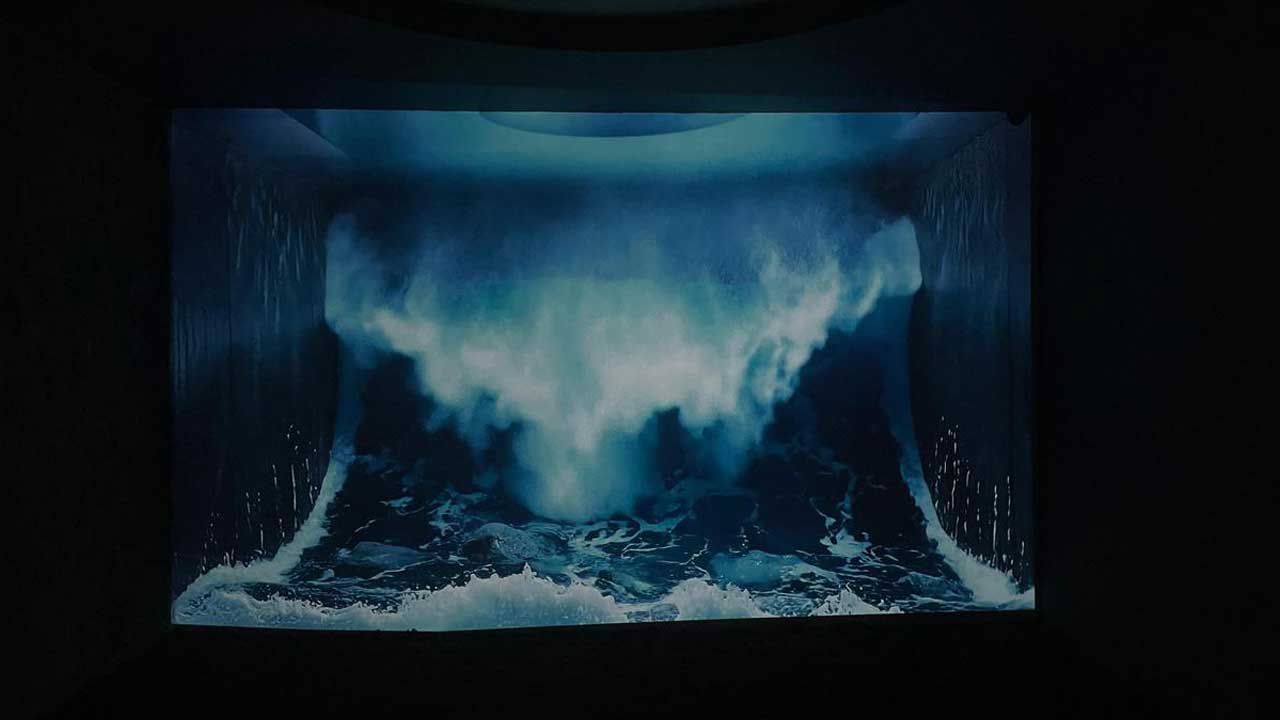
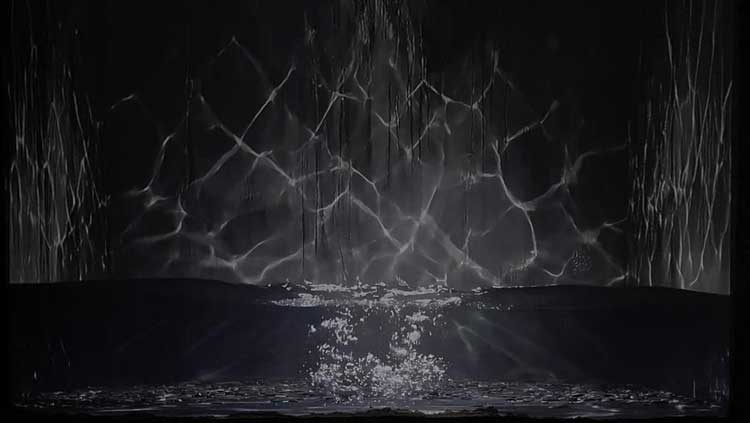
In the main hall, the installation, Before the Water Learns Our Names, becomes the carrier of the unsettling indication that water will soon overwrite the marks inscribed onto stones. The installation combines video animation with sculptural forms cast in fiberglass and cement, mimicking the slow drowning of landscapes as water levels rise to a threatening level, submerging rock art that has survived centuries of exposure. Soon, these surfaces may exist only as digital ghosts.
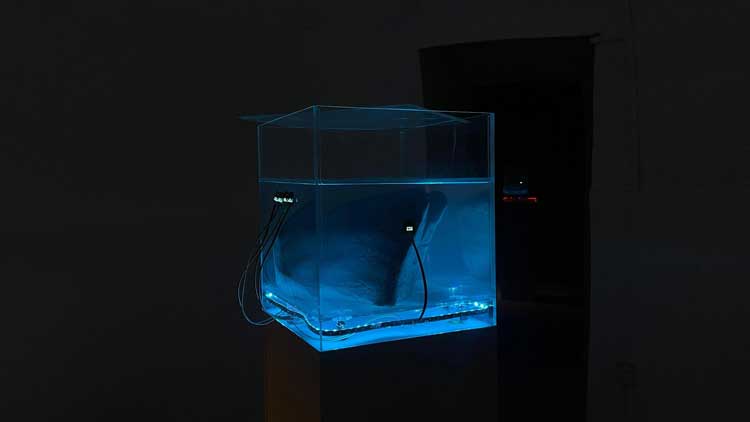
Accelerating Loss presented a kinetic sculpture responding to fifty years of glacier mass change data from northern Pakistan, particularly drawing from glacier systems such as the Baltoro and Biafo in the Karakoram range, alongside broader datasets from the region’s high-altitude cryosphere. Using climate records sourced from the European Union’s Climate Data Store; an open-access digital platform that provides standardized global climate datasets for research and policy, the work translates long-term environmental data into a physical and sensory experience. By incorporating LED and OLED screens, humidifiers, water sensors, and Raspberry Pi processors, Anwar creates an environment where the sculpture behaves like a breathing organism, representing climate change as an on-going process.
The exhibition’s second room extends the groundwork into themes of displacement through data-driven installation. Displacement and Belonging translate long-term datasets on climate-induced migration in Pakistan into a responsive kinetic sculpture, producing a continuous and unsettled state of transition. Alongside it, Patterns of Departure presents a series of algorithmic prints that reassemble fragmented cartographic material — historical and contemporary maps broken into data layers and recomposed through computational processes that reveal shifts in borders, routes, and settlement patterns over time.
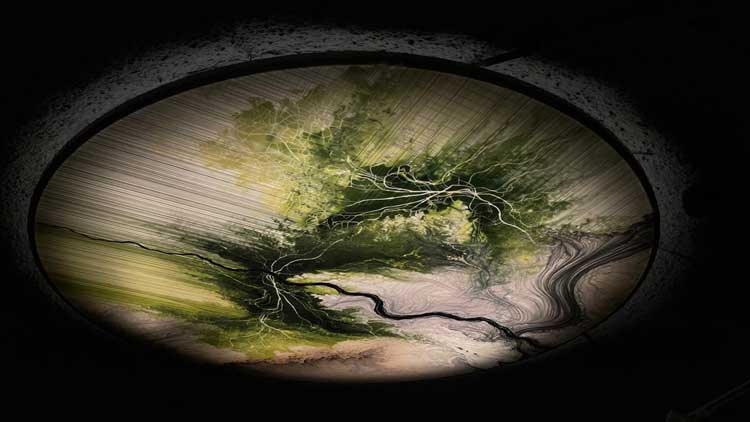
The third room shifts the focus toward preservation and archaeological memory. Works such as Findings, Heritage, History, along with the accompanying drone-shot video, reconfigure archeological documentation into an immersive visual form and show how processes of erasure are no longer gradual. This section was also effective in shifting archaeological imagery away from purely evidentiary into experiential, allowing viewers to feel the instability of the documented materials.
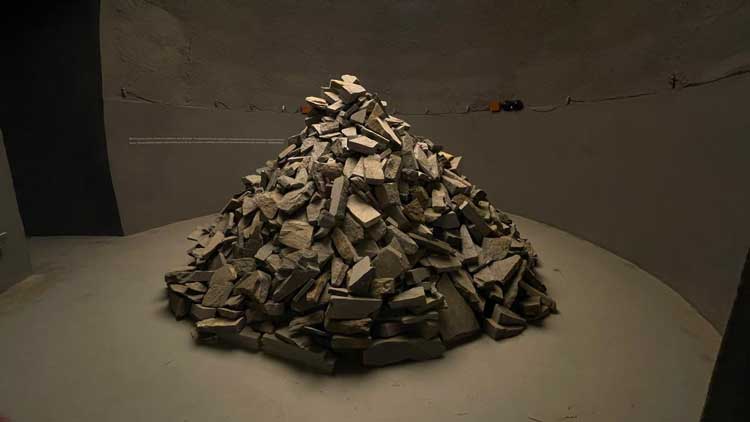
The exhibition concluded with Sounds of Stones, a motion-responsive installation that combined sound and natural stones, emitting subtle echoes and vibrations through space. According to the artist-curator, the stone structure assembled for the display had accidentally disassembled the day before the exhibition. His decision to leave it as it was enabled the stones to become active carriers of memory, letting them speak through sound and become witnesses to past histories and their ongoing disappearances.
Faisal Anwar’s curatorial approach emphasizes sensory experience, such as light, sound, movement and atmosphere to ensure the data is never allowed to dominate at the expense of affect. This becomes evident in installations where computational systems are translated into integrated environments; for instance, climate datasets materialized through shifting light conditions, and ambient soundscapes and kinetic forms that respond in real time. The works establish data as something felt as much as it is understood, producing an immersive register where information and emotion remain in constant negotiation.
The sensorial richness that makes the works in the exhibition so fascinating can occasionally soften the analytical clarity of the datasets they draw from, leaving interpretation suspended between experience and understanding. Yet this ambiguity is also where the curatorial strength lies. Rather than resolving data into fixed knowledge, the exhibition keeps it in a state of perceptual instability, asking the viewer to steer between evidence and interpretation. By metamorphosing abundant archeological data into interactive art installations, Faisal Anwar rethinks preservation as a technological but also a creative act, reminding us that saving histories now requires new forms of representation.
Title Image: Before the Water Learns Our Names, video animation with fiberglass and cement sculptures, 2026.
“Eternal Imprints” was conceived by Pakistani Canadian artist and curator Faisal Anwar, in collaboration with Murtaza Taj and Jason Neelis, and exhibited at The Barracks Art Museum, Lahore, from February 1 to March 26, 2026.
All images are courtesy of The Barracks Art Museum, Lahore.
Research & Exhibition Partners: Lahore University of Management Sciences (LUMS), Wilfrid Laurier University (Canada), UNESCO, USAID, SSHRC (Canada), Waksaw–Uddiyana Archaeological Alliance, Robert H. N. Ho Family Foundation (Global), kickstart (Pakistan)
Sumbul Natalia

Sumbul Natalia is a Lahore based visual artist, writer and researcher. She graduated in Visual Communication Design from College of Art and Design, Punjab University and holds an MPhil in Cultural Studies from the National College of Arts, Lahore. She currently serves as a lecturer in the Visual Communication Design Department at National College of Arts, Lahore and is a PhD scholar in Art and Design (studio practice) at the Punjab University. Natalia has been part of several group shows locally and internationally and has participated in various residencies and conducted curatorial projects. She regularly writes for different magazines including ArtNow, The Karachi Collective, Aleph Review, Nigaah Art, ADA magazine and The Friday Times.
There are no comments