He was born in Poona and his mentor in Rawalpindi. Fifteen years apart in age they grew up in different cities but eventually met in Karachi in the early 1970s. This is how the entanglement of the two artists, Ahmed Parvez and Wahab Jaffer, created an engaging chapter of Pakistan’s art history.
By the time they met, Ahmed Parvez was an established artist who had gained acclaim for his miniature oil paintings rendered in bejewelled colours. In post-war Europe, his palette caught the eye of leading critics, who received it with glowing reviews. His two marriages fell victim to his passion for art, when the wives discovered that Ahmed Parvez would always prioritize art, with whatever little money or time he had. With public acclaim and personal failure, he returned to Pakistan in the early 1970s. Here, he was befriended by the art community but had to reestablish himself as an artist.
The late Wahab Jaffer, who earned his reputation as a serious art collector and friend of artists, came from a family of industrialists settled in Karachi. In 1971, due to the massive nationalization of industries in the country, Wahab was forced into temporary retirement. With more time on his hands, he turned to an unfulfilled dream— painting. To learn the fundamentals of painting, he joined Ali Imam’s exclusive group of students at Karachi’s Indus Gallery.
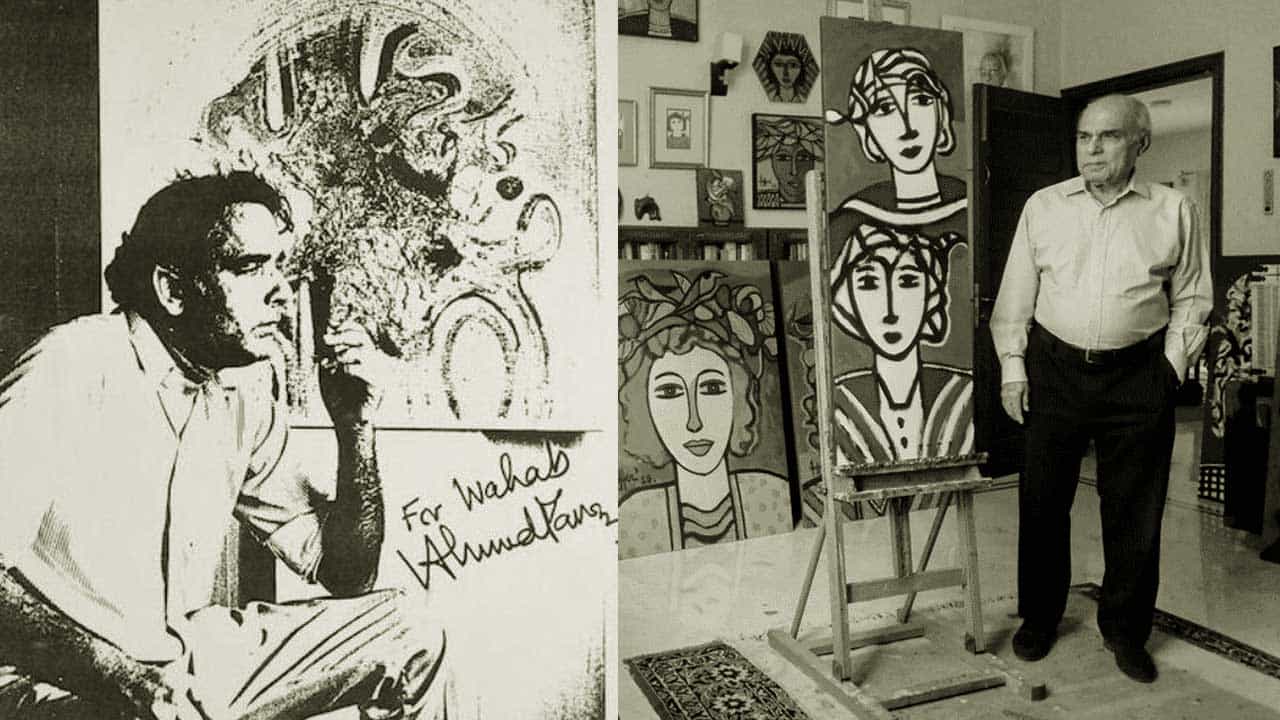
This was where Wahab Jaffer came into the orbit of the charismatic Ahmed Parvez. Wahab, who was fascinated by the chromatic richness of Ahmed Parvez’s paintings, befriended him, and a bond developed between the two that was to last for the rest of their lives. Wahab looked up to the artist as a mentor and his earliest works had such a strong influence, that Ali Imam refused to give him a solo show, till he developed an independent style.
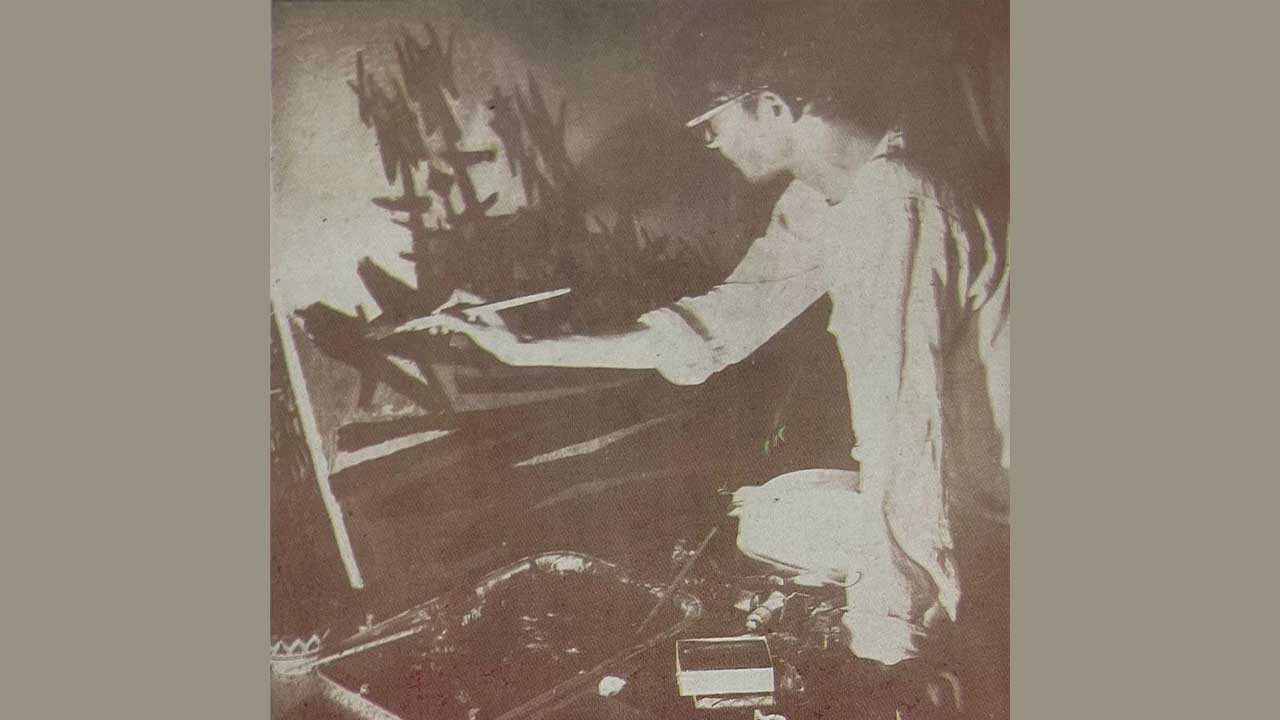
It was not easy to escape the influence of Ahmed Parvez who was an alchemist with colour. Colour was the energy that drove him, and form and texture remained subservient to it. He sometimes used still life to start a composition and then, like a strong wind that messes up an arrangement, he let the strokes be taken over by the evolving picture in his head. The artist’s use of white paint to tame colour and dry brush strokes to open crevices of light in saturated canvases was a mastery that gave an edge to his art. There were sunbursts and explosions of forms and colour in his canvases, sometimes against black; the dramatic impact suited the artist’s mood. Ahmed Parvez lived between highs and lows, emotionally and financially—this made him sometimes impetuous and belligerent. He was known to take his paintings off the wall during a show, if he had a disagreement with the gallery.
I remember interviewing Ahmed Parvez for the art school magazine in the early 1970s. Here, I saw another side of him. He was generous with his time and shared his story. Not for a moment was he condescending or impatient when asked to explain his complicated career. My last meeting was when I invited him to judge a citywide children’s art competition in 1979. He loved the spontaneous art that came from children and enjoyed their company. It was shortly after that we heard of how he was robbed while on a holiday in Sri Lanka and returned to Karachi, destitute. This broke his spirit and then on his health spiralled.
Wahab was one of the few that could maintain a steady relationship with Ahmed Parvez. Maybe this can be attributed to his gentle and generous nature, and to his good interpersonal skills as one of the younger children of the large Jaffer clan. The mentor passed on to Wahab an extraordinary commitment to art, as he saw Ahmed Parvez never fail to create art every day, even in the most difficult of times. The master would sometimes paste sheets of paper on the wall and under the spell of frenzied inspiration, paint a few works simultaneously. Later he would collect broken oil crayons from the floor and store them in a box as money was always short. There was also a time where he shared Wahab’s bathroom-turned-studio free from worries about material, and the next meal. These were spurts of stability in Ahmed Parvez’s life till he turned restless again.
Ahmed Parvez also inspired a sense of freedom that allowed Wahab to confidently discover his direction. This is best seen in the latter’s pen drawings that are playful musings. More asymmetrical and whimsical than his paintings where Wahab liked to work with an architecture of lines that he fills with bold flat colours. Sometimes he would introduce patterns and floral elements to break the symmetry of the central motif, which was often a female face. Wahab was a keen collector of art and a believer in documentation, he religiously collected cards and catalogues of exhibitions and often got them signed by artists. He also built an enviable photographic record, of the movers and shakers of Pakistan’s art world, since the 1970s.
In the last few years, he seldom stepped out of home, but in November of 2025, he made an extra effort to visit the retrospective of Meher Afroz, which I curated. I remember he spent a lot of time with the works. It was only a few months later that we heard of his passing. In his book Image and Identity (Oxford University Press: 1999), the late art critic Akbar Naqvi wrote of Wahab Jaffer, “The shamanistic presence of his guru in his paintings is unmistakable, even when it is invisible.”
At Wahab Jaffer’s memorial exhibition, curated by Nusrat Khawaja for Chawkandi Art Gallery in October 2026, one got to see his paintings from the last decade, but it was the drawings squirreled away in his sketchbooks that came as a revelation. They revealed how Wahab Jaffer had long come into his own, as an artist, but wanted to keep Ahmed Perwaz close to him, both as a talisman and a cherished memory.


There are no comments