The more you immerse yourself in Sadequain’s art the more you become aware of the vast vision and intellectual depth that unfolds in his murals, paintings, drawings and illustrations. The ambition of his scale and inventive breadth comes together to place him among the major artists of the second half of the twentieth century.
It’s being a traitor to history to tether a genius to ideological imperatives and force mold him into the false constructs of an official narrative. Sadequain, like many artists, poets and creatives, has been relegated to the margins because he spoke truth to power, or because his oeuvre did not fit within the framework of the national narrative created by the dictator Zia in 1980.Unfortunately, the politicized interpretation of culture has been institutionalized in the last four decades under insidious directives that, in the absence of a clear cultural policy, have impacted freedom of expression and failed to project the cultural reality of Pakistan. This silencing and ideological exclusion has created gaps and erasure leading to a distorted perception of art, theatre music and dance.
Sadequain, in his long career that spanned half a century, created over fifteen thousand paintings, countless drawings, forty-seven murals in his country and on three continents besides a magnificent collection of illustrated Rubaiyats. Despite being one of the most prolific artists of his age, the official narrative has privileged only his calligraphic works, while willfully marginalizing his extraordinarily diverse legacy. It cannot be denied that Sadequain was deeply invested in exploring the figurative to communicate the civilizational depth of his cosmopolitan worldview. He moved fluidly between Urdu and Farsi in his verse, illustrated the novel of the French revolutionary writer Albert Camus and paid homage to the visionary writers, poets, inventors, philosophers and artists across centuries in his iconic ‘Treasures of Time’, a mural on great thinkers of history, commissioned by State Bank of Pakistan in the 1960s. His tribute to Martin Luther King in a painting was part of the artist’s persistent engagement with human rights and civil liberties.
Born in Amroha, India, in 1927, he moved to Pakistan around 1947. Although he led a nomadic life, travelling within Pakistan, the region, and to Europe and North America, his family home remained in Karachi, to which he returned frequently. Sadequain also chose to spend his final years in Karachi, where he worked on his mural Arz-o-Samavat at Frere Hall. Murals were his chosen genre for public dialogue. Sadequain belonged to the generation that gave up their ancestral homes to migrate to Pakistan so they could participate in building the young country. They had a deep commitment to a just, egalitarian and peaceful society. Sadequain’s murals can be read as chapters of the early social contract the founders made with the citizens. ‘A Quest for Knowledge’ that emphasizes the rebuilding of knowledge centers destroyed during colonialism, at Services Club in Karachi, is among his earliest murals that was completed in 1959. ‘The Laboratory of Natural Universe’ is an ode to the natural resources that promise a better future with agrarian and industrial growth. The Mangla Dam mural titled ‘Saga of Labor’ cuts through the development and technological propaganda of the day to foreground the physical endeavors of the laborers. Sometimes he evoked the inspirational rigor of Allama Iqbal’s verses. This can be seen on the ceiling mural of the Lahore Museum where the power of poetry vibrates through the sunbursts of colors in the layers of stars and planets that mesmerize the visitor. Large scale work, despite the demands on his physical strength seemed to inspire Sadequain and even his failing health could not keep him from undertaking his last mural in 1987. He conceived and began painting ‘Arz o Samawat’ with the message of Ilm Aur Amal (Knowledge and Action) as the corner stone of human endeavor. He passed away before he could complete the work.
We can see many parallels between Sadequain’s murals and the Mural Movement established by artists Rivera, Orozco and Siqueiros in Mexico, because coming from the post-colonial experience, they knew the importance to awaken pride in local culture, power of the people and struggle against oppression.
A deeply personally parallel universe emerged in his Rubayats, where the emotional turmoil and conflicts intersected with intensity of line and word. Sadequain adopted the quatrain with its difficult rhythmic balance for his poetic expression and went on an inward trail to bare his heart— making love and loss, passion and rejection a reoccurring theme. Sadequain’s ambivalent attitude towards his career as an art as opposed to being a full-time poet, is a constant conflict he shares in the Rubayats. Perhaps this is the reason that the image and word have been given equal creative weightage in the poetic collection he designed and published. Here, Sadequain is seen working on his smallest scale as he deftly translating the intensity of his poetic expression into linear drawings in his signature rhythm.
Like most Modernists, he traversed academic art to enter Cubism and explore the abstract idiom. ‘The Cactus Series’ was a vital period of experimentation where the grammar of abstraction was stretched to accommodate his existentialist instincts. Here formalism intersects with the syncretism of cultural memory and abstraction cannot deny the emergence of the Urdu alphabet aif in vertical arrangements. The human limbs entwine and morph into the body of the cactus in the many re-configurations the two elements. These creative variations can be interpreted as rendering the ghazal in different ragas. Within this body of work evolved the unique language of Sadequain.
Calligraphy was something he inherited as a part of epistemic knowledge embedded in the traditions of Amroha. The calligraphic art that flowed from Sadequain’s pen and brush can be seen under three loose groups that constantly overlapped. His secular calligraphic paintings trace their lineage to calligrams that he pulls into the gravitational force of Modernism. Executing a marriage of abstraction and figures become his experimental space. In illustrated Quranic Verses, like Surah e Rehman, he places calligraphy within landscapes and among natural bounties, taking his clue from the contents of the verse. In the interaction with established scripts Sadequain pushes formal limits to craft his own script, ‘Khat e Sadequain’.
History will not forget the burning of the libraries of Baghdad and Cordova, the vandalization of the Bamiyan Buddhas and the looting of the Museum of Baghdad. We mourn today that the built heritage of humanity is being blown up by Israeli forces in Gaza. In a world besieged by conflict where legacy is stolen from people, the question foremost in our minds is: where does the resistance start?
It must start from art historians, educators, researchers, art critics and art writers and the community of artists. When these influential people become the vanguard against historical erasures and ideologically driven exclusions, the reclamation of history can truly begin.
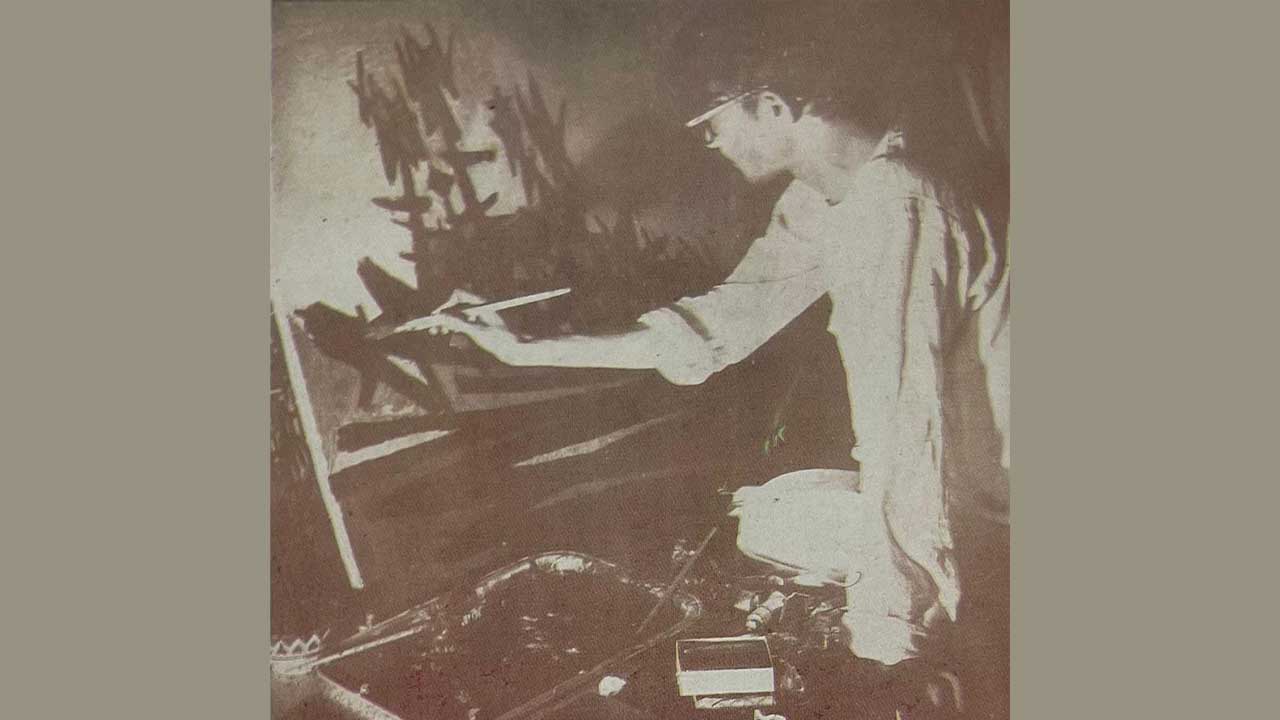
Title Image: From the catalogue commemorating Syed Sadequain Ahmed Naqvi and Trinidadian artist Art Derry, a two-man exhibition of Commonwealth artists, at the Commonwealth Institute on Kensington High Street in London on October 31, 1963.
Image Credit: Niilofur Farrukh and NCA Library.


There are no comments