
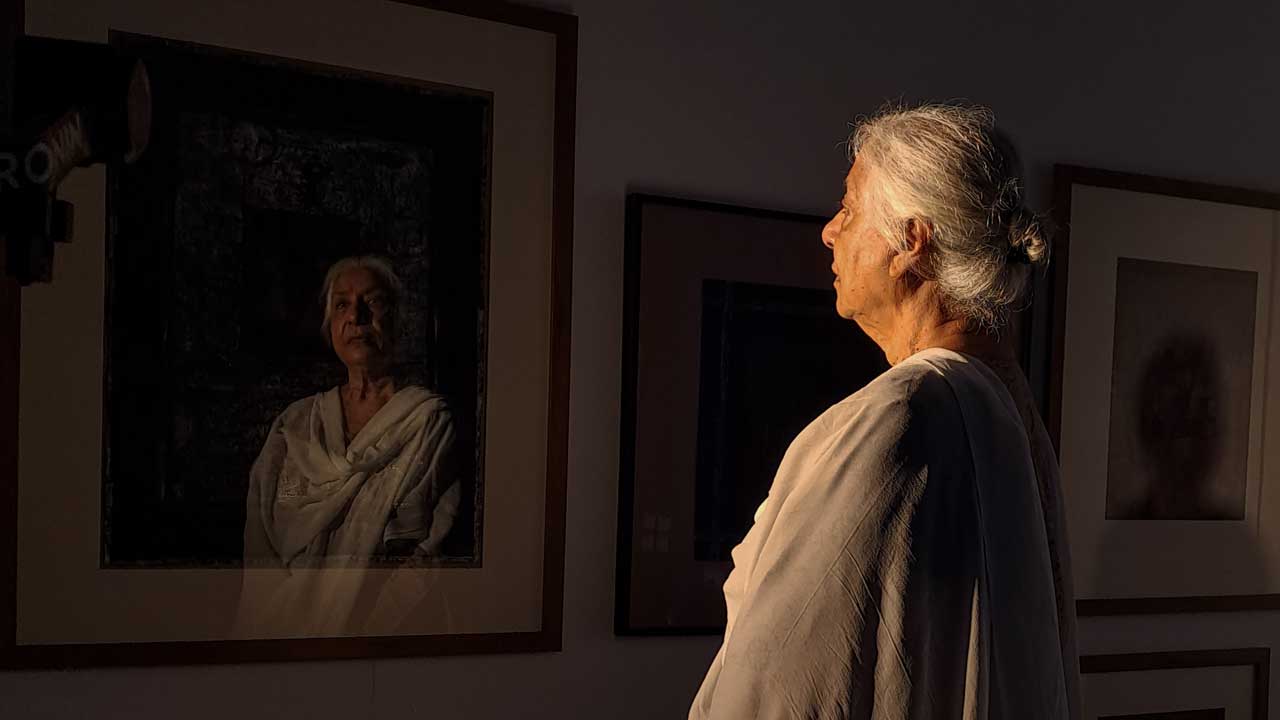
Meher Afroz’s multilayered art connects strands of thought with rich and restrained color. It holds secrets that concern the nature of existence and is impregnated with esoteric meaning. As one of Pakistan’s most iconic contemporary artists, Meher’s decades-long output richly deserved to be viewed through the long lens of the retrospective. Niilofur Farrukh, besides ranking among the most respected art practitioners in Pakistan, is a close personal friend of Meher Afroz, and has followed her trajectory through several milestone projects. Farrukh’s publication ‘Pioneering Perspectives’ (1998) looked at the life and art of three prominent women artists: Meher Afroz, Nahid Raza, and Sheherezade Alam. She hailed these three artists as “emblems of the new consciousness in Pakistani society.” Farrukh edited ‘A Beautiful Despair’ (2020), a volume dedicated to Meher Afroz’s life and art containing sixteen essays by various contributors. The book was further enriched by a remarkable selection of images.
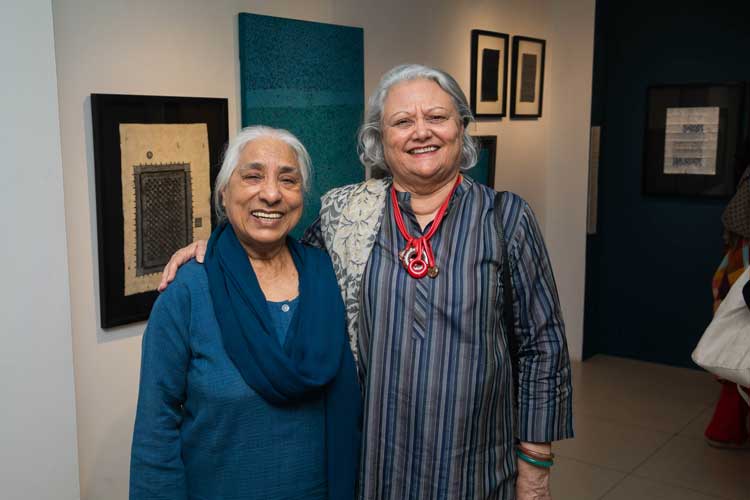
The Meher Afroz Retrospective of 2025, arranged at the Chawkandi Art Gallery and Alliance Francaise de Karachi, curated by Niilofur Farrukh, is the third and arguably the most ambitious project. In a sense, it has grown out of the knowledge bank contained in the aforementioned books and on the friendship between Niilofur Farrukh and Meher Afroz. Farrukh’s essay in ‘A Beautiful Despair’, Thinking Through Urdu: Embedded Epistemologies, has been reprinted in the retrospective catalogue. It expounds on the important instrumentalization of the Urdu language and script in Meher’s art in order to revalorize it:
“Through Urdu, Meher’s art engages with critical frameworks of religious discourse to complicate narrow interpretations of faith. She engages with belief not just through spiritual reflection but also moral paradoxes of lived experience.” Farrukh has also underscored the importance of the artist’s Lucknavi heritage as the wellspring of inspiration, independent of western canons of art styles.
The loosely linear chronology of Meher’s works from 1974 to 2025 follows the life path of the artist’s personal evolution and involvement with Karachi. The artworks are divided into four sub-themes which the curator has called “filters”, namely: ‘Seenah ba Seenah’, ‘Azaad Shehr ki Ghutan’, ‘Dastavaiz’ (all three at the Alliance Française de Karachi) and ‘Sukoon aur Sairaab’ (at Chawkandi Art Gallery). The overall title for the retrospective is “…connecting internal and external time…” The curatorial method, therefore, has made time the organizing principle for work sourced from thirty-two collections within Pakistan.
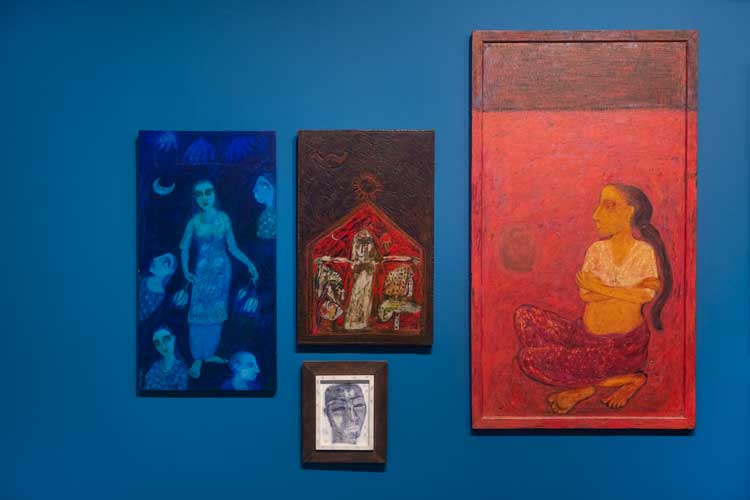
‘Seenah ba Seenah’ displays work against ultramarine blue walls (the color is repeated at Chawkandi Art Gallery as an element of cohesion between the two venues). The curator has drawn attention to cultural memory through the “indomitable spirit of women”. She suggests there is transmission of strength from empowered Awadhi women such as Begum Hazrat Mahal who took arms against the British during the 1857 uprising. The paintings displayed in ‘Seenah ba Seenah’ are all of women. They are assembled from diverse series as is natural in a retrospective that has drawn on loaned paintings from collectors of Meher’s art. Gathered in a single space, certain features become apparent. Most faces are left-facing. Whether portraits of full figures, the women stand out against a scumbled and uncluttered background. Their primal forms are indifferent to identity. Rather, they seem to represent cosmological deities who exist out of time and within a symbolic space, at once calm and mysterious. Occasionally, the women are paired with symbols such as the crescent, the rose, and the poshak or choga overcoat. These are recurring symbols in Meher’s repertoire, and they represent important sentiments in her complex personal mythology. Blue and coral hues dominate in the paintings.
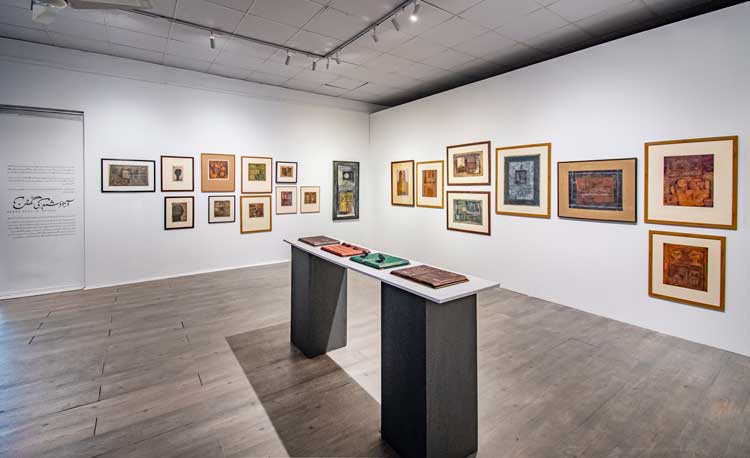
The section ‘Azaad Shehr ki Ghutan’ aims to connect Meher to frenetic Karachi where she relocated from Lucknow in 1971. The color palette is more somber in this section as if to reflect anxiety and claustrophobia. Meher was already an accomplished painter and printmaker when she immigrated to Karachi to rejoin her family. The art resources of the city at that time did not include a printing press. Meher started to make collagraphs, and some of her earliest creations are on view in ‘Azaad Shehr ki Ghutan’. They are testament to her persistence as a printmaker and are important precursor artifacts to the development of printmaking in Pakistan.
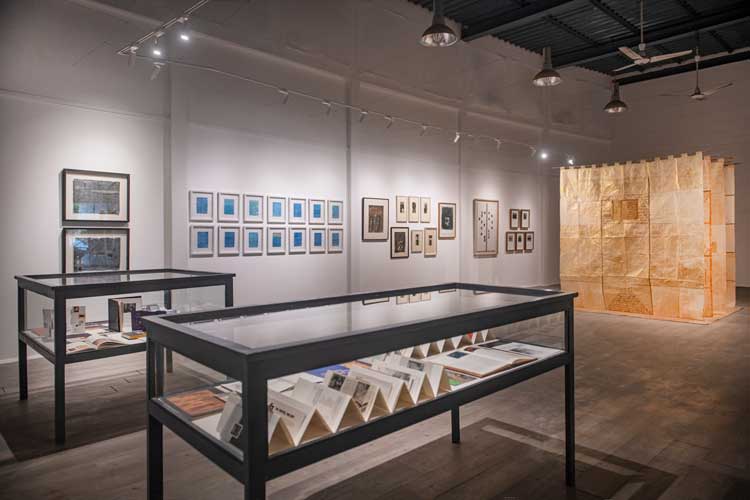
The section called ‘Dastavaiz’ is a comprehensive selection of work from three decades of Meher Afroz’s practice. We see the introduction of text as a poignant expression of both tradition and angst. There are works on paper, on textile, works with embroidered stitches, and stitches enclosed within boxes. The quintessence of “internal and external” time is captured within the diversity of three decades of productivity. The philosophical and spiritual maturing of the artist is evident in her choice of words and motifs. A stylized safety pin, the arrowhead, a rose, become part of the image library. Their repetitions are like choral echoes in the Marsiya khwani tradition, where the audience repeats the last line of a naat to emphasize the importance and understanding of the sentiments being recited.
The work ‘Dreamscape’ (2014) is a tall installation created with large sheets of semi-translucent, buff-colored Nepalese paper. It is covered with fine text. It’s near-minimalist structure underscores the poignancy of its mysterious presence.
Niilofur Farrukh is an art activist, and it is not surprising that her ardent anti-colonial stance and deep engagement with the city’s afflictions seep into her interpretation. She has stressed resilience, friction, and anxiety in her descriptors of Meher’s work. However, she has also countered the worldly with the spiritual dimension that is integral to Meher’s way of being. Much of Meher’s art is born out of her quest for self-amelioration by expansion of the inner eye.
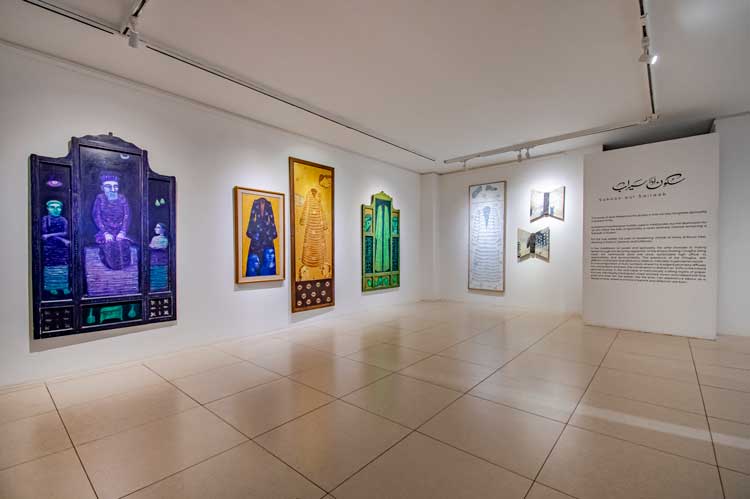
‘Sukoon aur Sairaab’ (Peace and Fulfillment), displayed at Chawkandi Art Gallery, is the fourth segment of the retrospective. Magnificent wooden jaalis (ornamental wooden grilles), line up on a long wall. These are found objects that Meher scoured for and found in antique markets. They become material embodiments of craft traditions. She painted on their surfaces with bright, but restricted range of, color. We see the floating choga, the faces and symbols from Seenah ba Seenah repeat again on the jaalis. Their repurposing as art objects transforms their functionality into powerful talismans of wisdom.
As with all her artwork, Meher never states the obvious. Her expressions are nuanced, and they signal rather than state their meaning. There are chequerboard-style artworks in acrylic and thread. There is a takht installation covered with green velvet and embroidered with gold zardozi and adorned with diaphanous drapes making us recall ‘Dreamscape’.
Clearly in ‘Sukoon aur Sairaab’ we have entered a metaphoric space where spirituality is not abstinence or renunciation. Rather, the richness of direct experience is conveyed through sukoon and sairaab as metaphors. The golden embellishments on many artworks serve as material manifestations of glowing spiritual experience.
In addition to the painstakingly arranged artwork in the two galleries, there was great attention given to a vigorous public programme. The opening of the retrospective with a discussion between Niilofur Farrukh and Amra Ali on ‘Meher ka Art History Mein Maqam’ accompanied by a catalogue launch, followed by a conversation between Chawkandi Art Gallery’s founder Zohra Husain (who also happens to be Meher Afroz’s cousin), and collector Gertrude Jatoi. A compelling reading performance from Meher herself in which she read from texts that have profoundly influenced her self-development. Many schools and institutions visited the retrospective and were delighted to find the energetic curator Niilofur Farrukh on site to speak with them. Credit must also be given to the valiant team at Chawkandi Art Gallery who supported the curatorial effort.
It is appropriate to give Meher Afroz the last word. Her statement from an earlier show, Kehkashan-e-Neesti which was curated by Amra Ali and opened at Chawkandi Art Gallery on 28 January 2025, explains her journey in her own words:
“The edification of the human being is at the heart of my quest. I seek enlightenment from literary texts that are poetic and instructive. My Lucknavi heritage is steeped in Persian literature which has profoundly influenced the development of Urdu. Ferdowsi’s Shahnameh from 10th century Iran remains a perennial epic, valorizing the lives of kings. Mir Anees and Dabeer, both from Lucknow, perfected the art of Urdu marsiya-writing in the 19th century…These texts make us reflect on qualities of greatness such as grace, forbearance, fortitude, single-minded pursuit, and courage in the face of adversity. They direct us towards an ascendant path that requires the relinquishing of the ego. From the chequerboard of our mundane preoccupations, we are guided by the example of exceptional people towards pathways that draw us closer to divinity.”
“…connecting internal and external time…” was on display from November 24 to December 17, 2025.
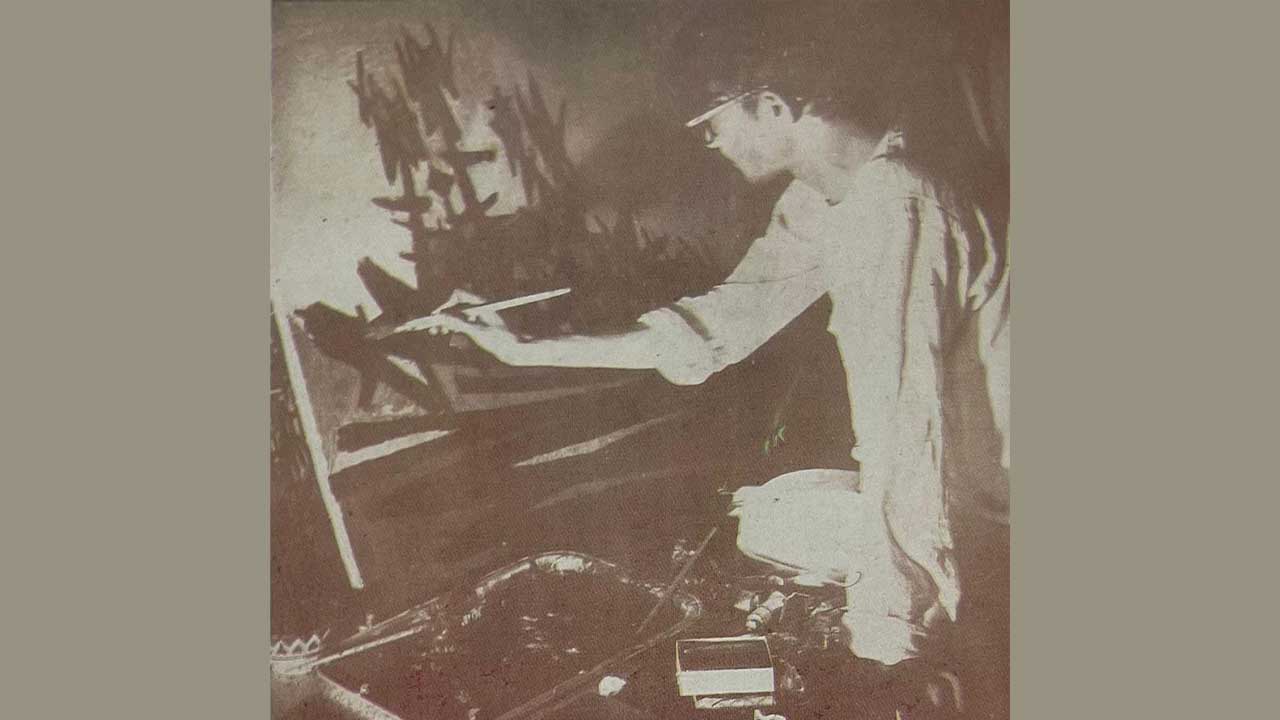
Title image: Meher Afroz during a reflective moment. Photo credit@Razin Rubin.
Nusrat Khawaja

Nusrat Khawaja is an independent researcher, curator, and landscaper. She writes on art and literature. She is a member of the Karachi Biennale Discursive Committee.
There are no comments