
Stone, in its silent endurance, stands as a paradox— inert yet expressive, permanent yet shaped by time. Across cultures and centuries, it has not only built our shelters, tools, and monuments, but also housed our metaphors for memory, resilience, and the sacred. As a material, stone predates history and will likely outlast us. It connects the fleeting nature of individual lives with the enduring legacy of collective civilization.
Set in Stone, curated by Sadiqa Tayebaly and Sohail Zuberi at the Koel Gallery, is a bold and expansive exhibition that delves into this paradox. Bringing together a diverse array of artists, archaeologists, architects, designers, filmmakers, and craftspeople, the show investigates the enduring cultural, historical, and symbolic significance of stone within Pakistan. It seamlessly bridges the ancient and the contemporary, the archaeological and the artistic, emphasizing stone not merely as matter, but as a vessel of meaning. The exhibition is anchored in a curatorial strategy that creates a dialogue across time. By juxtaposing archaeological artefacts with contemporary works, the show deliberately disrupts linear narratives of progress and tradition. Instead, it positions stone as both a repository of ancestral knowledge and a living, dynamic participant in present-day artistic discourse. Through this dialogue, stone becomes more than relic or resource; it becomes a witness.
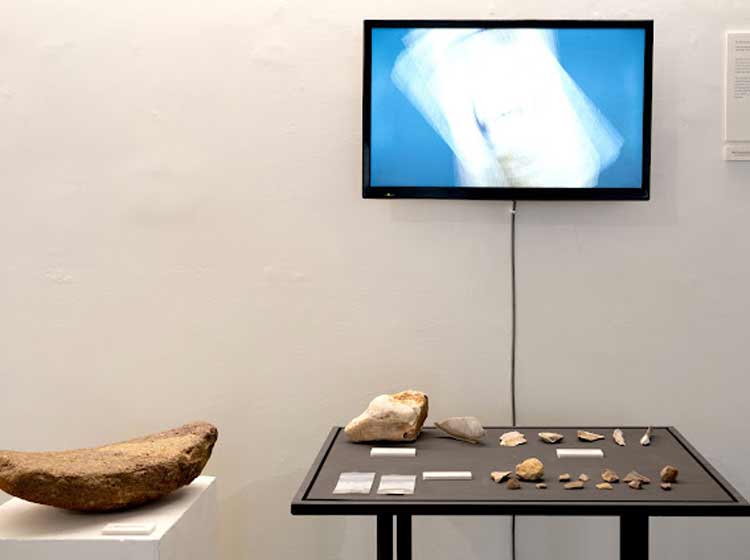
At the heart of the exhibition lies a remarkable selection of original artefacts excavated from the Allah Dino archaeological site in East Karachi. Dating back to the mid-third millennium BCE, the site reveals a prehistoric community that predates modern urban centres in the region. These objects, namely, chert (flint) tools, seals, jewelry, pottery and inscribed fragments are presented not as museum specimens, but as tactile links to a deeply rooted human presence.
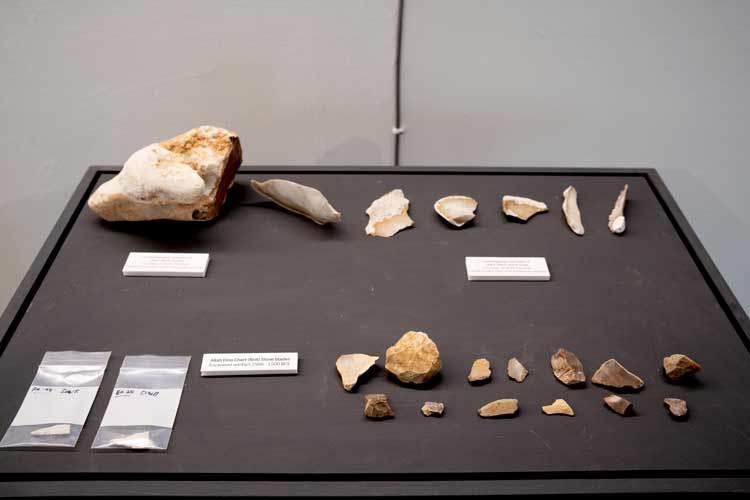
Their inclusion is not merely illustrative, it is foundational. These are not reproductions, but original excavated objects— tangible remnants of a civilisation that lived, worked, and imagined on the same land we occupy today. Their presence honours the labour of archaeologists like Dr. Asma Ibrahim, Dr Kaleemullah Lashari, Dr Zulfiqar Ali Kalhoro whose tireless work in recovering, documenting, and protecting cultural heritage bridges the past and present. These artefacts remind us that history is not abstract. It is layered beneath our cities, buried in our soil, waiting to be rediscovered.
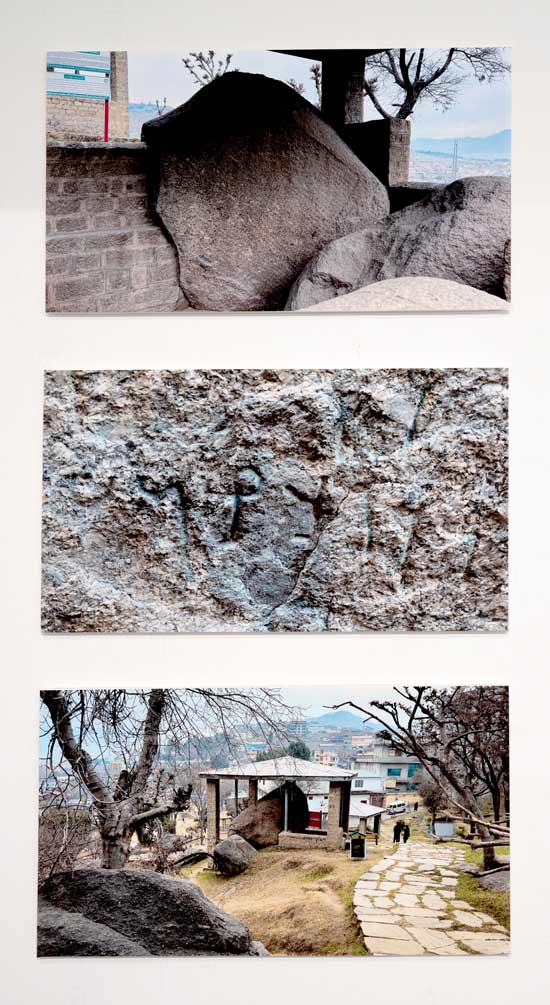
Photographer Faysal Khan Elahi’s series, Moral Code: Ashoka’s Edicts in Mansehra, offers another entry point into the spiritual and ethical dimensions of stone. Documenting the 3rd-century BCE inscriptions of Emperor Ashoka etched into rock, Elahi transforms these sites into visual texts of quiet dignity and enduring relevance. The edicts, which promote non-violence, compassion, and justice, resonate with values that transcend their ancient origin. Elahi’s work is more than documentation. It is preservation, meditation, and connection. Through high-resolution photography and digital tools, embedded throughout the gallery, viewers are invited to engage with distant sites like the Swat Buddhas or the Mansehra inscriptions. In this way, the exhibition becomes a digital palimpsest, where the ancient is made accessible and the past is not just remembered, but reactivated.
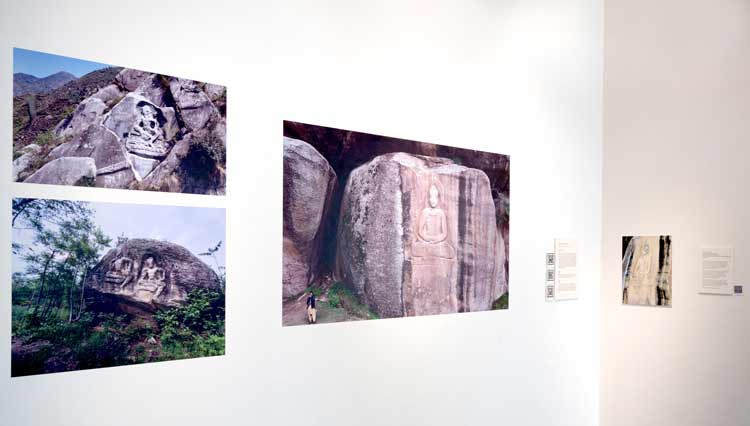
One of the most affecting segments of the exhibition features the story of the Jahanabad Buddha in Swat. This monumental 7th-century CE rock carving, once defaced by Taliban iconoclasts, has been painstakingly restored through a joint effort by Pakistani and Italian archaeologists, led by Salman Khan and the Italian Archaeological Mission. Through high-resolution images, the exhibition documents this act of cultural recovery as a form of resistance— an assertion that memory and identity cannot be erased. In the face of violent erasure, the restoration of the Swat Buddha is an act of profound defiance. It stands as a symbol not just of heritage preserved, but of cultural dignity reclaimed. Stone, here, becomes a battleground between preservation and destruction, between memory and forgetting.
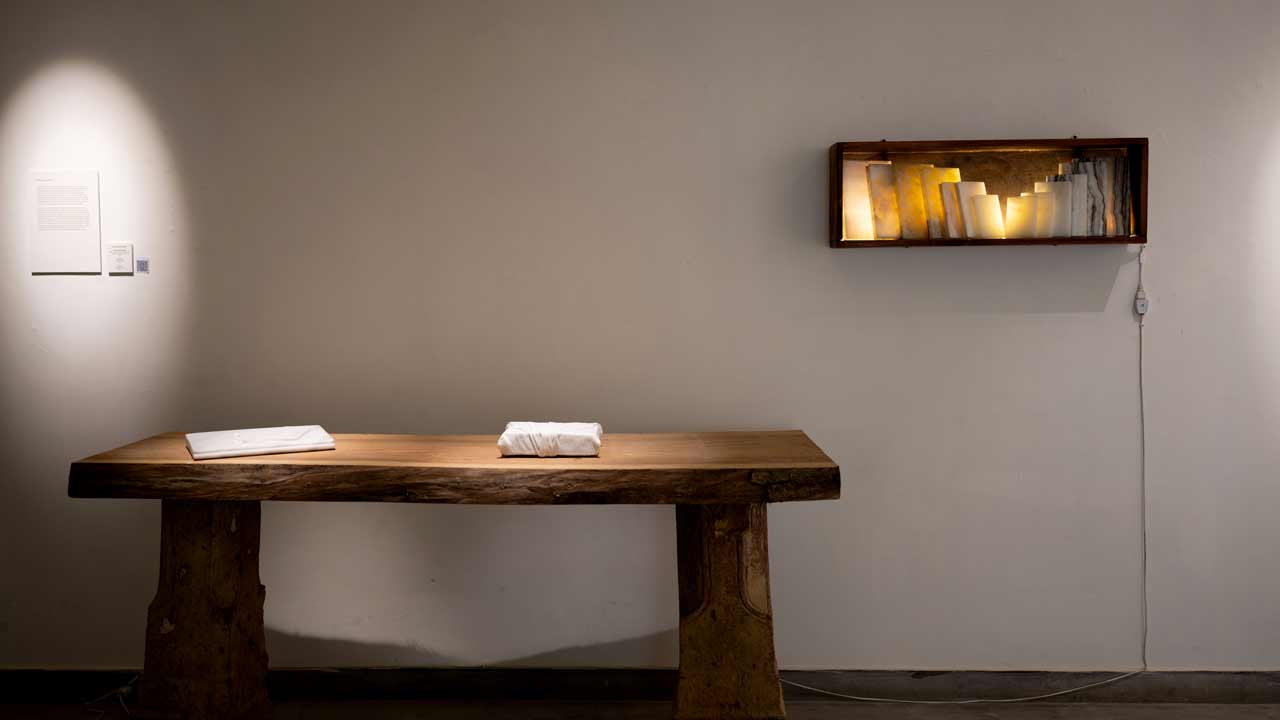
This dialogue across time finds one of its most compelling expressions in the work of Nabeel Majeed Shaikh. In pieces like The Secret and E-Book, Shaikh carves contemporary digital-age objects. These include a laptop, AirPods, and a marble book, what appears like a Quran wrapped in a juzdaan, using Renaissance techniques and materials. By rendering the ephemeral tools of our present in a medium as enduring as marble, Shaikh invites reflection on what we choose to remember. His work is both elegy and monument, questioning what future archaeologists will find worthy of excavation.
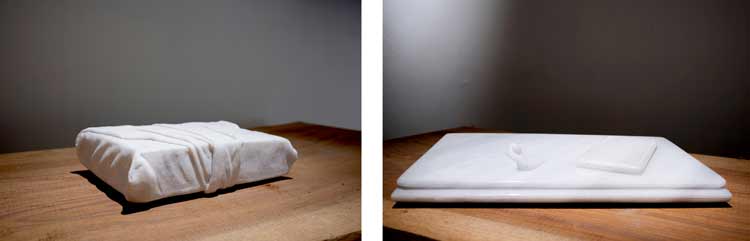
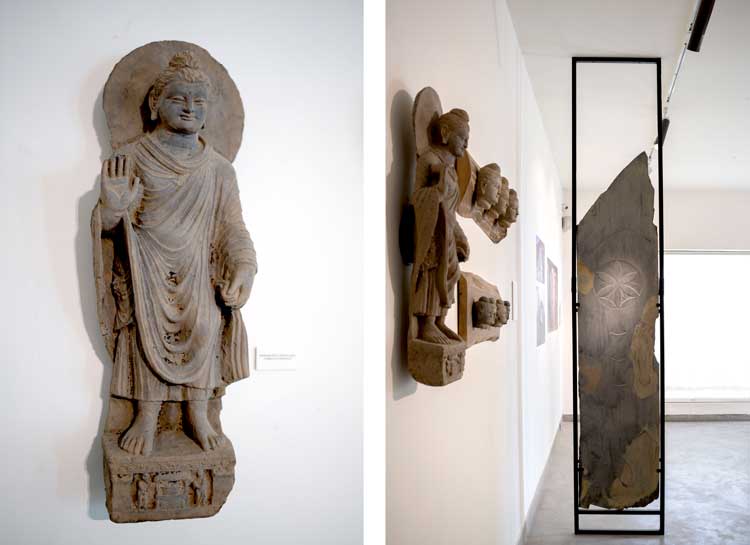
These juxtapositions are not merely aesthetic— they are conceptual. They allow viewers to see how material and memory can be reactivated in the present without being fossilized by nostalgia.
Not all stone is enduring. Muhammad Ilyas’s Chitarkari Panels explore the brittleness of slate as metaphor. His works, created from a stone known for its layered and fragile surface, embrace erosion and breakage as part of the stone’s language. They shed and fragment like memory itself. Here, the stone does not defy time, but it succumbs to it, yet continues to speak. Ilyas draws from personal and communal histories. His use of vivid, irreplaceable pigments and delicate etching techniques turns slate into a living archive: intimate, expressive, and vulnerable. His work stands as a reminder that memory, like stone, is shaped as much by what is lost as by what remains.
The Gandhara sculptures featured in the exhibition add a further layer of historical depth. In early Buddhist art, the Buddha was never depicted in human form, instead, his presence was evoked symbolically. It was only during the Gandhara period, where Hellenistic and Indian traditions merged, that the Buddha was given a face. These sculptures— serene, soft-eyed and draped in Greco-Roman robes are among the first attempts to humanize the divine. Displayed in the gallery, these carved faces are more than sacred icons. They are expressions of cultural hybridity, artistic evolution, and spiritual continuity. They remind us how ideas move across time and space, adapting to new contexts while carrying old truths.
The exhibition begins in the Stone Age, tracing humanity’s earliest engagements with material through engravings and carvings on walls. From these primal gestures, the narrative moves toward the Age of Enlightenment, a period defined by the symbolic and literal presence of light.
Within this continuum, the practice of Tariq Hasan, particularly ‘ Ascension’, emerges as a contemporary articulation of stone’s evolving possibilities. Traditionally perceived as dense and immovable, stone in Hasan’s hands reveals an unexpected translucency. By moulding and reshaping its surface, he transforms a material often associated with permanence into one that appears fluid, luminous, and strikingly modern.
Light plays a pivotal role in this transformation. The illumination of Hasan’s works not only accentuates the inherent qualities of stone but also invites viewers into a heightened awareness of its materiality. Functional as well as aesthetic, these pieces are designed to inhabit domestic spaces, where they alter atmospheres and generate a profound sense of calm. In doing so, they bridge the realms of matter and energy, creating environments imbued with spirituality and positive resonance. Through Hasan’s work, stone transcends its historical role as a marker of weight and endurance, becoming instead a medium of illumination—one that redefines how we encounter both the material and the spaces it inhabits.
The exhibition also gives significant attention to Pakistan’s geological diversity and the cultural value of indigenous stones. Artists such as Mariya Suhail, Sherezad Rahimtoola and Meherunnisa Asad explore these resources in innovative ways— blending traditional materials with contemporary forms. Whether through sculpture, architecture, jewelry or installation, their work expands our understanding of what stone can be.
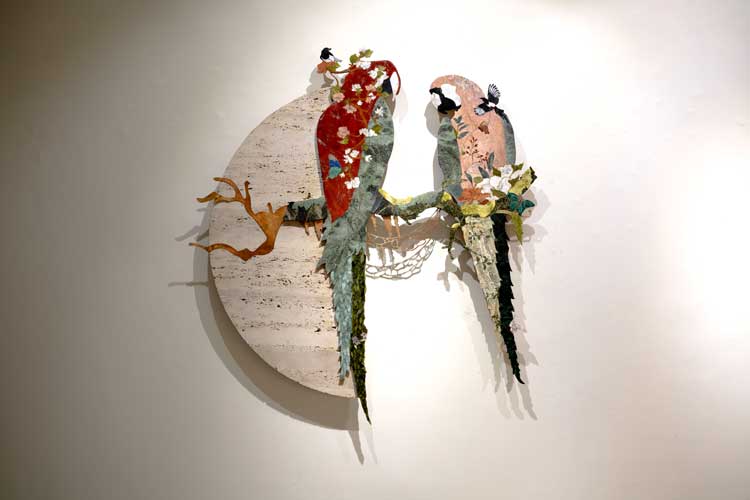
By integrating heritage craft with modern design, these artists make a powerful case for the ongoing relevance of stone. They show that tradition is not a fixed past but an evolving present; one that can be revisited, reimagined, and reclaimed.
In the wider context of this exhibition, where resilience and restoration recur as central themes—from the reimagined Jehanabad Buddha to other works of reclamation—Meherunnisa Asad’s practice resonates with particular force. While her mosaics are undeniably luminous, marked by beauty and a sense of refinement, beneath their elegance lies a profound engagement with history, displacement, and survival.
Her work is layered with narratives that carry both personal and collective memory. Drawing on stones sourced from across regions, as well as those intimately tied to her own upbringing, Asad grounds her practice in the art of mosaic. Yet, beyond the intricacy of her material language, her works speak to deeper concerns: the endurance of the human spirit, the search for belonging, and the persistence of connection amidst dislocation.
In this way, Asad’s practice extends beyond ornamentation. Her mosaics echo with memory and transformation, situating themselves within a broader curatorial thread that runs throughout the exhibition—stone as both witness and vessel. Across time, stone has served as a marker of histories that exceed human lifespans; it becomes a bearer of resilience, carrying traces of what endures even after loss. Asad’s contribution brings this truth into sharp relief: that within beauty lies resilience, and within material, memory.
Other artists featured in Set in Stone likewise revive traditional stone-carving practices, such as tomb engravings and soapstone craft, only to reframe them within contemporary contexts. These juxtapositions are not merely aesthetic but conceptual, revealing how material and memory can be reactivated in the present without being fixed in nostalgia or reduced to history alone. A compelling conceptual and thorough line emerges around the idea of rhythmic movement; a physical and symbolic reverberation that ricochets through the tools, gesticulations, and surface patterns across the exhibition. This rhythm of the show animates the otherwise inert; drawing attention to the time-bound, bodily, and meditative labour of shaping stone. Several artists use repetition not just as an aesthetic device, but as a way of invoking ritual, memory, and the deep tempo of tradition.
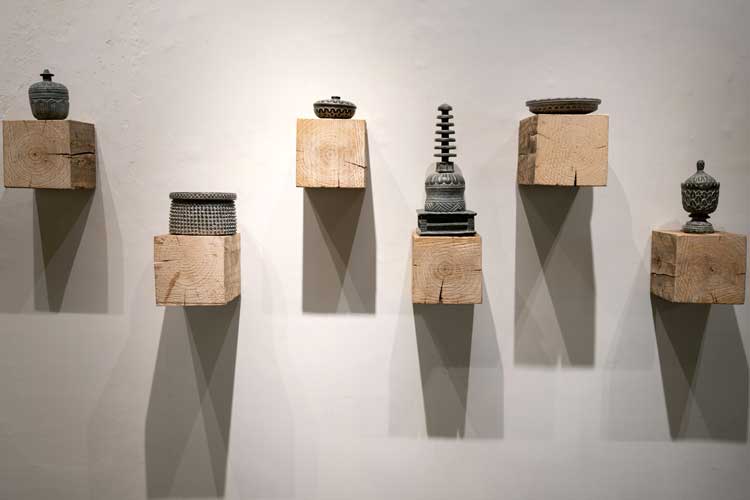
This cadenced logic unfolds visually in the carved soapstone works of Ramzan Kaka, where the soft, yielding material invites intricate surface work— geometric motifs, floral curls, lattice forms— that repeat with meditative precision. These patterns do not merely decorate, they pulse. Their symmetry and flow create visual rhythms that echo the bodily rhythms of their making. Each curve and cut bears the residue of a repeated gesture: hand, tool, stone, and hand again. The pattern becomes a visible trace of invisible time.
One of the exhibition’s most poignant examples is the work of Muhammad Ammar Raza, who incorporates the sil batta, the traditional stone grinding slab used in South Asian kitchens for centuries. In his installation, a video plays on loop: a hand methodically grinding spices in repetitive, circular motions. The cadence is slow, deliberate, and hypnotic. It does not rush, and it does not need to. The loop forms a temporal circle, echoing the act it documents—an everyday choreography passed down through generations, unchanged and unhurried.
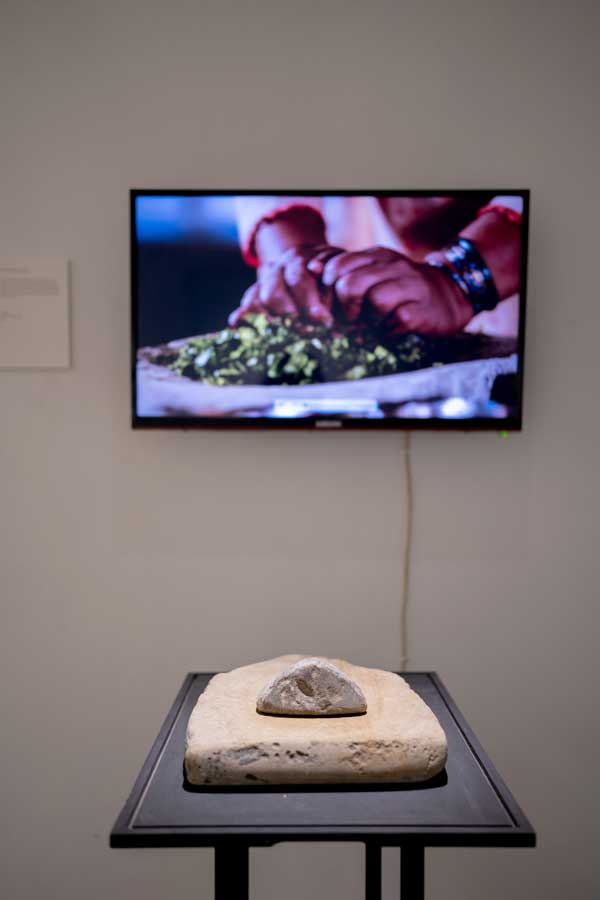

It becomes both an artistic strategy and a philosophical stance. It resists spectacle. It resists speed. It invites a slower mode of perception, one attuned to nuance and depth. Like devotional chants or ancestral storytelling, the recurring movement becomes ritualized— disciplined, sacred, sustaining.
The theme of repetition also takes a spiritual dimension in Syed Noor Hussain’s video work Physical to Metaphysical. A looped montage of stone shrines across Pakistan namely monasteries and temples unfold in slow, pulsing succession. The repetition mirrors devotional practices like zikr, where meaning is deepened through cyclical return. The video becomes a visual chant, echoing the spiritual and physical rhythms that run throughout the exhibition in carved motifs, grinding motions, and sculptural labour. In both form and content, the work underscores how repetition in stone, whether architectural or ritual, becomes a path to remembrance, reverence, and transcendence.
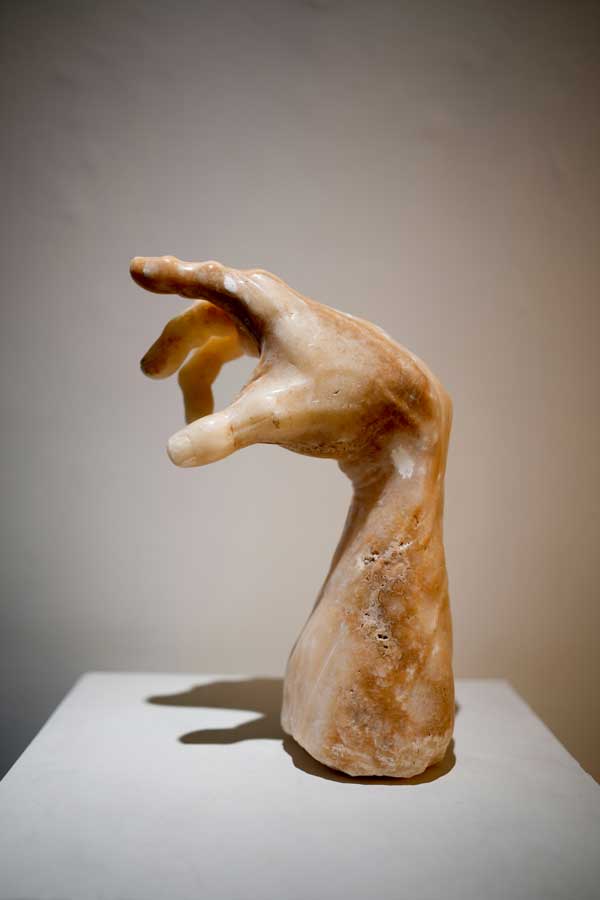
Muhammad Darab Muneer explores this idea through sculpture, with a marble rendering of a human hand— veins wrapping around it in a looping, obsessive pattern. The repetitions are not mere anatomical detail; they are a meditation on bodily memory and touch. The marble, cold and dense, becomes unexpectedly intimate, as if warmed by the insistence of the artist’s gesture.
All the artists in Set in Stone have approached the material with profound sensitivity, conceptual clarity, and technical skill, doing full justice to the complexity and cultural weight of stone. Whether through meticulous craft, thoughtful symbolism, or innovative use of digital media, each artist engages the material not merely as a substance to be shaped, but as a vessel of memory, history, and meaning. Their works honor stone’s ancient legacy while reactivating it in contemporary contexts— be it through ritualistic repetition, sculptural reinterpretation, or digital preservation. Collectively, they reveal the enduring relevance of stone as both medium and message, bridging eras, geographies, and sensibilities with remarkable coherence and depth.
Set in Stone is not merely an art exhibition, it is a cultural meditation. It asks urgent questions about time, permanence, and meaning. In a world increasingly obsessed with speed and disposability, stone reminds us to slow down, to endure, to witness. It reminds us that the most fragile of truths, ethics, memory, and belief can sometimes be made solid. Whether as sacred icon, digital proxy, archaeological remnant, or sculptural medium, stone in this exhibition becomes a carrier of continuity. It testifies to both loss and survival, to beauty and brutality. It holds form and through form, it holds meaning. As the curators rightly frame it, “stone is a witness” and in this exhibition, that witness speaks; clearly, powerfully and across millennia.
Curated by Sadiqa Tayebaly and Sohail Zuberi, Set in Stone traces the unbroken thread of stone’s cultural, spiritual, historical, and artistic significance in Pakistan, and was on display at Koel Gallery from February 25, 2025 till April 25, 2025.
All images are copyrighted and used courtesy of Koel Gallery and Sohail Zuberi.
Title Image: Shot of Nabeel Majeed Shaykh’s sculptural installations on display. The E Book, 1.8 x 13.5 x 9.5 inches, carved ziarat white marble, 2021(left). Secret, 2.6 x 7 x 10 inches, carved ziarat white marble, 2025 (middle). Top corner right: Illuminated Knowledge, 33 x 11.5 x 6-inch wooden box, 13 carved books in pink, honey, white and gray onyx marble, sizes variable, 2024
References:
Zuberi, Sohail, and Tayebaly S, curators. Set in Stone. Exhibition catalogue. Karachi: Koel Gallery, 2025.
Ibrahim, Asma. The Archaeological Heritage of Pakistan: From Prehistory to the Indus Civilization. Karachi: Department of Archaeology & Museums, 2017.
Khan, Salman, and Italian Archaeological Mission. “Restoration of the Jahanabad Buddha: A Cross-Cultural Conservation Project.” Journal of Asian Heritage Studies 12, no. 2 (2024): 85–103.
Allchin, Bridget, and Raymond Allchin. The Rise of Civilization in India and Pakistan.
Elahi, Faysal Khan. Moral Code: Ashoka’s Edicts in Mansehra. Artist’s statement and interview by Koel Gallery, 2025.
Shaikh, Nabeel Majeed. “Renaissance Tools for a Digital Age.” Artist talk, Koel Gallery, Karachi, March 2025.
Ilyas, Muhammad. Chitarkari Panels and the Language of Fragility. Karachi: Artist publication, 2024.
Raza, Muhammad Ammar. The Kitchen Archive: Performance and Repetition in Domestic Space. Lahore: Independent Art Press, 2025.
Hussain, Syed Noor. Physical to Metaphysical. Video installation statement. Koel Gallery, 2025.
Muneer, Muhammad Darab. “Whispers in Marble.” Artist note, Koel Gallery, 2025.
Bilgrami, Noor Muhammad. Stones of Pakistan: Geology, Culture, and Craft. Karachi: Oxford University Press, 2019.
Lahiri, Nayanjot. Finding Forgotten Cities: How the Indus Civilization Was Discovered. Delhi: Permanent Black, 2005.
Zara Saeed Zuberi

Zara Saeed Zuberi is an Art writer residing in Karachi. She completed her Bachelor In Fine Arts from Central Saint Martins, (University of the Arts, London) UK. She has worked previously with the Karachi Biennale in 2019, working alongside artists and curators in preparation for the show.
There are no comments