
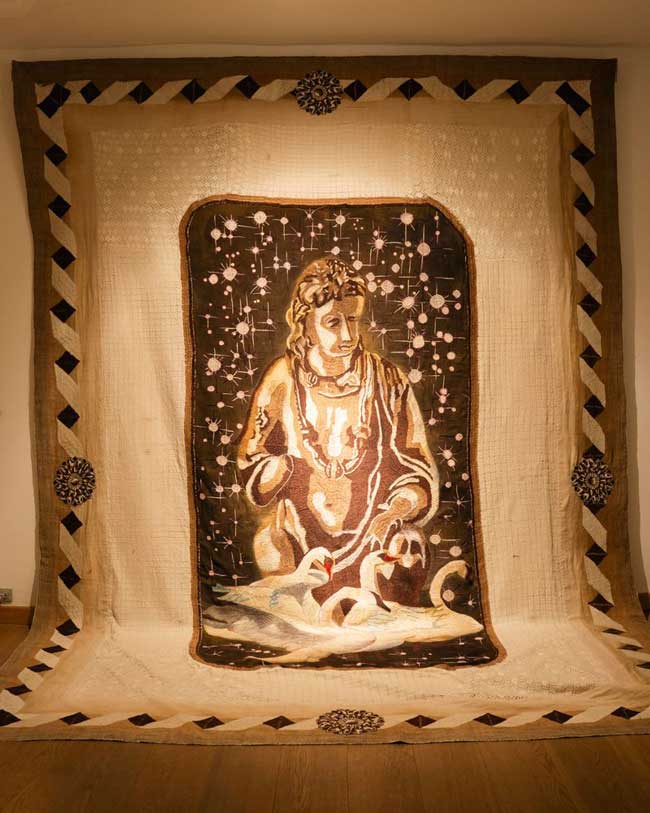
In light of this upcoming exhibition, sometime in April, I sat down to have a conversation with Faiza Butt. Although a lot of information was confidential at the time, I learnt that the state backed pavilion of Pakistan was to explore the crafts and indigenous cultures of Punjab, Butt yielded that she took into account historic Punjab, elucidating that borders and boundaries are fluid, they shift over time but the culture persists, morphs and expands to respond to the needs of the populace on the ground. At the time, Butt divulged that her research began with the etymology of the name Punjab, she considered the five rivers or the panj aab that make up the geography of the land. Hence the exhibition at Ex Farmacia Solveni was titled, Punj AB: A Sublime Terrain.
According to the press release the premise was ‘conceived specifically for the pavilion, the project marks both a continuation of Butt’s longstanding engagement with identity, memory, and representation, and a significant departure into new material and collaborative, spatial practice’. This collaboration mentioned in the press release, is exemplified by Butt working on ground with various artisans, craftspeople and community groups including Haveli Crafts, an organisation consisting primarily of women, making homeware with traditional craft techniques.
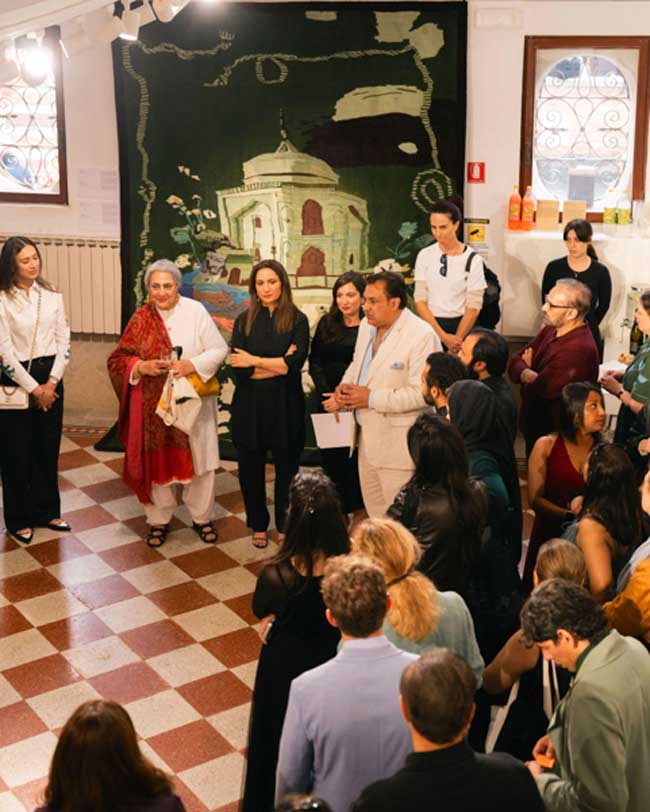
From our conversation, I gleaned that Butt has endeavoured to present what Pakistan yields at the rural level, from a historical point of view up until present day. She focuses on crafts using mostly cotton, wool and precious metals. With the inclusion of precious metal crafts, Butt leans into incorporating feminism in the mix, as she mentions the role of gold as security for women as it is passed from generation to generation. The works that include small-scale intimate paintings, sculpture, video installation and tapestries explore history— from architecture to craft in the Punjab as well as reference elements such as faith and spirituality that form part and parcel of daily life.
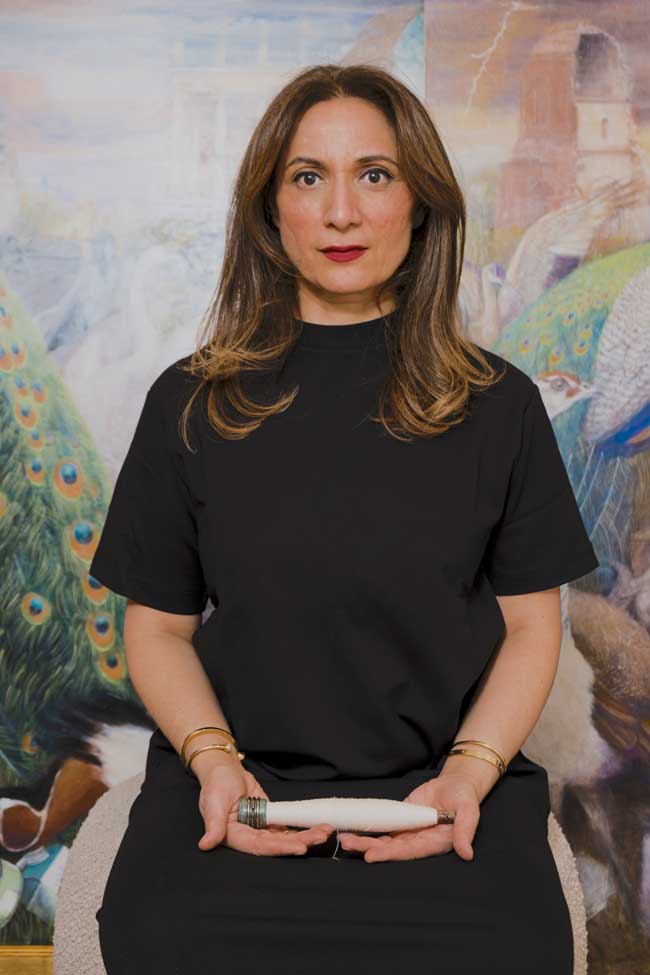
When asked how the work reflects the artist’s artistic sensibilities and the political climate that we live in, Butt responded that in contrast to contemporary art in the west, which can be insular, and institutions such as the Venice Biennale that cater to a western gaze, judge creativity and art-making on western metrics, the Pakistani pavilion will subvert that notion by expanding and breaking away from the shadows of the past, casting a softer cultural image of the country. Looking at (Punjabi) culture through a grounded lens, Butt explores the underdog, the under-celebrated, the non-monumental, i.e the menial yet elaborate, the craftsmanship and artisans practicing traditional skills passed down generationally (interestingly, the large-scale tapestries that are on display in the Pakistan Pavilion are anything but non-monumental). Hence, Pakistan’s very participation in this biennale is political in its nature. Extrapolating from that, Butt explores the tiered identities that make-up the country, reflecting on years of invasions, cultural cross pollination backed by a personal narrative of sorts, as the idea originates from her own ancestry that traces back to Amritsar and Kashmir.
Speaking on politics, besides the historic survey of Punjab, its cultural crafts and identities, she has also managed to traverse slightly and highlight the climate crisis Pakistan faces — despite being a negligible contributor to global carbon emissions — that the country suffers from exponentially.
At a time of poly-crisis, and despite the many detractors and protests against the Venice Biennale on the partial inclusion of the genocidal state, Israel, Butt clarified her position, stating that one can make larger strides from within the system than from outside. To quote her in this regard, “the louder you get, the more tone deaf the others become.” This concept also exemplifies the shifting image of Pakistan on the global stage as the country steps up as key negotiator in global events. Although the work focuses on crafts and culture of Punjab, it is a political statement, a testament to Pakistan’s placement on the world map, led by a woman. At least in the arts.
The Venice Biennale continues from 09th May to 22 Nov 2026, with Faiza Butt’s ‘Punj AB’ displayed at Ex Farmacia Solveni, Dorsoduro 993-994, Venice.
Title image: ‘In memory of a new age’ series, Hand woven wool and cotton, 2026, 365 x 275cm each
Samar F Zia
Samar F. Zia is an artist, curator and writer based in London. Besides being a mother artist and maker, she authors critical essays examining cultural markers such as art and books. Zia holds an MA FA from Central Saint Martins, London and graduated with Distinction in BFA from Indus Valley School of Art and Architecture, Karachi. She regularly contributes to her Alma Mater UAL’s Alumni of Colour Association (AoCA) by curating exhibitions and events. She has been artist-in-residence at the Fitzrovia Community Centre where she curated multiple exhibitions. She is also a Trustee of the Fitzrovia Chapel. Zia is founder of Art Social where she facilitates bespoke creative workshops for youth groups and adults for various institutions across London. Zia regularly exhibits in both Pakistan and the UK. Zia has also participated in art fairs in UK such as the Affordable Art Fair and Fresh Art Fair. Besides being an independent curator and workshop lead, she has worked as Exhibition Guide at the Hayward Gallery. She has served as visiting faculty at Indus Valley School of Art and Architecture, Karachi and taught at Art Academy London.
There are no comments