
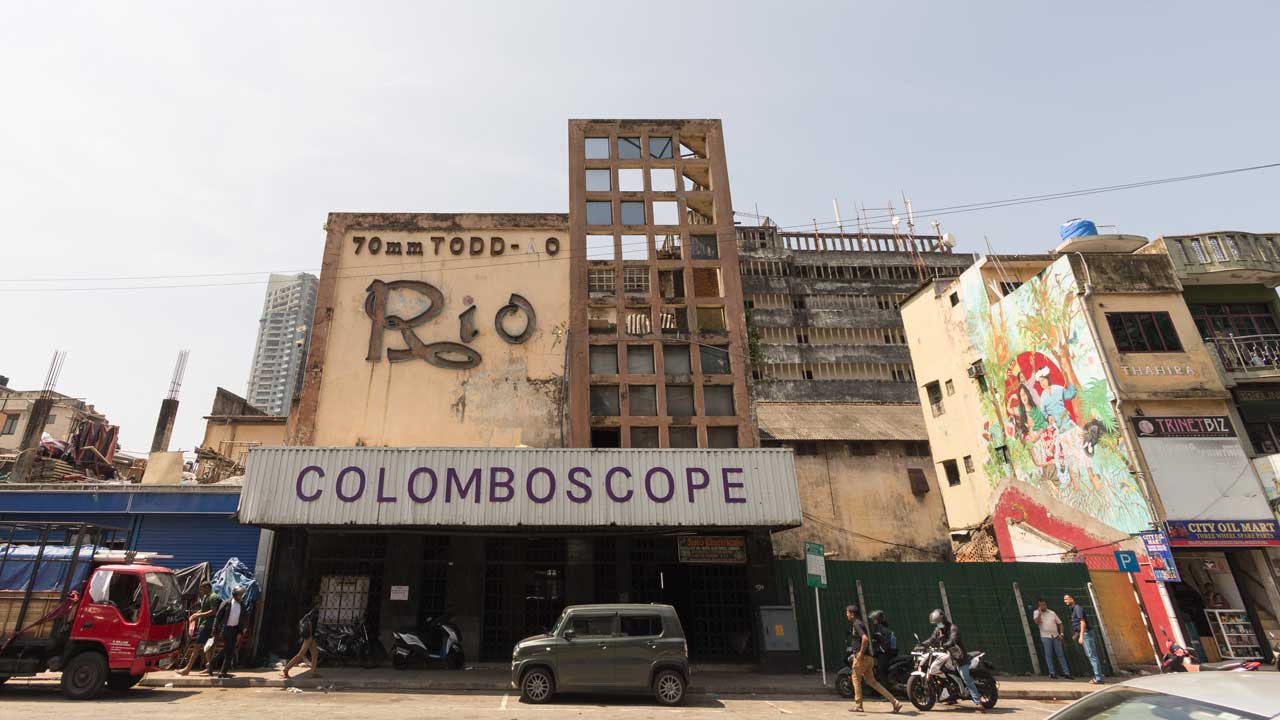
Colombo rests upon a living, aqueous tapestry of thirty-six wetland patches that intertwine with some 50 km of meandering canal.1 The city is neither entirely water nor land, remaining in a perpetual state of flux further shaped by legacies of colonisation, political upheaval, and increased economic development. This characteristic of constant transformation was effectively harnessed in this year’s edition of Colomboscope, entitled “Rhythm Alliances,” curated by Hajra Haider Karrar. Most days before attending the festival, I would visit a different wetland, attuning myself to the city’s polyphonous sounds from which the program draws its energy. I would listen deeply to the dissonant flute-like drawl of the oriole, the raucous screech of a parakeet or the piercing whistle of the babbler. This daily birdsong would ripple outwards to meet the multitude of voices that embodied the festival, collectively forming a chorus that amplified the rhythmic alliances envisioned by Karrar.
Collaborating with over 100 artists, the festival was at its most resonant when it effortlessly embodied a reciprocity between land and bodily rhythms. The gnarled mangroves of Colombo’s wetlands, often interlocking to become an impassable labyrinthine structure, echoed the tangled forms comprising Kenyan sound artist KMRU’s installation Float – a Wind of Time (2026) at Colpetty Town House. An aquamarine room was wrapped in an undulating watery horizon composed of digital prints of boats and coastlines, taken by the artist when on a residency in Lamu, Kenya. Protruding out of the wall was a woven lattice-like structure, mirroring the entangled forms of both fishing nets and mangroves. The installation, through which the gentle echoes of an ambient sound piece permeated, responded to the rhythms generated by a rhizomatic form engaged in a constant cycle of appearing and disappearing.
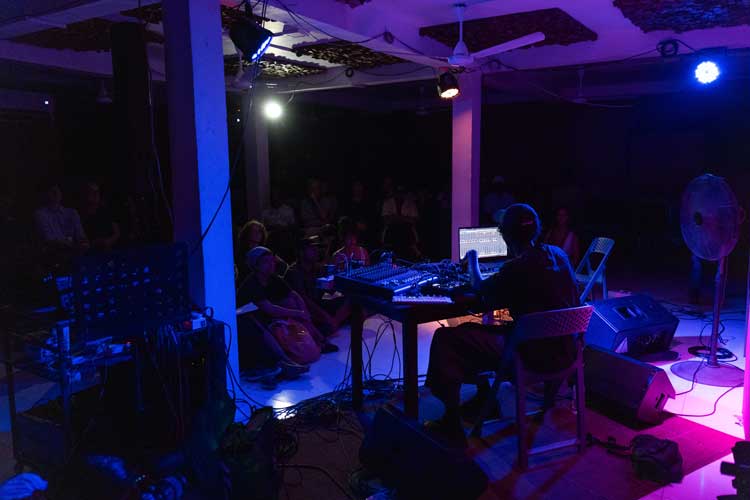
A strong programme of daily performances activated “Rhythm Alliances,” of which KMRU’s improvisation L25 was a highlight. L25 was marked by a series of sprawling, yet highly controlled, waves of cascading drone tones, interwoven with tantalising sounds that animated the oceanic ecologies conjured by KRMU’s field recordings. The piece was held in place by intersecting atmospheric textures that evoked the tensile quality of a spider’s web, also acknowledged by director Natasha Ginwala as one of Colomboscope’s unique qualities. 2
Sensing the landscape was a central gesture throughout the festival with potent works, such as Paris-based artist-researcher Saadia Mirza’s A Phenomenology of Iceberg Collisions (2025). Displayed as an immersive audio-visual presentation, the work conjured a visceral experience of the disintegration of the world’s largest iceberg, B15, currently passing the South Atlantic Ocean. Radar imagery of melting ice sheets, akin to calligraphic ink strokes, was paired with a soundscape that voiced the earth’s otherwise invisible subterranean movements. A line from the film, “we try to grasp the ungraspable,” almost became the festival’s refrain as Mirza embedded the audience in the vibrations of a geological archive-in-loss.3
Such spectral forms were echoed in the evocative print series Woven Nights (2025) by Pakistani artist Seher Shah, presented at Radicle Gallery. A group of glass vitrines housed delicate concertina books, outspread to display monotypes alongside their subsequent ghost prints. The folds of the paper endowed the piece with a sculptural quality, while the smeared traces marked across it reiterated its fragility. The faint lines read like a musical stave; yet without any notes, it marks a significant silence. As their structural display emulated a tidal motion, the works invoked an unstable terrain, shifting between states of presence and absence.
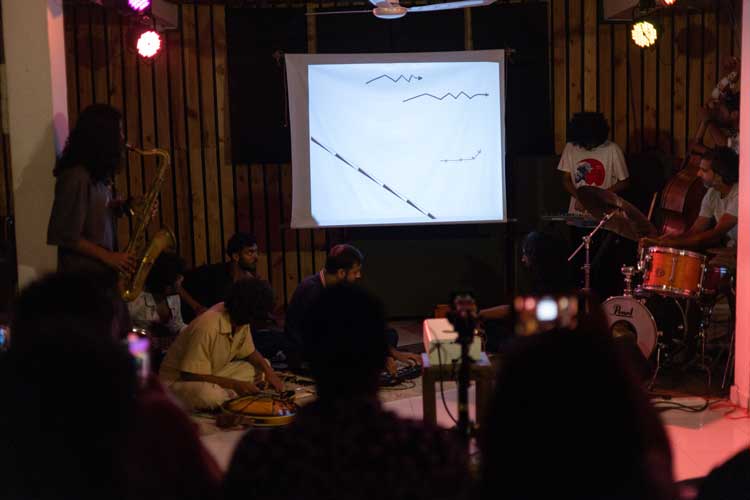
Scores and notations continuously expanded across the festival’s static spaces. Reappearing in multiple sites, Diné composer Raven Chacon’s dazzling geometric compositions shifted between musical arrangement and artwork. Students of Colombo-based Musicmatters Music School were invited to play the graphic score accompanying lahgo adil’i dine doo yeehosinilgii yidaaghi (2004), which was provided to them without any instruction. As Chacon has previously noted, the work itself observes how performers from different cultural contexts choose to interpret a composition comprising a Navajo title and Indigenous symbols.4 The resulting performance, the first to happen in Sri Lanka, produced an ethereal sound shaped by fluid percussive accompaniments and synth-heavy maelstroms.
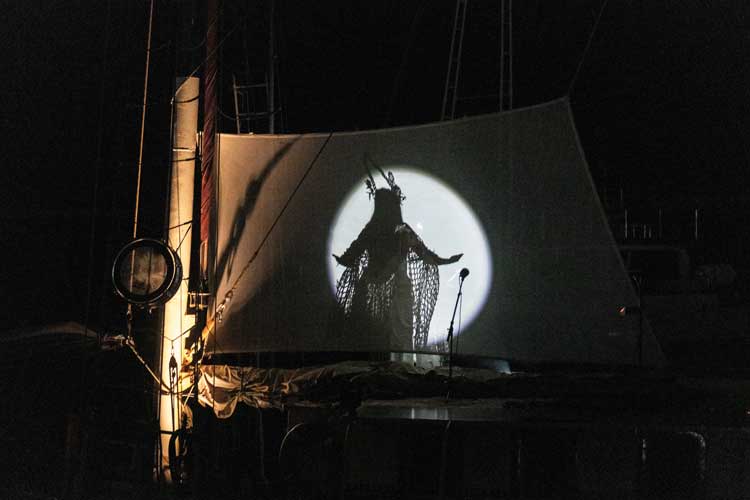
Shapeshifting forces were embraced in the spectacular portside sailing ship-based performance, Arka Kinari. While the name references the mythological creature from Buddhist and Hindu folklore (the guardian of the tree of life), Arka Kinari’s musicians Nova Ruth and Grey Filistine adopt the role of the guardian as they use their floating stage that shifts between states of transportation, dwelling, and performance to enact a post-carbon future. As they docked into Colombo’s Sail Lanka Port, the epic performance became an electrifying fusion of Javanese melodies and strong beats to match the sea’s idiosyncratic polyrhythms. Transparent drums suspended by the ship’s rigging beamed like the moon while riotous visuals projected onto the ship’s monumental sails depicted the earth’s rapid descent. The performance embodied both alarm and beacon. The group were mid-way through their trip around the Indian subcontinent, charting a journey that followed the monsoon trade winds that once connected Indian Ocean territories with the Arabian Peninsula and the Mediterranean.5
As a highly energetic offering, “Rhythm Alliances” reminded us that corporeal and ecological rhythms are one and the same. This combination drew my attention away from the hyper-capitalist skyscrapers continuously encroaching on the city as the festival’s strongest works were invitations to ground in the currents, murmurs, and vibrations emanating from the wetlands and the broader Indian Ocean. The festival allowed itself to be moulded by Colombo’s own sonic and liquid expressions, gesturing towards the idea that both rhythm and bodies of water are precious containers for life itself.
The ninth edition of Colomboscope entitled “Rhythm Alliances,” was held in Colombo, Sri Lanka, between 21 to 31 January 2026. The festival was curated by Hajra Haider Karrar.
Title Image: Installation shot, Colomboscope. Photo by Sanjaya Mendis.
Bibliography
Azeez, A.H., Handy, S., Poloni, J., Silvey, E. (eds) (2025) Wetland-ing: Terrains For Collaboration
https://www.are.na/wetland-ing/000-wetland-ing
Dave, R. (2026, January 27) Rhythmic entanglements: Colomboscope enters its ninth edition.
https://www.stirworld.com/inspire-people-rhythmic-entanglements-colomboscope-enters-its-ninth-edition
Singh Soin, H. (2017) We Are Opposites Like That https://www.himalisinghsoin.com/we-are-opposite-like-that
Chacon, R. (n.d.) …lahgo adil’i dine doo yeehosinilgii yidaaghi. Artist’s website.
https://spiderwebsinthesky.com/lahgo-adili-dine-doo-yeehosinilgii-yidaaghi/
- Azeez, A.H., Handy, S., Poloni, J. & Silvey, E. (eds) (2025) Wetland-ing: Terrains For Collaboration.https://www.are.na/wetland-ing/000-wetland-ing
- Dave, R. (2026, January 27) Rhythmic entanglements: Colomboscope enters its ninth edition. https://www.stirworld.com/inspire-people-rhythmic-entanglements-colomboscope-enters-its-ninth-edition
- Singh Soin, H. (2017) We Are Opposites Like That https://www.himalisinghsoin.com/we-are-opposite-like-that
- Chacon, R. (n.d.) …lahgo adil’i dine doo yeehosinilgii yidaaghi. Artist’s website. https://spiderwebsinthesky.com/lahgo-adili-dine-doo-yeehosinilgii-yidaaghi
- It has been recorded that monsoon winds and currents were used by seafarers as early as the late Iron Age Period to conduct long-distance maritime trade. While trade routes elsewhere were extremely arduous, the climatic conditions of the seasonal monsoon in the Indian Ocean created a much more stable environment to navigate.
Amrita Dhallu

Amrita Dhallu is an independent curator, editor, and researcher based in the Southeast of England. She provides support structures for artists through commissioning, editorial projects, and creation of artistic networks. Working across installation, performance, publishing, and aural records, she builds embodied curatorial frameworks that centre polyvocality and collaborative research. She is currently Associate Curator at Grand Union, Birmingham. Amrita was Assistant Curator, International Art at Tate Modern, London, where she co-curated Lubaina Himid’s monographic exhibition (2021-2) and worked on projects such as Zanele Muholi (2024), Rasheed Araeen’s Zero to Infinity (2023) and Hilma af Klint and Piet Mondrian: Forms of Life (2023). She has previously held curatorial roles at the Bluecoat, Chisenhale Gallery, Iniva, and Barbican Art Gallery.
There are no comments