
FIBERS OF MEMORY
After graduating from the National College of Arts, Sabah Husain made a remarkable decision. She opted to go to Japan to study printmaking. The choice came with the challenges of learning Japanese and navigating her way in a culture that differed so greatly from her own.
With characteristic determination, Husain honed multiple technical skills during her apprenticeship in Kyoto. She observed and absorbed the aesthetic principles inherent in philosophical aspects of artistic production in Japan. The intuitive nature of Japanese aesthetics created a dialogue with her cultural background that was steeped in Urdu literature, Persian literature, and Indian classical music. Husain’s immersion into Japanese arts and culture became an integral part of her sensibility. The experience played a seminal role in her artistic evolution. This link between Japan and Pakistan is key to understanding her diverse output. Gardens of Memory, her solo show at Chawkandi Art, is case in point.
All the works in the show are done on Sabah Husain’s stock of handmade washi paper she made during the Japanese interlude. Washi papermaking is an ancient technique that dates back to China in the reign of Emperor Wu (r. 140 BCE to 86 BCE). The technique of converting plant fibers to paper spread from China to Korea and then to Japan. Eventually, papermaking migrated across Asia and replaced parchment as a surface to write.
Washi paper is used to make shoji sliding screens, tatami mats, and paper lanterns. It uses plant fibers from indigenous Japanese trees such as kozo, mitsumata, gampi, and bamboo. Its making requires pure water and a plant glue called neri. Japanese masters would advise papermakers to build homes not near friends but near good sources of water. Each variety of fiber yields different properties of pigment absorption. The holistic and intuitive comprehension of process by the craftsman is an essential ingredient in the conversion of raw materials to yield fine grade paper.
There is a verse attributed to Maulana Rumi:
“Khod kooza, O khod koozagar, O kho gil-e-kooza” [The self is the clay, the self is the potter, the self is the drinker from the clay cup…]
The verse describes a seamless transition from the crafting of material, to envisaging the concept, and finally creating the artwork—all phases executed by the crafter/artist who incorporates material processes in their artwork. Husain used the verse as a title to a work created in 2012. It remains relevant to the artwork in Gardens of Memory as her output embodies the fluent transition from craft maker to artist.
A mature garden also embodies processes that have unfolded over long periods of time. Trees in particular give architecture to space; they structure views through their tracery of branches and give bursts of colour when flowering. Moreover, they memorialize the caregiver they may outlive, who has loved and tended to them.
Sabah Husain has used the microcosm of her garden as a place of repose and discovery. The garden assumed great poignancy during the Covid lockdown as it became a counterfoil to fragility in the face of disease. It facilitated the recovery of lost memories and experiences, as recounted by the artist in her statement for the exhibition: “During a year of lockdown during Covid, the garden became, even more so, a place to explore, observe, nurture and connect with many pasts in the present, a palimpsest of time.”
From the brilliant yellow flower clusters of the amaltas tree, loved by her mother who had planted it as a sapling, to even older trees such as the neem and the pipal, these natural “companions” encode long passages of time in their bark and canopies.
Classical raags and the recitation of poetry from Shiraz to Faiz evoked another aspect of time and gathering of family. Husain has brought these diverse elements to bear in a contemplative series of work that seems like botanical art but is actually a capsule of memory, elegantly encoded in the natural form of plants. What is unseen is equally real as visible form and colour. This delicate perception of time or space is exemplified in the Japanese aesthetic concept of “Ma” that bears deep resonance in Husain’s work.
Approaching Husain’s art through the lens of Ma gives insight into the meaning of her work. Ma is a subtle and multidimensional term that at its simplest may be described as an interval either of time or of space. Ma corresponds to a moment of stillness, to negative space, and to the magical point where boundaries of space and time collapse. It is a space full of expectation and possibility in which imagination has time to cohere. Ma can be real and metaphorical. It is poetic, phenomenological, negative but not empty, and it accentuates structure that is external to its boundaryless quality.
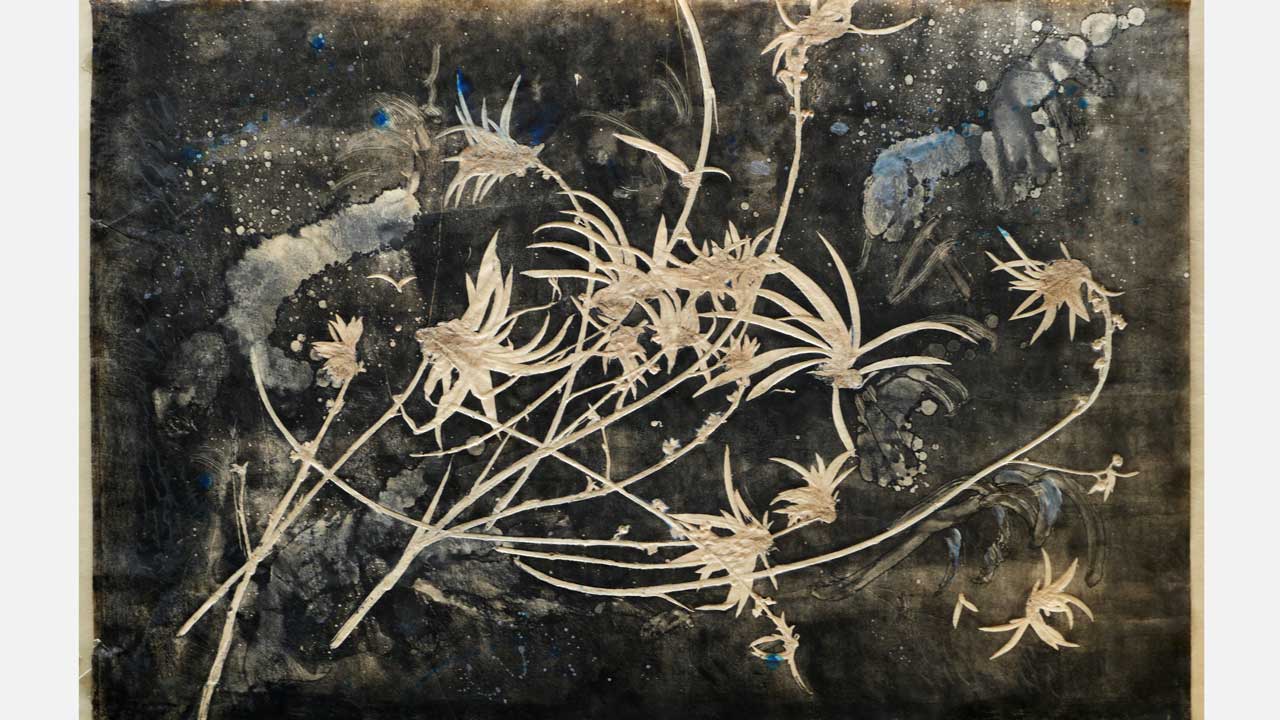
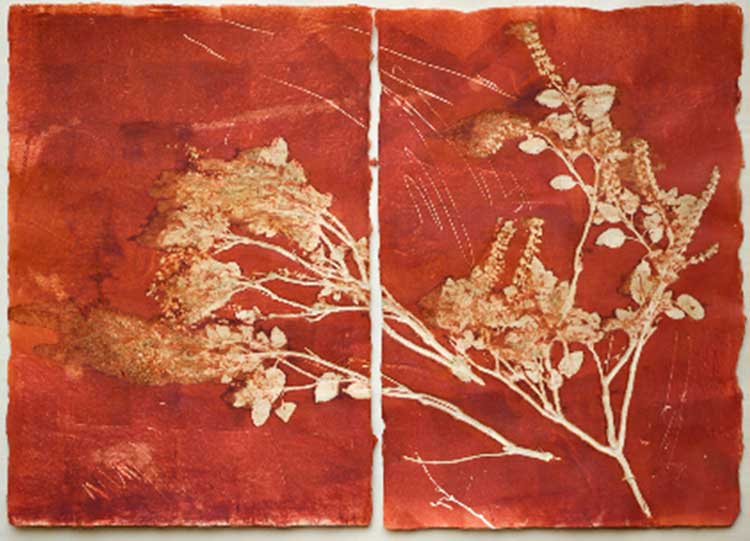
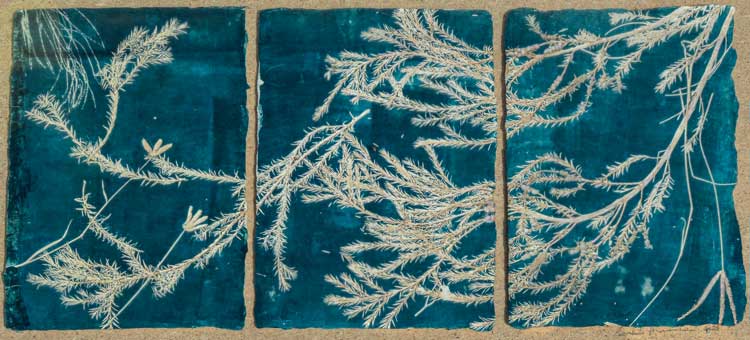
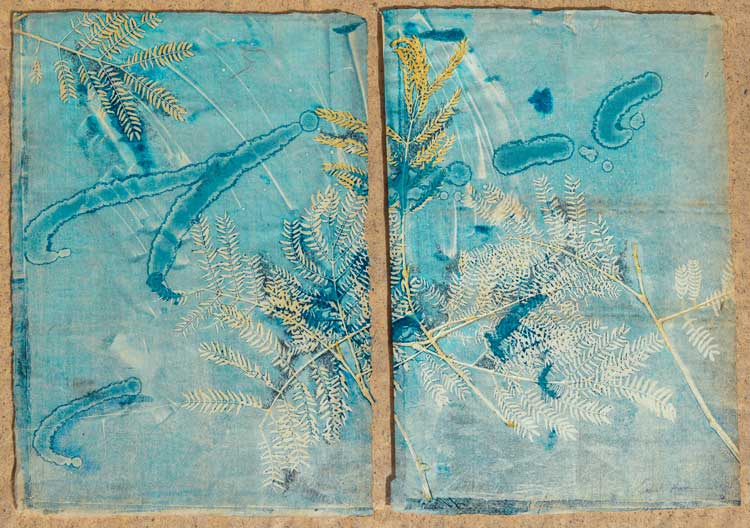
Like tidal ebb and flow or musical call and response, Husain’s work transitions from the fieldwork phase of harvesting flowers, leaves, and stems from a real garden to creating art with the raw material in the studio. We see botanical material in white silhouette laid on paper. Washi paper allows laser-sharp outlines to be created on the paper. The fine edges of bipinnate and serrated leaf forms leave crisp outlines. The background of the paper is coloured and provides a foil to the blank white spaces created by the shape of plants.
Against the stained backdrop, the outlines of willow branches, cannabis, bamboo, amaltas, and gulmohur leaves are clearly identifiable as are grass, quisqualis, and vinca flowers. The plant material is placed individually as well as overlaid to create highly complex compositions.
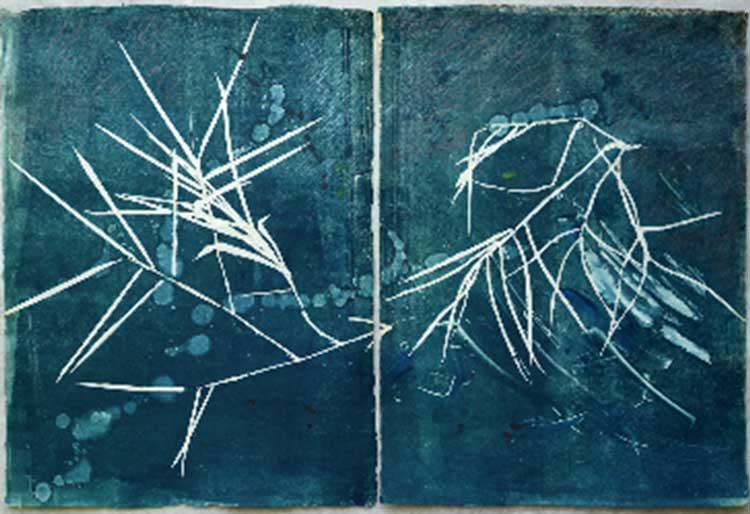
Husain has added minimal marks to the background. This accentuates the plant silhouettes and also creates ambiguity. The plant impressions are so prominent in their whiteness that they seem like the main subject of the painting; and yet they can equally flip roles with the backdrop to represent negative space as there is no mark making within their silhouettes.
The space is white but not empty. According to the principle of Ma, this unusual space becomes a realm of possibilities. It is interactive and interpretative. It is exactly like the enclosure of the garden in which Husain ruminates during lockdown. It becomes an intermediate realm between the domestic confines of the house and the public space beyond the garden’s boundaries.
Sabah Husain’s solo show, ‘Gardens of Memory’, showed at Chawkandi Art from the 15th to 24th October, 2025.
Title Image: Chlorophytum, evergreen spider plant (diptych part 2), kozo and gampi fibers, drawing, painting and printing with organic dye and oil-based paints on handmade paper, 35 x 23 inches each, 2021.
All images are courtesy of the artist and Chawkandi Art.
Nusrat Khawaja

Nusrat Khawaja is an independent researcher, curator, and landscaper. She writes on art and literature. She is a member of the Karachi Biennale Discursive Committee.


There are no comments