
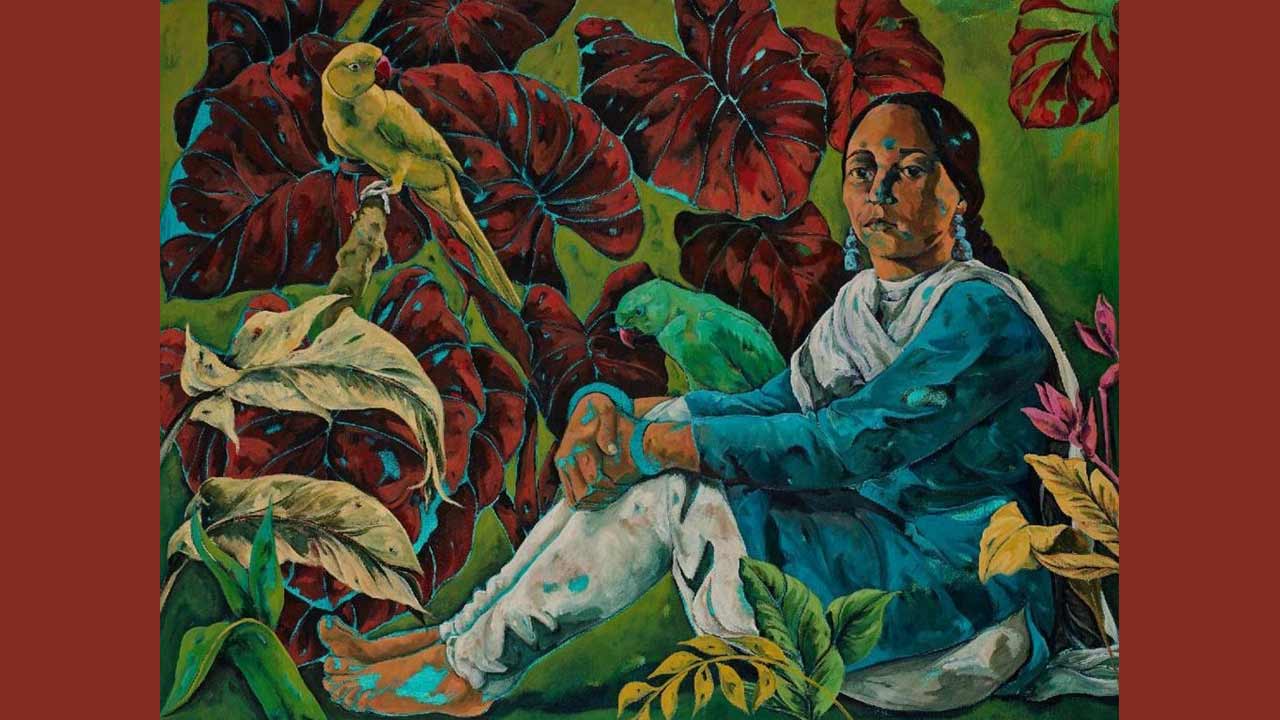
The women in Farazeh Syed’s paintings come to us from colonially produced and disseminated photographs that never intended to tell the subjects’ real stories. Syed’s exploration of this history is presented in her solo exhibition, All the Women in Me. . The exhibition draws on nineteenth-century ethnographic photographs produced under British colonial projects such as The People of India (1868–75), 1 an eight-volume ethnologic study containing 468 annotated photographs, compiled by John Forbes Watson and John William Kaye.2
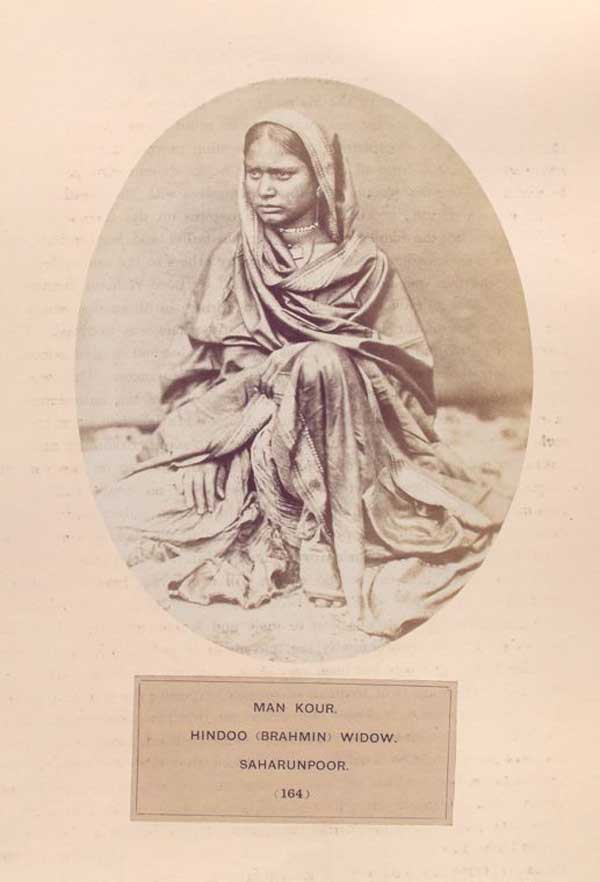
Art historian and anthropologist Christopher Pinney has argued that colonial photography functioned as a classificatory device, where props, light, and pose were carefully arranged to render bodies legible in categories of caste, tribe, occupation, and race.3 Colonial photographic albums sorted Indian women into fixed types, with a particular fixation on nautch girls and courtesans. These images were distributed through popular postcards across Britain and Europe.
The artist’s intervention begins at this convergence of classification, sexualisation, and surveillance encoded within the colonial image. Working on wasli and drawing on iconography that belongs to the same period as her subjects, the work carries an intimacy and specificity that situates it firmly within the history it engages.
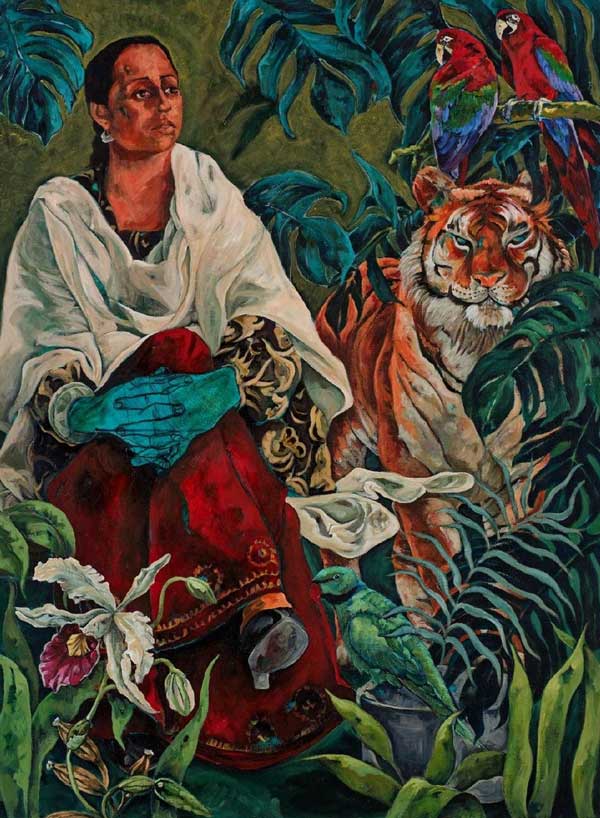
In the dense composition of All the Women in Me I, a seated woman occupies the foreground, her body angled slightly away, and her hands resting in her lap, with a gaze that appears disengaged from the viewer. The artist anchors this painting in personal history by including her grandmother4 in the frame. Her attire is painted in deep earthy reds and muted creams—hues that feel both painterly and lived in. A tiger emerges from thick foliage beside her, with a body rendered in glowing amber and burnt sienna and stripes cutting through the surrounding greens. Two parrots perch above, their feathers alive with flashes of crimson, cobalt, and acid green.
The tiger carries a sense of strength and authority, while the parrots, iconography familiar within South Asian visual traditions, suggest voice, repetition, and desire. Attention shifts away from the woman as the primary site of the viewer’s gaze and toward the animals. The forms mould the space around the figure, becoming part of how she exists within the painting, rather than the animals simply acting as her companions.
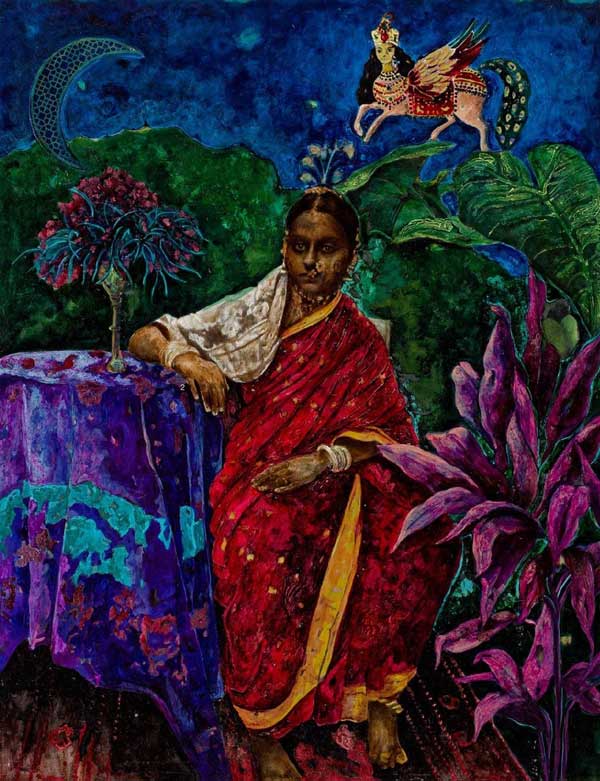
Farazeh Syed’s works on wasli, such as All the Women in Me XV (2025), are constructed as collages and drawn from ethnographic documentation produced under the British. Where All the Women in Me I is immediate and relational, the wasli pieces operate through layering and mediated observation, creating a distance between the subject and the viewer that differs markedly from the grounded presence of Farazeh’s familial portraits.
Art historian Griselda Pollock has written about the “spaces of femininity”, where women are often represented within controlled interiors or symbolic enclosures.5 For Pollock, the setting in which a woman appears is not separate from her position within the image; it can determine how she is seen and the kind of subject she is allowed to be. Farazeh expands these spaces. Her women inhabit environments that are lush, excessive, and alive. These are not neutral settings but active fields that resist containment.
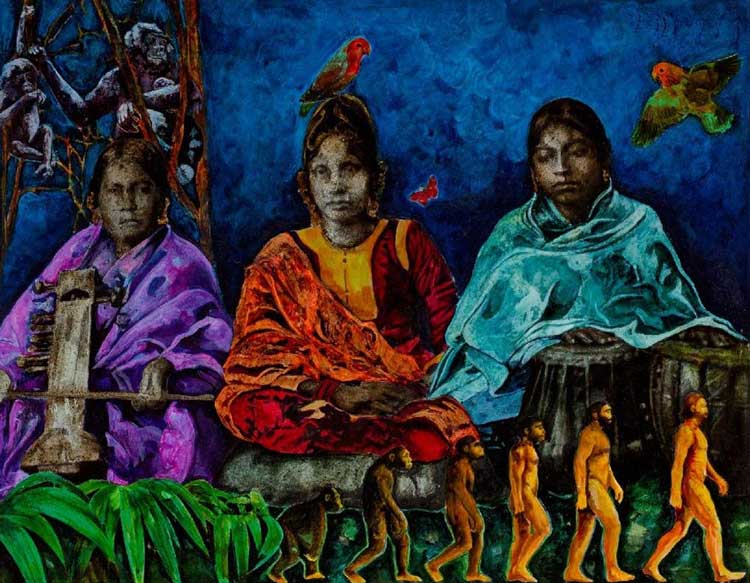
In another piece, All the Women in Me IX (2025), the structure shifts as the work brings three women and their aligned bodies together, with their faces drawn from archival photographs. The expressions of the women remain subdued as their eyes carry a distant and unsettled quality. Yet the image refuses to leave them in that state. Their garments are painted in vivid, saturated hues. One figure is wrapped in a rich violet, another in a glowing vermilion, and the third in a cool, pale turquoise that catches light softly.
I take these paintings as acts of care extended toward women, whose lives have been reduced to archival images. The foliage, animals, and colours the artist works with are worlds these women inhabited; however, they cannot fully reveal the extent of those realities. This impossibility of truly recovering these women’s histories is part of what makes the work compelling. The paintings do not restore a lost history so much as reveal how much has been lost. Farazeh’s paintings return the women to environments, histories, and forms of beauty that the colonial archive could not and did not record. In doing so, she shifts our perception from how these women were once classified under colonial rule, to what it means to represent them now.
Title image: All the Women in Me VII, acrylics, inks and collage on wasli, 2025
‘All the Women in Me’ was exhibited at Canvas Gallery, Karachi, from January 20th to January 29th, 2026.
All images are courtesy of Canvas Gallery.
Bibliography:
New York Public Library. “Digital Collections.” Accessed March 31, 2026.
http://digitalcollections.nypl.org/collections/ed948d00-c5fb-012f-238b-58d385a7bc34?page=8
Pinney, Christopher. Camera Indica: The Social Life of Indian Photographs. Chicago: University of Chicago Press, 1997.
Pollock, Griselda. Vision and Difference: Femininity, Feminism and the Histories of Art. London: Routledge, 1988. Accessed March 31, 2026. https://search.worldcat.org/title/Vision-and-difference-%3A-femininity-feminism-and-histories-of-art/oclc/1491122948
Shelley, Cameron. “Aspects of Visual Argument: A Study of the March of Progress.” Informal Logic 21, no. 2 (2001): 85–96.
Watson, J. Forbes, and John William Kaye. The People of India: A Series of Photographic Illustrations, with Descriptive Letterpress, of the Races and Tribes of Hindustan. Internet Archive, 2026. Accessed March 31, 2026. https://archive.org/details/peopleofindiaser02greauoft/page/n15/mode/2up
- J. Forbes Watson and John William Kaye, The People of India: A Series of Photographic Illustrations, with Descriptive Letterpress, of the Races and Tribes of Hindustan (Internet Archive, 2026), accessed March 31, 2026, https://archive.org/details/peopleofindiaser02greauoft/page/n15/mode/2up.
- New York Public Library, ‘’Digital Collections’’, accessed March 31, 2026. digitalcollections.nypl.org/collections/ed948d00-c5fb-012f-238b-58d385a7bc34?page=8
- Christopher Pinney, Camera Indica: The Social Life of Indian Photographs (Chicago: University of Chicago Press, 1997)
- Farazeh Syed, interview by the author, February 2025.
- Griselda Pollock, Vision and Difference: Femininity, Feminism and the Histories of Art (London: Routledge, 1988) https://search.worldcat.org/title/Vision-and-difference-%3A-femininity-feminism-and-histories-of-art/oclc/1491122948
Zunera Rashid

Zunera Rashid is a multidisciplinary artist and writer based in Karachi. Her practice explores found paper and its material and historical possibilities, drawing on textures and histories of Karachi’s paper markets to examine representations of women and femininity. Alongside her visual practice, she writes on contemporary art and culture and facilitates collage-making workshops. Her research on Karachi’s paper markets has been published in the Urban Repository Archive in collaboration with the Art South Asia Project. She has exhibited at VM Art Gallery, Sambara Art Gallery, and Koel Gallery.
There are no comments