
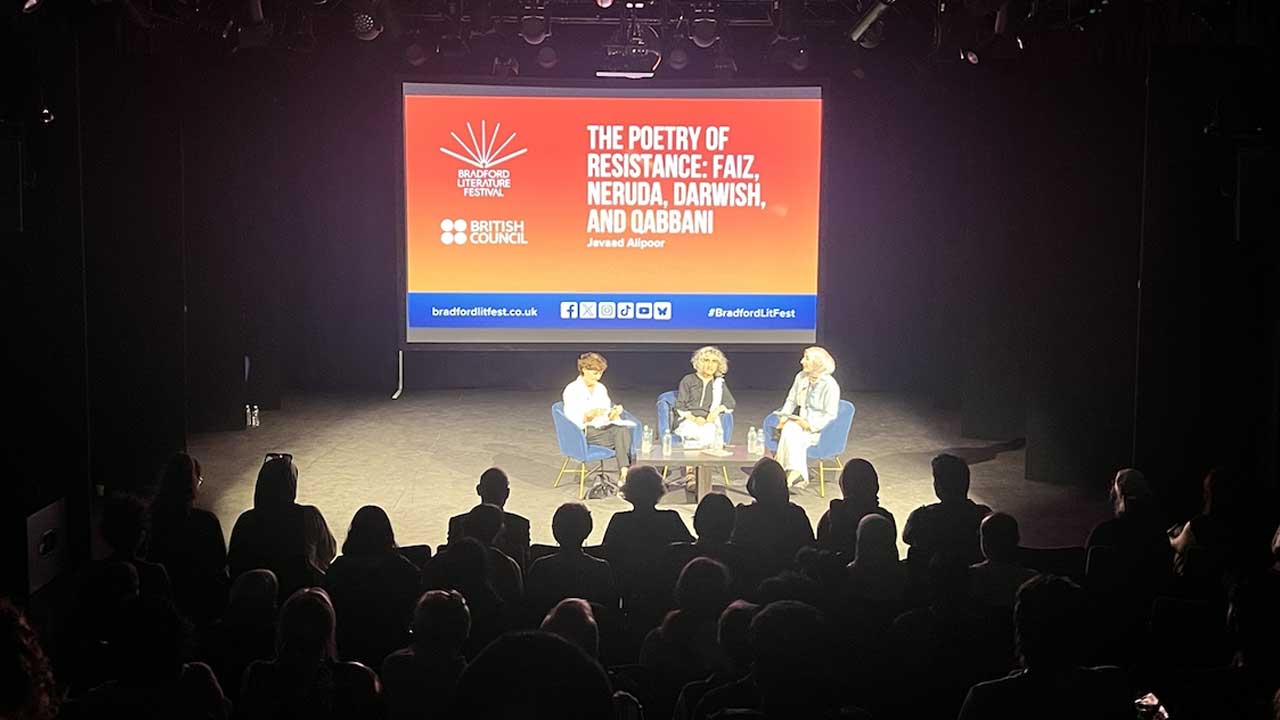
In the summer of 2025, I wandered beneath the large white marquee of the Bradford Literature Festival in the UK, browsing new books, exploring exhibitions, and attending a few talks and lecture performances.1 The most captivating session was “The Poetry of Resistance: Faiz, Neruda, Darwish, and Qabbani,” chaired by the British journalist Remona Aly2, with panellists Prof. Amina Yaqin, a British Pakistani academic in World and Postcolonial Literatures, and Alexandra Pringle, a former editor-in-chief at Bloomsbury Publishing.
I developed a fondness for Urdu poetry at a young age, although it was initially limited to listening to ghazals from India and Pakistan, an activity my peers and schoolmates found inexplicably premature. During my university years, I sporadically read poets and writers, including Ghalib, Faiz Ahmad Faiz, Munir Niazi, Habib Jalib, Parveen Shakir, Ahmad Faraz, and Jaun Elia, drawing from my father’s extensive shelves of poetry and prose. Their depth revealed itself much later, when I began to explore their verses thematically. By the time I was to recognise the seriousness of their poetic craft, I was on the other side of the lecture dais, teaching my students and simultaneously learning from them. In this sense, I remain a late, though earnest, convert. Still, I can’t recite the poems by heart, but I understand the meaning-making behind them.
In contrast, my familiarity with poets like Nizar Qabbani, Mahmoud Darwish, and Pablo Neruda was largely impressionistic—encountered in anthologies, public recitations, and fragments of cultural memory rather than sustained reading. Having immersed myself in the visual arts since beginning university and later in writing, I had long followed visual artists, designers, and fiction writers more closely than poets. Consequently, I approached these figures with genuine curiosity and intellectual enthusiasm, hoping to understand them through dialogue and to draw comparisons for future reference. Although these poets wrote in different languages and regions, all emerged from societies influenced by the aftermath of empire; yet their poetic responses reveal markedly different post-colonial conditions—ranging from the disappointments of independence to the persistence of occupation and exile. The most common alignment I found was that lyric poetry is characterised by a single speaker expressing intense personal emotion. A form of poetry that gives voice to personal emotion, memory, or reflection, typically spoken in the first person. For poets like Faiz, Darwish, Neruda and Qabbani, the lyric became a vessel for something larger than the self—love, grief and longing entwined with exile, occupation and political defiance.
By placing Faiz at the centre, I can see how poets spanning Chile, Palestine, and Pakistan mastered the art of “the soft revolution.”
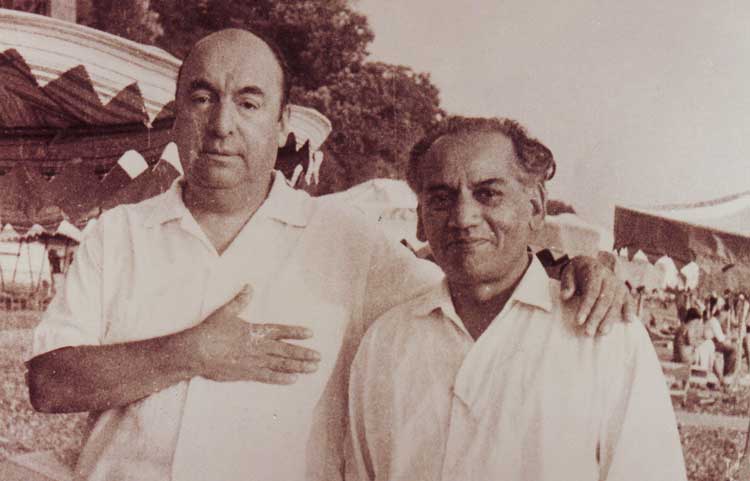
Faiz Ahmad Faiz (1911–1984) remains one of South Asia’s most influential modern poets, situated within anti-colonial struggles and postcolonial political turbulence. His poetry blends classical Urdu forms with a politics of solidarity that refuses to separate personal affection from collective suffering. Faiz’s relationship with these poets was rooted in an intellectual camaraderie and shared struggles. He and Pablo Neruda were contemporaries and fellow travellers in anti-colonial and humanist literary circles. Faiz often praised Neruda in editorial writing and championed his work in Lotus, the Afro-Asian journal he edited.3 Faiz and Mahmoud Darwish were close friends, forged in the crucible of exile in Beirut, where they shared poetic and political affinities during Lebanon’s civil strife.4 Although there is no record of direct correspondence between Faiz and Nizar Qabbani, their work was thematically aligned through a mutual critique of social and political repression, and Qabbani’s verse circulated in the same transnational resistance networks that Faiz engaged with in literary forums and diasporic intellectual spaces.
What follows is my attempt to move beyond a narrow view of my own, mapping both the similarities and the fruitful differences among these poets. While their shared courage and commitment place them within overlapping histories of resistance, their differences ultimately deepen our understanding of their distinct poetic paths.
In Beirut, Faiz forged a friendship with Darwish, evident in literary dialogues about the role of the poet during war, which were written and remembered in Darwish’s memoir Memory for Forgetfulness. The text situates Faiz amid the siege as a figure who challenges artists to respond to violence through creation rather than abstraction.5
Faiz’s love poetry and its development demonstrate why the personal becomes political in his works. In Mujh Se Pehli Si Mohabbat (“Don’t Ask for That Love Again”), Faiz starts with a lover’s plea and concludes with a broader awareness of hunger, suffering, and oppression. This individual longing becomes a moral critique of inequality and collective struggle.
A line that crystallises Faiz’s intertwining of love and struggle—especially toward solidarity with Palestinians—appears in his poem Lullaby for a Palestinian Child:
“mat ro bachche, ammī, abbā, bājī, bhaa.ī, chāñd aur sūraj, tū gar ro.egā to ye sab, aur bhī tujh ko rulvā.eñge, tū muskā.egā to shāyad, saare ik din bhes badal kar, tujh se khelne laut ā.eñge.”
Don’t cry, child,
If you cry,
mommy, daddy, sister, brother,
the moon and the sun, all
will have you made even weepier.
But maybe if you smile,
They will one day all return
in a different guise
to play with you.6
Here, love becomes interwoven with resistance: comfort in the face of violence is testimony to resilience and collective care. In “Dasht-e-tanhai”, Faiz Ahmed Faiz refuses to retreat from politics into abstract love; instead, love becomes a morally and historically charged modality that sustains ethical imagination amid exile, Partition, and societal injustice. This is evident in lines such as “This was not how I wanted, wished to happen / Not only grief of love, the world is full of other sorrows, heartaches”, where personal longing is inseparable from collective suffering. Faiz acknowledges intimate loss while situating it within broader social realities of death, disease, and oppression, demonstrating that love and grief coexist with ethical awareness. Salman Kureishy, in one of his articles, which appeared in The Friday Times7, notes that Faiz’s revolutionary poetry, including “Hum Dekhenge”, moves between hope and despair, and that Darwish’s later work similarly meditates on exile and resistance without guaranteed triumph.
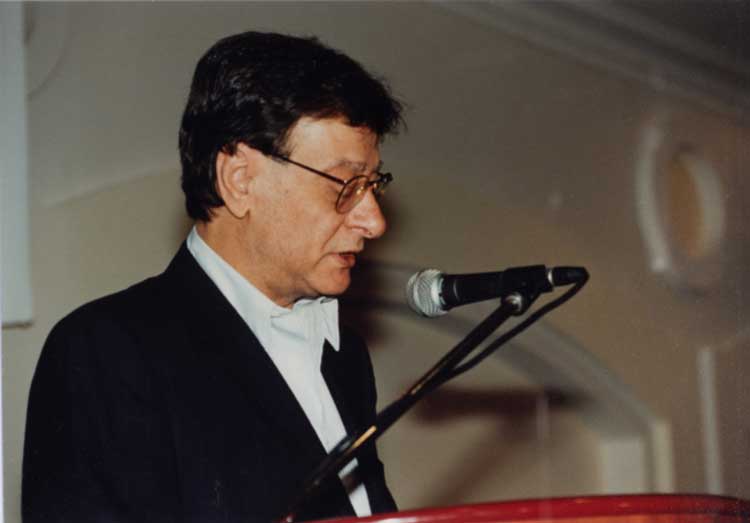
If Faiz’s poetry taught me that love carries political weight, Darwish’s work made clear that resistance defines the world itself. Darwish (1941–2008) became Palestine’s most recognised poetic voice of national consciousness, expressing exile and identity in ways that transformed personal longing into collective affirmation. Darwish’s early poetry, including the now-iconic “Write Down, I Am an Arab,” emerged from the lived experience of military rule and displacement, intertwining love for the homeland with defiance against erasure. His passion as a poet can be fully understood and felt in the 2014 documentary film of the same name, directed by Palestinian filmmaker Ibtisam Mara’ana.8
A stanza from Darwish’s poem “On This Land” resonates as an embodiment of love for life and homeland:
“On this land there is what deserves life: the echo of April,/ the smell of bread at dawn… and the fear of tyrants from memories.”
Shu’un Filastiniyya9 (Palestinian Affairs) and Al-Karmel10 were prominent literary and theoretical magazines that Darwish himself edited and helped found—work that further entrenched him within intellectual networks committed to a poetic politics grounded in identity and solidarity. Yet his catalogue is not purely nationalist. Critics such as Hajar Mahfoodh have shown how his early confrontational tone gradually gives way to a dialogue between homeland and loss, transforming resistance into a poetic language of belonging and memory.
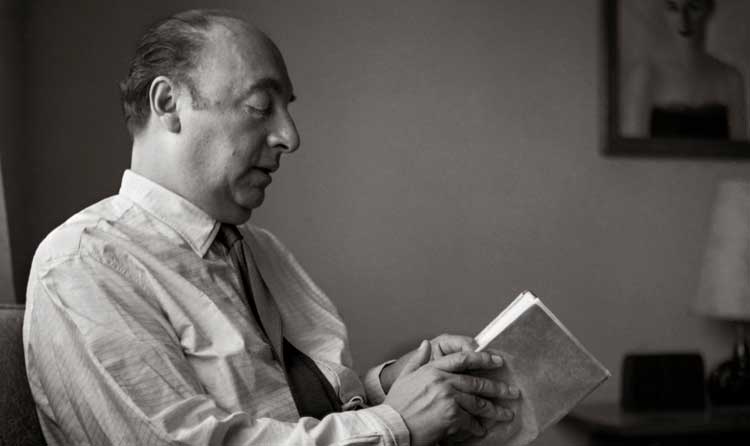
Chilean poet Pablo Neruda (1904–1973) bridges the intimate tone of romantic lyricism with the collective voice of the oppressed, especially in his epic work Canto General (1950), which chronicles the landscapes, histories, and people of Latin America. Here, Neruda writes as a historian-poet, recording the suffering and hopes of a continent under colonial and neocolonial pressures.
Neruda’s individual romanticism, best seen in works like Twenty Love Poems and a Song of Despair (1924), coexists with an impassioned political poetics. The shift in his oeuvre from personal to collective reflects a movement towards interwoven love—love for the beloved and love for humanity as a universal subject and agent of historical change.11
In her book Faiz Ahmed Faiz: Urdu Poet of Social Realism, Estelle Dryland explores that their “friendship” wasn’t just ideological; they were comrades in the global Progressive Writers’ Movement. They famously crossed paths in international circles, most notably during the Lotus Magazine years and the Afro-Asian Writers’ Bureau. Neruda once famously remarked that while he was a poet of the “rugged earth,” Faiz was a poet of the “soul’s struggle.”12
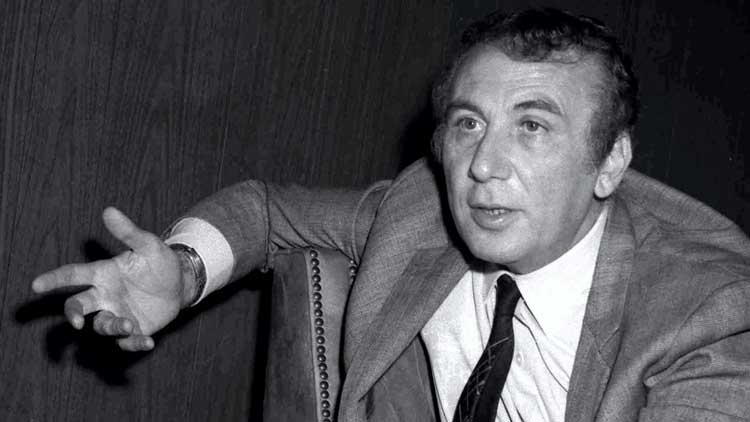
The Syrian poet Nizar Qabbani (1923–1998) received little attention from the panellists, prompting me to research him more, a poet who made erotic language a tool of social and political critique. He is often introduced through his romantic verse, which celebrates sensuality and desire, but his work develops into a critique of social conservatism, authoritarianism, and gender inequality. Critics like Sabry Hafez have identified Qabbani’s role in democratising poetic expression across the Arab world and in using the language of love to challenge social norms and political restrictions.13
Though no archival record confirms a direct exchange between Qabbani and Faiz, their poetics speak the same language. In Qabbani’s Footnotes to the Book of the Setback (1967), a translated line by Abdullah al-Udhari that gestures toward collective resistance reads:
“You will break our chains. Kill the opium in our heads, Kill the illusions.”14
Here, love’s urgency becomes a demand—for speech, for freedom, for change.
Attending this talk made clear that these poets share a poetic grammar in which love becomes resistance and resistance becomes a form of intimate, affective belonging. Faiz’s integration of tenderness into political coalitions, Darwish’s framing of homeland as a site of beauty and struggle, Neruda’s epic humanism, and Qabbani’s critique through desire all extend the idea that poetry can be a language of moral vision, a language that carries within it a sense of right and wrong, where every image, every metaphor, is quietly taking a position.
This comparative approach challenges reductive readings of poets as fixed to their national literatures; instead, it situates them in translocal networks of anti-colonial, anti-authoritarian, and pro-peace imaginaries. Conversations such as The Poetry of Resistance remind us that poetry is a living practice that can animate solidarity, nurture resilience, and imagine peace.
The Bradford Literature Festival 2025 took place from Friday, June 27, to Sunday, July 6, 2025.
Title image: Photo Credit © Aarish Sardar
(Urdu and Arabic verse translations by Google Language Model.)
- Bradford Literature Festival, “The Poetry of Resistance: Faiz, Neruda, Darwish, and Qabbani,” event listing, https://www.bradfordlitfest.co.uk/event/the-poetry-of-resistance-faiz-neruda-darwish-and-qabbani/.
- Remona Aly, journalist and broadcaster, https://remonaaly.com.
- Salman Kureishy, “Faiz Ahmad Faiz, Pablo Neruda: Poets of Resistance, Humanity, Struggle, Justice,” The Friday Times, 20 November 2025, https://www.thefridaytimes.com/20-Nov-2025/faiz-ahmad-faiz-pablo-neruda-poets-resistance-humanity-struggle-justice.
- Arab News, on Faiz and Darwish’s friendship in Beirut, https://www.arabnews.com/node/2458601.
- Mahmoud Darwish, Memory for Forgetfulness, trans. Ibrahim Muhawi (Berkeley: University of California Press, 1995).
- Lullaby for a Palestinian Child,” translation, The Contrapuntal, https://thecontrapuntal.com/lullaby-for-a-palestinian-child/.
- Salman Kureishy, “The Arc of the Moral Universe Bends Towards Justice: Faiz, Darwish Respond,” The Friday Times, 21 October 2025, https://www.thefridaytimes.com/21-Oct-2025/arc-moral-universe-bend-towards-justice-faiz-darwish-respond.
- Write Down, I Am an Arab, dir. Ibtisam Mara’ana (2014), IMDb, https://www.imdb.com/title/tt4019184/.
- Shu’un Filastiniyya (Palestinian Affairs),” Palestine Archive, https://www.palarchive.org/index.php/Detail/objects/252617/lang/en_US.
- Al Karmel,” Wikipedia, https://en.wikipedia.org/wiki/Al_Karmel.
- David Anderson, The Epic of Latin America: Reading Neruda’s Canto General (Austin: University of Texas Press, 2007).
- Estelle Dryland, Faiz Ahmed Faiz: Urdu Poet of Social Realism (1911–1984), Google Books, https://books.google.co.uk/books/about/Faiz_Ahmed_Faiz_1911_1984_Urdu_Poet_of_S.
- Sabry Hafez, A History of Arab Poetics (Cambridge: Cambridge University Press, 2005).
- Nizar Qabbani, Footnotes to the Book of the Setback (1967), trans. Abdullah al-Udhari, Critical Muslim, https://www.criticalmuslim.io/footnotes-to-the-book-of-the-setback/.
Aarish Sardar

Aarish Sardar is an Associate Professor (on sabbatical) at the Department of Visual Communication Design of Mariam Dawood School of Visual Arts and Design, Beaconhouse National University. He holds a BFA in Fine Arts (2000), MA in Multimedia Arts (2003) from the National College of Arts, Lahore and an MA in Communication Design from Kingston University London (2006). He has worked as a communication designer & a multimedia consultant with clientele inter(nationally) from the USA and the UK to Pakistan and beyond. Aarish regularly writes for inter(national) newspapers and magazines includonb “The News on Sunday”, “Dawn”, “Friday Times” “ICONICA Magzine” (Pakistan) and Arte Morbida (Italy) on Arts & Culture and Travel.

There are no comments