
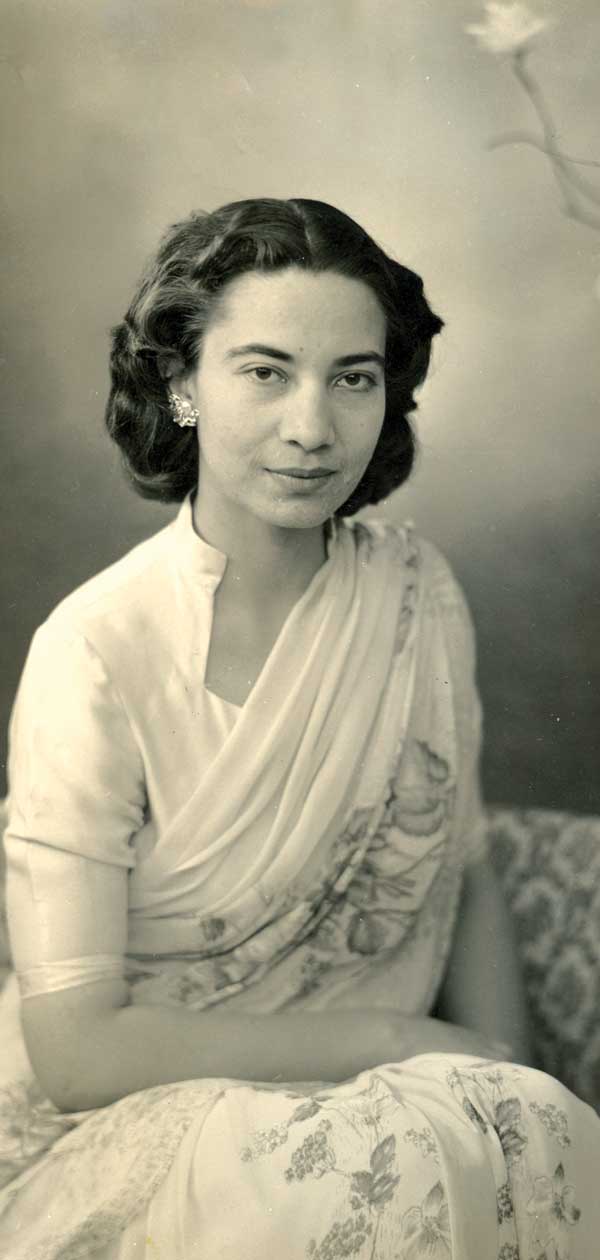
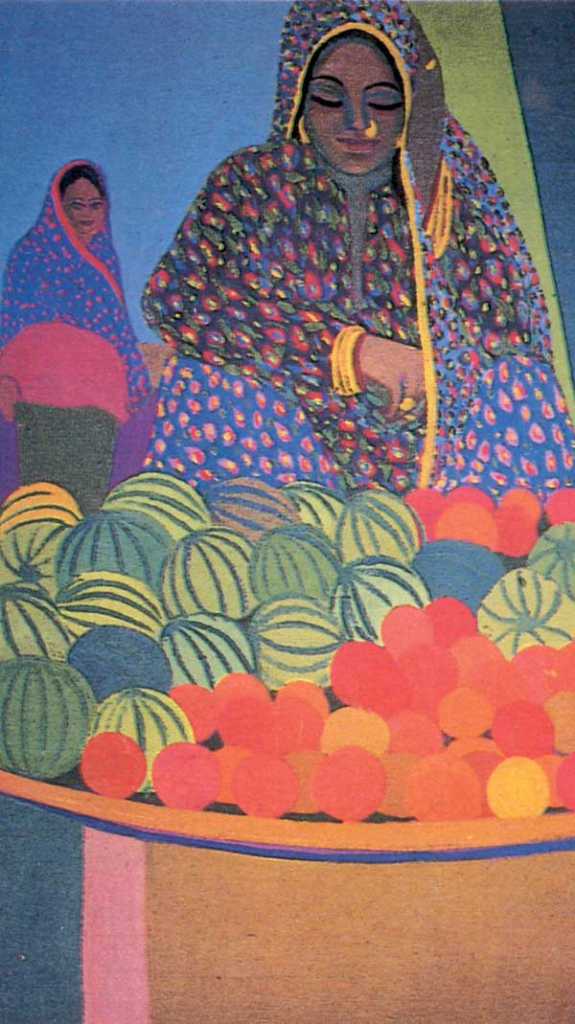
Early in the year we lost the last of the pioneers, whose oeuvre defined the earliest phase of transition of Pakistani art to Modernism. Miriam Habib was an integral part of Lahore’s artistic and cultural fabric where, in the 50s and 60s, artists like Shakir Ali and others converged to address the challenges that faced the young nation in search for a new vocabulary of art. A student of Anna Molka Ahmed, Miriam Habib was one of the two women painters in the Lahore Artists’ Group, in the mid 50s, along with Razia Feroze, Ahmad Pervaiz, Shemza, Ali Imam, Moyene Najmi, and Safdar whose inspiration stemmed from Shakir Ali’s exploration of Modernism.
Her close proximity to the early developments both as a participant and observer are documented in her writings, providing an invaluable resource that traces the nuances and turning points of the early years of art-making in Pakistan. She wrote extensively, especially on the work of Shemza. An incomplete project that remained her last: a book on the life and work of Shemza, which she was unable to complete due to a sudden illness that was to eventually take her life. She wrote in depth, also on Anna Molka’s life, providing an insight on Molka’s personal struggle while battling with the administration of the Punjab University and her tireless effort in trying to break gender-related barriers.
Miriam Habib was an advocate for the propagation of grassroots art and for the integration of art to education. Especially devoted on developing art education for children, she convened the Art Teachers’ Forum at the Mayo School (now the NCA), the basis of which was to inject progressive ideas into art education. In 1962, she submitted her dissertation for the Master of Science Degree, State University College at New Paltz, and New York as a Fulbright Scholar. The title of her research was ‘Ceramics in Islam’ and ‘A Plan for a School Program in Pakistan’.
As a founding member of WAF, HRCP and APWA, her passion for human rights was reflected in her deep and continued commitment to human rights, and to social work. The different facets of Miriam Habib’s life, her art, art criticism and social activism were interlinked, reflecting the values of her generation who took the responsibility of defining new structures that would reflect the aspirations of generations to follow.
‘It seems like an attempt to capture the transitory to manifest it as a theme for higher contemplation,’ She wrote for Mary Shemza, before she passed away on January 5, 2007.
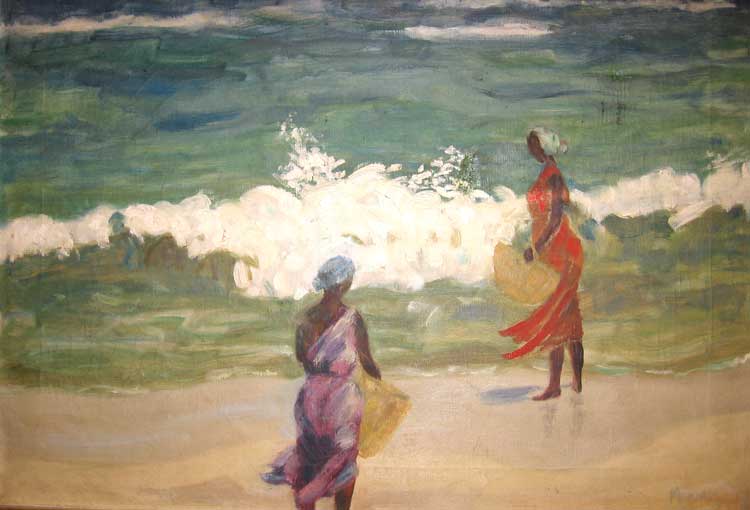
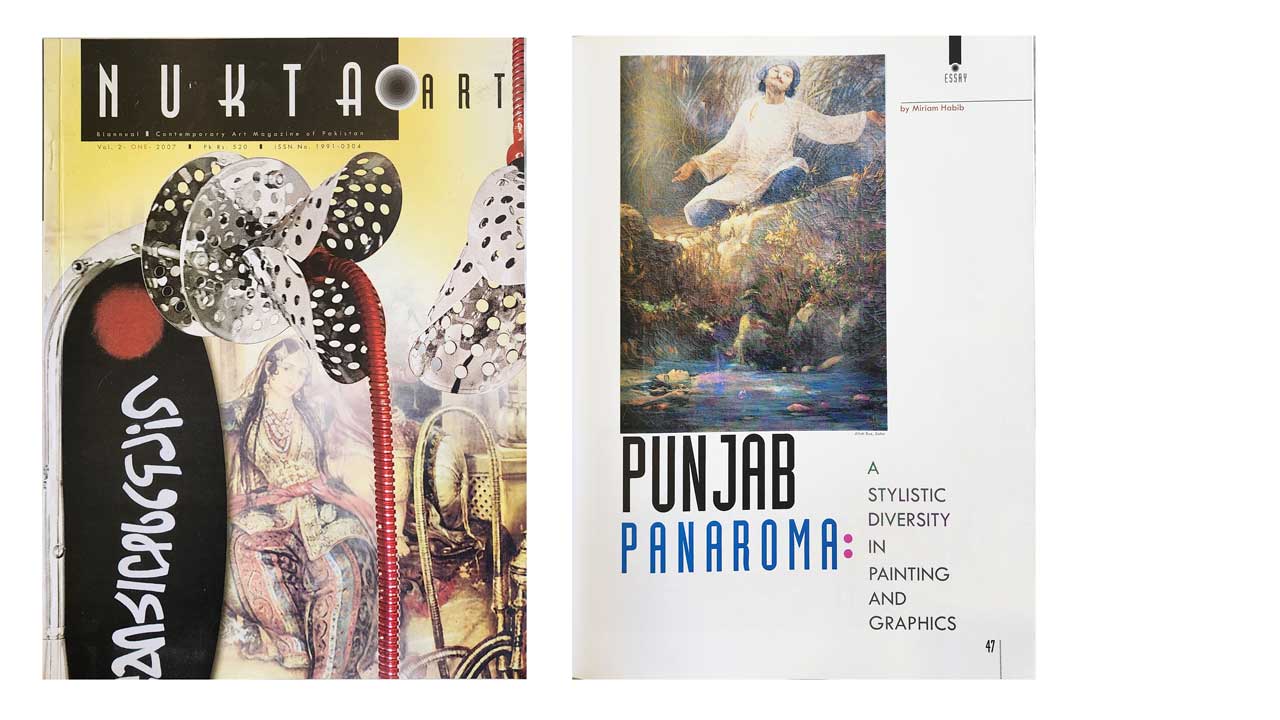
This text was originally written in 1982, some 25 years ago, on the occasion of an important retrospective held in Lahore. NuktaArt is reproducing it as a part of its Art Writing in Retro series.
NuktaArt acknowledges the generosity of the late author’s son, Ali Habib, and daughter-in-law, Mehjabeen Abidi Habib, for permission to reprint this article.
Lush, fertile Punjab has been mother to many an artist, with Lahore, its ancient capital, serving as a cultural hub. Green plains, clear skies, the quiet pace of rural life are the perennial themes for the brush, rendered in moods of varying perception.
The exhibition season starts somewhere in late September when the fierce summer gives way to kinder temperatures, petering out by May’s end as the scorching rays bear down once again. Summer of ’82 was an exception, the nation’s Independence Day on August 14 witnessed the spring of a grand retrospective-cum-contemporary display of paintings and graphics by Punjab artists during the 35 years since independence. It was possible to survey in chronological sequence, under the high roof of the impressive Alhamra Arts Centre, a panoramic view of the leading personalities, the styles and groups that have given the painting landscape its history and character. One-man shows continue through the viewing season as each practicing artist of significance makes a statement on progress and change in his interpretation of the aesthetic experience. The galleries run by pioneer and art teacher Moyenne Najmi, provides a private outlet for the exhibitor as an alternate to the state-managed Arts Councils, and has in the last several months arranged small shows featuring established artists and new hopefuls. The combination and co-operation of both sectors makes for a happy diversification and pluralism to form the basis for a living art expression. Add to these the presence of two flourishing art schools enjoying distinctive traditions, which frequently open to public view the creations of students and staff, and the art lover has a variegated table at which to feast.
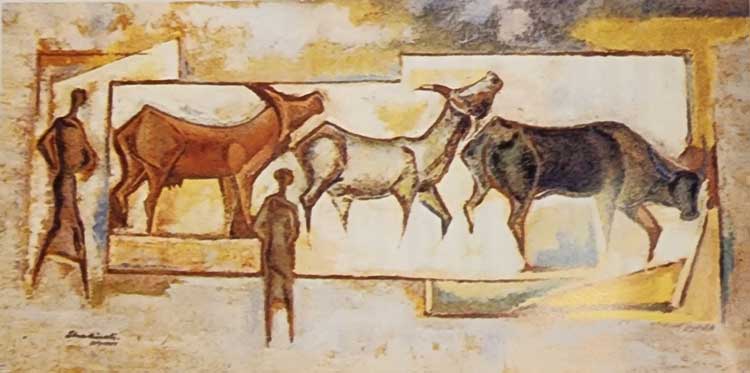
Having said this much it may be admitted that in a young country seeking to enter the contemporary world, old traditions, social and artistic, have been integrated and modified, as influences from West and East make themselves felt in every social concern. Pakistani painting is therefore eclectic, even in its traditional modes. Apart from the Miniature that preserves the techniques and themes from the Moghul epoch, there is no pure style exclusively in possession of this Muslim state that looks to both the Islamic hinterlands and Asia for its heritage.
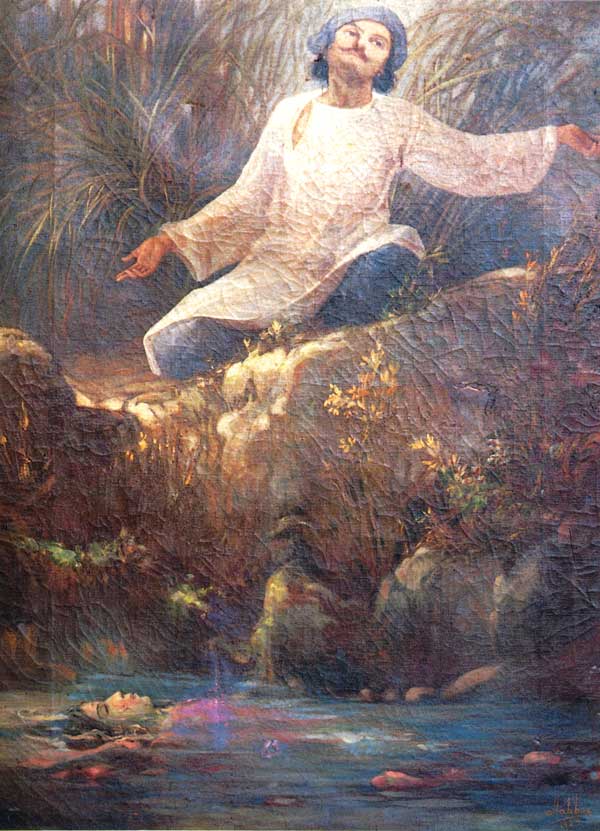
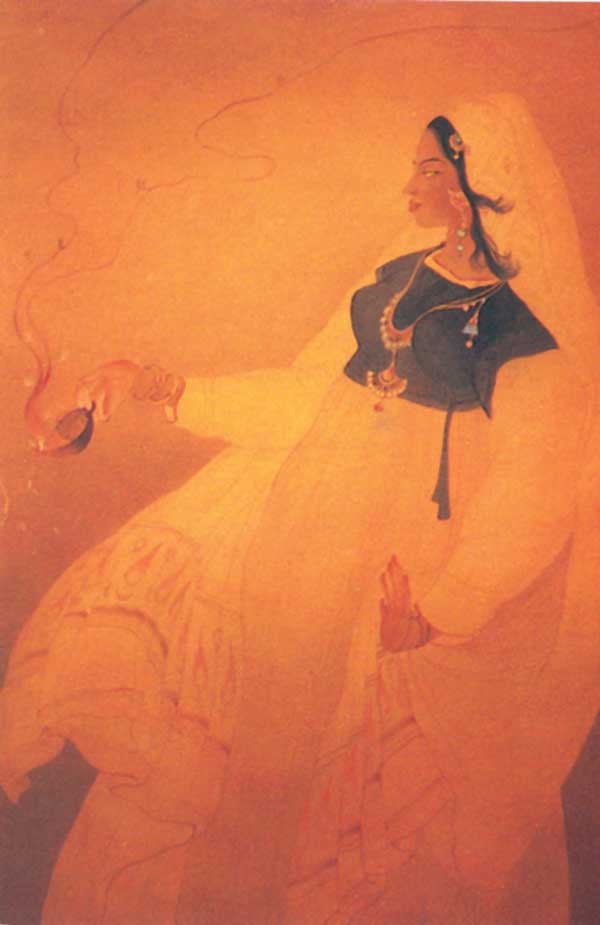
Three departed masters have left a lasting impression on the painterly scene. The diversity of approach can be gauged from the specimens of the female figure. The eternal Master, Abdur Rehman Chughtai, unique in his imagery and the subtle tones of his graduated water colour washes has bequeathed a legacy of several thousand paintings and etchings now housed in a private museum managed by his heirs since his death in the 70s. Lyrical in coloration, his forms are designed in flowing lines, and literary symbols such as the lamp and nightingale import a depth of meaning. He has many imitators, but no equals in Pakistan. His individualized style goes by the generic term: “Chughtai Art”. The late Allah Baksh was another veteran artist, prolific in an altogether different mode, who migrated to Lahore before Independence to set up a studio and found a school. Using oils and gouache, he turned out canvases of rustic life, peasant festivals and typical portraits of beloved folk heroes and heroines; his treatment in a realistic, somewhat idealized manner.
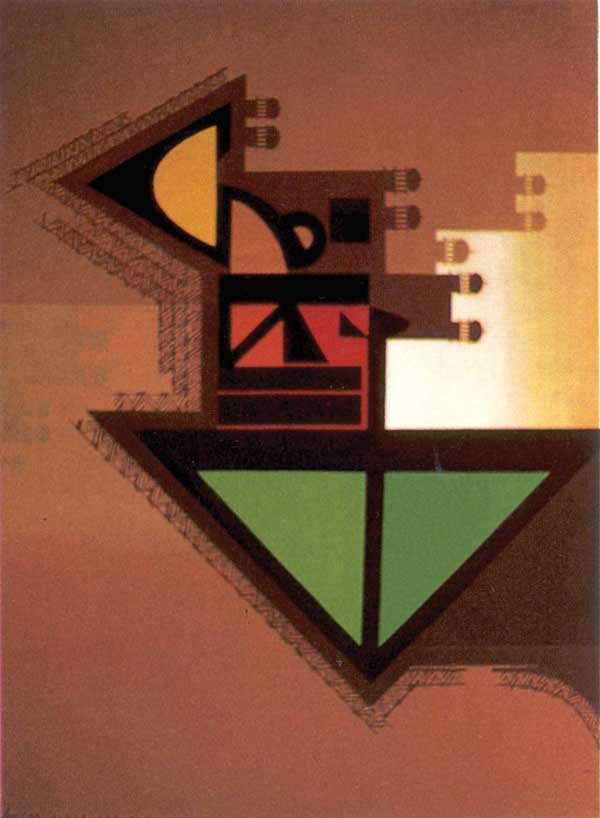
The phenomenon known as Shakir Ali entered Pakistan in the fifties to eventually make Lahore his artistic base. Trained in India and Europe, a Modernist in the international idiom, and as Principal of the National College of Art for two decades, he has made art history. A circle of friends and admirers worked under his inspiration, as he liberated succeeding waves of art graduates from the inhibitions of academic realism. His technique was Western, his content often indigenous. But in the more imaginative abstracted canvases, space, texture, economy and balance become the predominant elements. Landscapes express different interpretations of the physical environment.
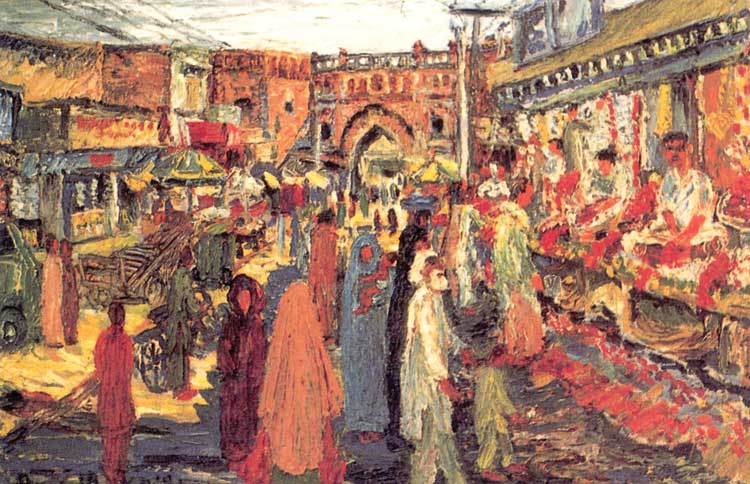
Anna Molka Ahmad, a pioneer art educator and easel painter, employs a light-suffused impressionist language of the brush. Her former pupils, Khalid Iqbal and Ghulam Rasul make their own explorations. The first, trained at the Slade School of Art, uses a fine academic discipline to recreate the mundane landscape into an almost mystical harmony of form, light and colour; the latter juxtaposes flat shapes with satisfying economy.
An entire generation is at work, extending over a wide range of articulation from the avant-garde to those who favour more representational canvases. The credit for keeping the Miniature alive in the Punjab must be awarded to that grand master, the late Haji Sharif and his disciples, who retained the technique of this exacting craft as it were practiced three hundred years ago for the pleasure of the Moghal emperors. A handful of young men have attained proficiency but the problem is one of application and subject matter. A few Miniaturists have experimented with present-day themes, yet the scale and technique seems intrinsically wedded to the content and matter of its heyday – it was a palace-art and today is (more of) a pleasing historical relic than a living (art) form.
By contrast, that beloved Muslim art, calligraphy, has witnessed unprecedented efflorescence. The classical masters of pure forms are coming into their own in a climate of Islamic Cultural renaissance. However, a fascinating development is calligraphy as expressionism, as abstraction, as Modern painting. Classic and free forms embodying Quranic texts are integrated into two dimensional compositions. An entire community of painters has adopted the genre as an artistic vehicle, though not always with aesthetically well realized results. Aslam Kamal is among the best-known practitioners of creative calligraphy and winner of awards in this category.
Artists of the Punjab function within an ambience of curiosity and courage, pursuing with vigour the ongoing process of growth and communication, that is painting.


There are no comments