

Schahbaz’s exhibition, The Garden, curated by Jasmine Wahi is currently showcased at the Museum of Contemporary Art (MOCA) in North Miami. The exhibition is a cross section of the artist’s practice from the last fifteen years, with over seventy works – some rooted in the style of Persian miniature paintings i.e illuminated manuscripts, and some that depart from the traditional scales. The visuals in her works refer to the four mundane elements—earth, fire, air, and water—with a touch of fantasy expressed through Eastern and Western mythological creatures such as dragons, mermaids, and unicorns.
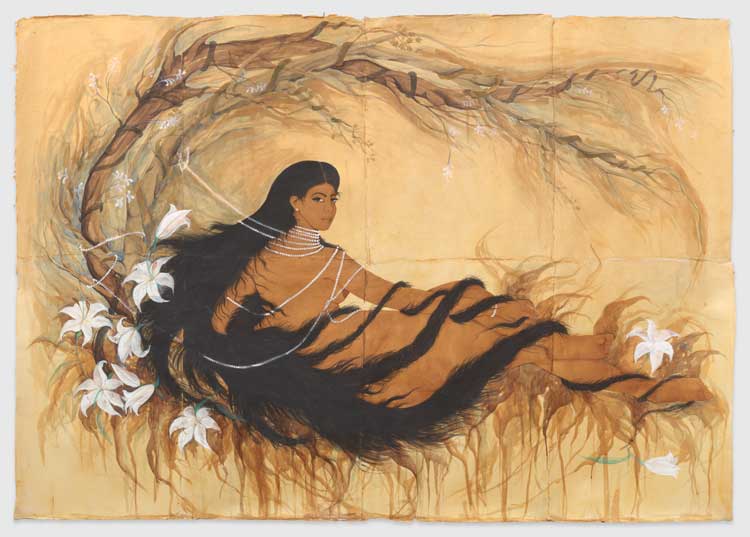
One of the paintings included in the MOCA exhibition is Self Portrait as the Grand Odalisque (2016), named after Ingres’s nineteenth century painting of the same name. In her sepia-toned reinterpretation of the controversial Orientalist painting, the artist portrays herself in a pose inspired by the original. However, unlike Ingre’s figure that is inside a bedroom with abundant items and patterns representing the Eastern harem, the artist chose to situate herself in an obscure landscape with overhanging tree branches. The figure has dark hair, extending like fire around her, and pearls that envelope the body. While creating the work, Schahbaz found it difficult to hold the pose, which highlights the limits of the body and the role of imagination in art.
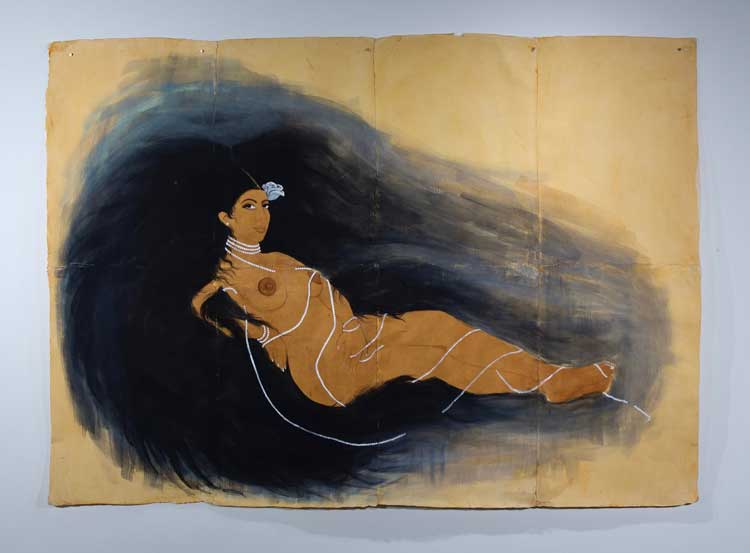
Schahbaz has painted various such paintings inspired by historical Western artworks. Another similar work made in the same year is Self-portrait as Olympia, stylised after Manet’s 1963—also controversial— painting. Again, she places herself in the same pose as Manet’s muse but in an unidentifiable space, with a flower reminiscent of the original work tucked in her hair with a string of delicate white pearls coiled around her figure. Schahbaz exemplifies her fascination with the female form, however, the blank backdrops have evolved and developed into mythical surroundings in newer works.
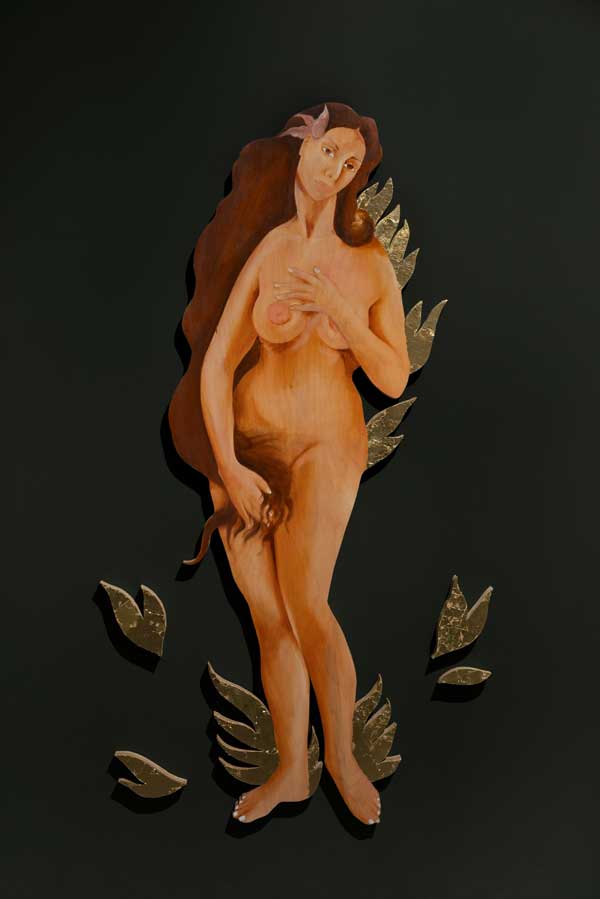
Inspired by Botticelli’s Renaissance masterpiece Birth of Venus (1485-1486), Fire Woman (2023-25) is a life-size oil on wood. Composed of a human-shaped cutout following the contours of Boticelli’s Venus, this painting exemplifies a transition from small intimate miniature paintings to larger-than-life works that she describes as “avatars”. Although their scale is dwarfing, the exuding energy is intended to uplift the viewer. Schahbaz says that viewing her work is like being transported back in time to the various psychological states she experienced while making the paintings. However, she also wants it to serve a purpose besides introspection by providing awe, beauty, and stimulation for her viewers.
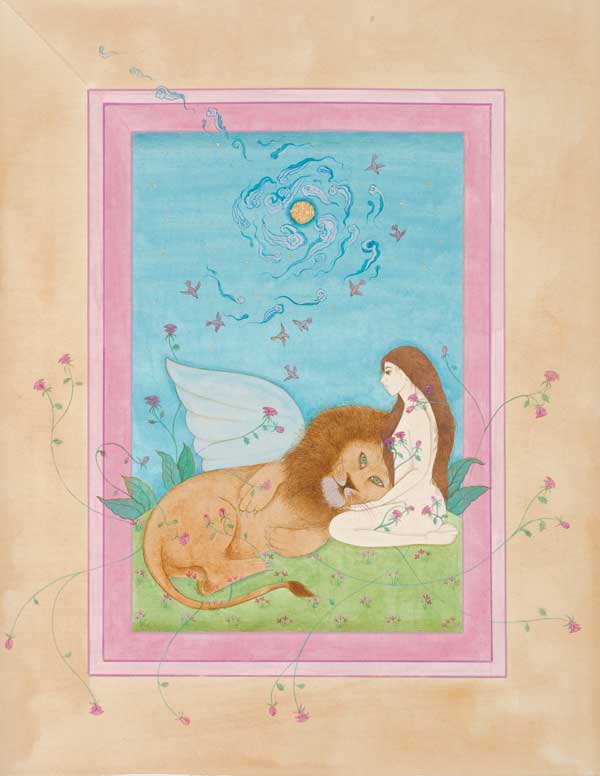
In My Heart (2020) follows a traditional Mughal miniature format. Here, the self-portrait of the artist in profile can be seen on the right, while a winged lion rests in her lap and faces the viewer. Set in a landscape with a blue sky and green grass; a tiny sun marked by gold leaf, pink birds, and clouds appear in a circular formation above the two figures. Dissimilar to Schahbaz’s interpretations of Western paintings, this surreal depiction of an idyllic scene in muted tones requires intimate interaction between the viewer and the painting and conveys a sense of calm that is in defiance of the energy of the larger works.
Many themes arise from Hiba Schahbaz’s paintings, such as the difference in the Eastern and Western representation of notions of beauty through time, the gravity of societal norms, and the implication of culture and art as an escape from reality. An exhibition like The Garden offers a variety of moods and feelings. It is up to the viewer, how they choose to resonate with them.
‘The Garden’ is on display at the Museum of Contemporary Art in North Miami from 5 November until 16 March 2026.
Title Image: Mermaids, watercolour and tea on paper, dimensions variable, 2025. All images are courtesy of the artist.
All images courtesy of, and copyrighted to, the artist.
The interview took place over an online call on January 12, 2026.
Samar F Zia
Samar F. Zia is an artist, curator and writer based in London. Besides being a mother artist and maker, she authors critical essays examining cultural markers such as art and books. Zia holds an MA FA from Central Saint Martins, London and graduated with Distinction in BFA from Indus Valley School of Art and Architecture, Karachi. She regularly contributes to her Alma Mater UAL’s Alumni of Colour Association (AoCA) by curating exhibitions and events. She has been artist-in-residence at the Fitzrovia Community Centre where she curated multiple exhibitions. She is also a Trustee of the Fitzrovia Chapel. Zia is founder of Art Social where she facilitates bespoke creative workshops for youth groups and adults for various institutions across London. Zia regularly exhibits in both Pakistan and the UK. Zia has also participated in art fairs in UK such as the Affordable Art Fair and Fresh Art Fair. Besides being an independent curator and workshop lead, she has worked as Exhibition Guide at the Hayward Gallery. She has served as visiting faculty at Indus Valley School of Art and Architecture, Karachi and taught at Art Academy London.
There are no comments