

The Girl Who Learned from Makers: Early Life and Education
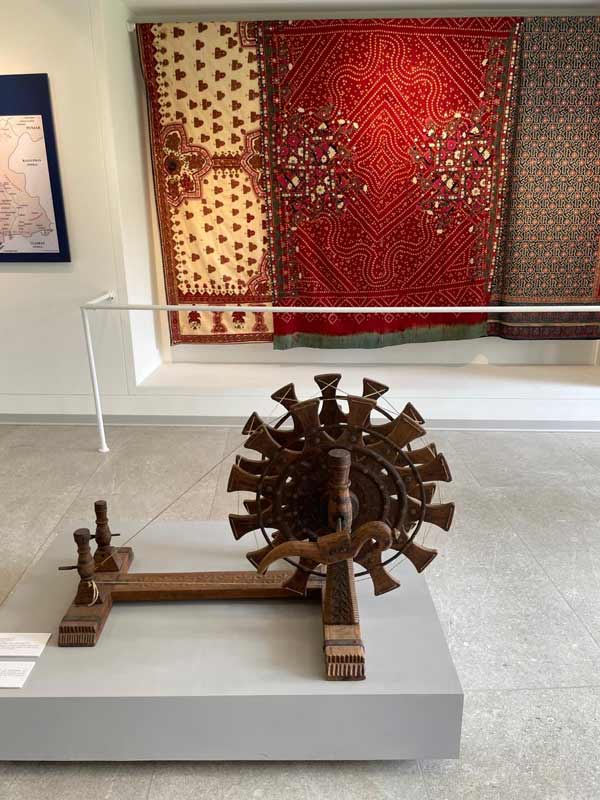
There is a story about a barefoot girl running through villages that encapsulates the philosophy of our textile heritage. Silver anklets announce her arrival at the silversmith’s hut, thread looms hum Kabir Das’s verses, dyers coax rose-pink from crushed petals, and potters sing of impermanence as they shape clay. Time passes. The girl grows and finds herself in a city of noise, smoke, and artificiality. She searches for wedding garments in shops lined with synthetic sequins, glitter, and thick clumsy embroidery. The fabrics are silent, their stories stripped away. Kneeling before her disappearing inheritance, she senses the threads of memory whispering to her: “You forgot the count, child, the warp is eighteen threads per inch, the weft are your matriarchy’s songs. May some girl yet unborn feel phulkari stir in her fingers, pull a needle through time, and hear the gentle whisper: ‘Never let them forget how we loved.’” 1
This elegiac parable mirrors the ruptures that Askari’s life-long work has sought to heal. Nasreen Askari (née Ismail) was born in Karachi in 1950, the youngest of six siblings. Partition loomed large in her family history and left indelible impressions of displacement, memory, and a desire for cultural preservation. She graduated from Karachi Grammar School in 1968 and studied dental surgery at the University of Sindh, Jamshoro, graduating in 1973. During this period, she encountered rural Sindhi dresses with embroidery, motifs, and garments that conveyed information about tribe, religion, marital status, and social identity. After a year as a junior surgeon at Jinnah Postgraduate Medical Centre, she moved to London in 1975 for postgraduate work. Life abroad, including later relocations to Hong Kong and Tokyo exposed her to global art institutions and scholarly practices. In Tokyo, she enrolled at Sophia University to study Asian Art and Civilisation, refining her appreciation for cultural artefacts and deepening her understanding of Pakistan’s textile heritage. 2
A New Path: From Medicine to Textiles to Mohatta Palace
Askari’s professional journey is remarkable for its deliberate shift from medicine to cultural scholarship. A turning point came in London at the Victoria & Albert Museum, when she requested to view the Justice Feroz Nana textile collection from Pakistan. Hidden in metal drawers, the collection awaited a scholar. “Nobody is interested in Pakistan and there is no scholarship,” she was told. Askari did not accept this verdict. Through persistence and fundraising (nearly £150,000), she co-curated Colours of the Indus: Costume and Textiles of Pakistan between 1997-98 with Rosemary Crill at the Victoria and Albert Museum. The accompanying publication of the same name remains foundational to textile studies in the region.
The exhibition was triumph of vision and logistics. Gossamers from diverse regions of Pakistan were displayed alongside texts detailing their social, historical, and symbolic significance. The success of the exhibition sparked renewed interests in the research and preservation of Pakistani textiles, locally and internationally.
In 1998, the Government of Sindh acquired Karachi’s Mohatta Palace, an Indo-Saracenic structure built in 1927 by businessman Shivratan Mohatta. The palace had passed through multiple governing bodies including Pakistan’s Foreign Ministry and Pakistani stateswoman and politician Fatima Jinnah, who resided there from 1964 till 1967. The Palace, later known as Qasr-e-Fatima, was passed to her sister Shireen Bai until 1980, after which it lay abandoned and at risk of dereliction. Askari was invited to help establish a museum of Pakistan’s cultural heritage in the building.
Mohatta Palace Museum opened in 1999 with Askari as founding director. The museum also became a hub for education, hosting lectures, workshops, and community programmes, inspiring a new generation of curators, scholars, and artists. Askari was awarded the Pride of Performance award by the Government of Pakistan in 2008, in recognition of her contributions. Some of the Palace’s landmark exhibitions include:
- Treasures of the Talpurs (1999): Showcased artefacts from Sindh’s royal courts, establishing Mohatta as a site of serious cultural scholarship
- Threads in Time: Costume and Textiles of Pakistan: Explored regional dress across centuries
- Makli: Symphonies in Stone (2018–2020): Examined architectural ornamentation of the Makli necropolis
- Tale of the Tile: Showed ceramics across Pakistan
- Gaj: Colours of the Rainbow (2020–2021): Focused on regional embroidery including minority communities in remote areas
Falak Sayr: A Journey Through the Sky
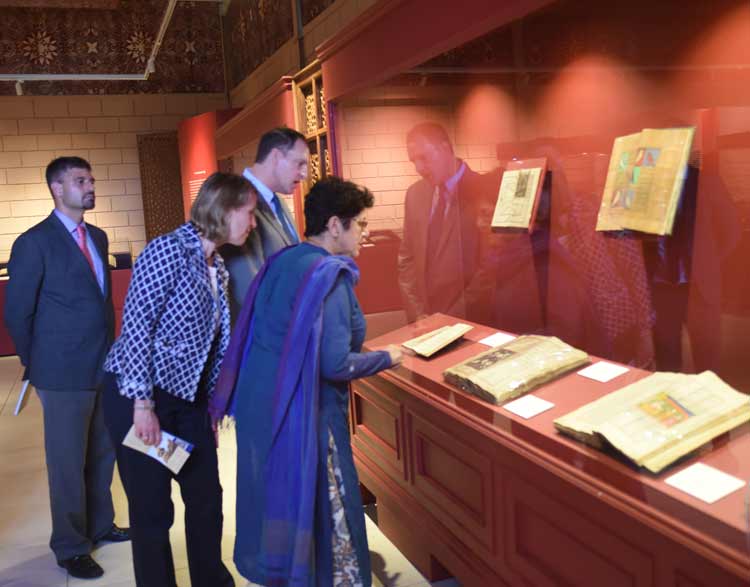
After her retirement from Mohatta Palace in 2025, Nasreen Askari co-curated the exhibition Falak Sayr at The Haveli Museum with Manizhe Ali. The show explores textile traditions of Khyber Pakhtunkhwa and gathers objects from Swat, Kohistan, Chitral, Hazara, and Kohat. From kurtas and shawls to ceremonial garments, the exhibition presents costumes as cosmologies, each piece reflecting a community’s beliefs, environment, and history.
The diversity of techniques here is staggering. Swati embroidery juxtaposes indigo-dyed backgrounds with red silk patterns and creates vibrant rhythmic surfaces. Kohistani jumlos display exuberant layering of threads, while cowrie-laden kupas of the Kalash women incorporate shells, beads, and coins. Phulkari motifs linking the Punjab plains to the mountains demonstrate migration, cultural exchange, and the persistence of narrative forms across geography.3 Each object is displayed with care: panels explain the stitch, region, and the artisan’s intent, while stories of their makers illustrate continuity, loss, and innovation. The Haveli thus serves as the culmination of Askari’s life-long effort to unveil craftsmanship that is often out of sight for ordinary viewers.
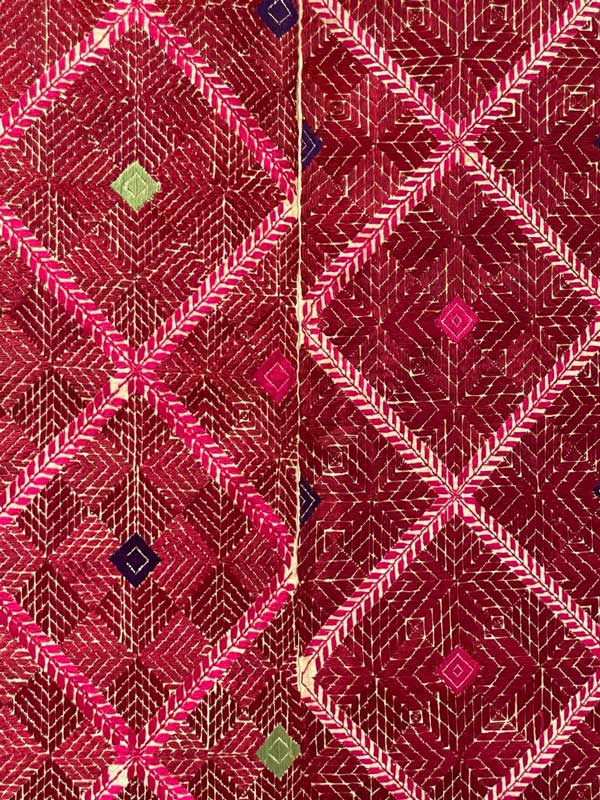
Central to Askari’s scholarship is the recognition that textiles are women’s voices. One memorable encounter, while she was a medical student in Jamshoro, Sindh profoundly shaped her understanding of embroidery as identity. She tells me about her time as a medical student while travelling in Pakistan, where she once asked a mother about her son’s illness. The woman gestured to her embroidered Khosa Baloch chadar that was embroidered with red hibiscus flowers except one black hibiscus which symbolised her dying son and said, “This is my wujood (existence/being), my shanakht (identity).” Then before leaving, she pressed a red embroidered scrap into young Nasreen’s hand. “Give this to your daughter and don’t forget my chadar,” she said. Askari says, she never did.4
Stories like this resonate with the elegy of the phulkari mentioned earlier. Partition, urbanisation, and industrial production severed threads of cultural inheritance. Askari’s curatorial work has consistently sought to reconnect these threads, ensuring that craft knowledge, ritual practice, and narrative artistry remain accessible and meaningful, rather than frozen as museum objects, alone.
Objects as Storytellers at The Haveli
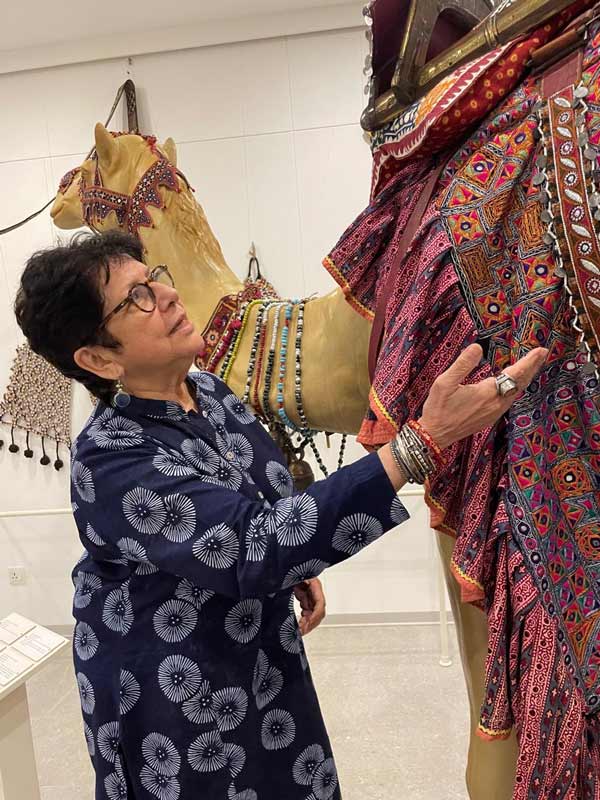
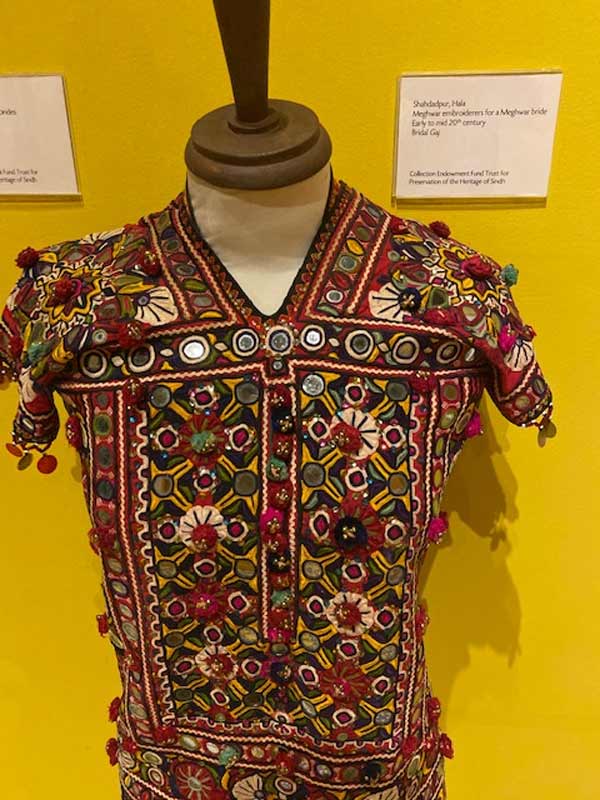
The museum’s collection comprises over 1,000 objects, gathered over 50 years and span multiple regions in Pakistan. The inaugural exhibition, A Coat of Many Colours: Textiles from Sindh, displayed approximately 75 pieces: embroidered tunics, dowry purses, men’s sashes, bandhani shawls, ceremonial camel trappings, and others. The Haveli acts as a cultural hub. Its gardens and gift shop create a welcoming space whereas curated panels, guided tours, and workshops ensure that visitors engage deeply with the materials. The museum also highlights women artisans, providing them with visibility, preserving endangered techniques, and inspiring younger generations to continue these practices.
Askari’s curatorial approach is narrative and layered. Each piece of textile is treated as a storyteller, its threads bearing witness to generations of human experience. She carefully contextualises the items: where they were made, by whom, for what occasion, and the symbols they carry. For example, in A Coat of Many Colours, a 1978 bandhani head shawl is represented as a map of dyeing practice, trade networks, and ceremonial use. Similarly, the bujhkis (dowry purses) carry intimate family histories and ritual significance.
Publications and Sustainability
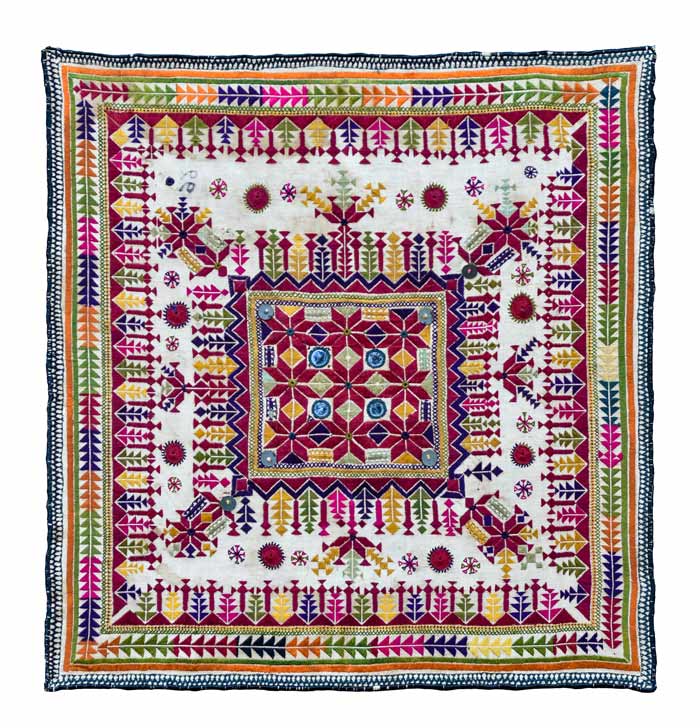
Books by Askari, often collaborations with other researchers, combine high-quality photography, history, and technical details of the objects they present. She has thus established a comprehensive archive of materials that provides scholars, curators, and artisans with a reference point for both study and practice. Her publications include:
- Uncut Cloth (1999), co-written with Liz Arthur, published by Merrell Publishers: Explored regional dress and embroidery
- Tale of the Tile: The Ceramic Traditions of Pakistan (2006), co-written with Abdul Hamid Akhund
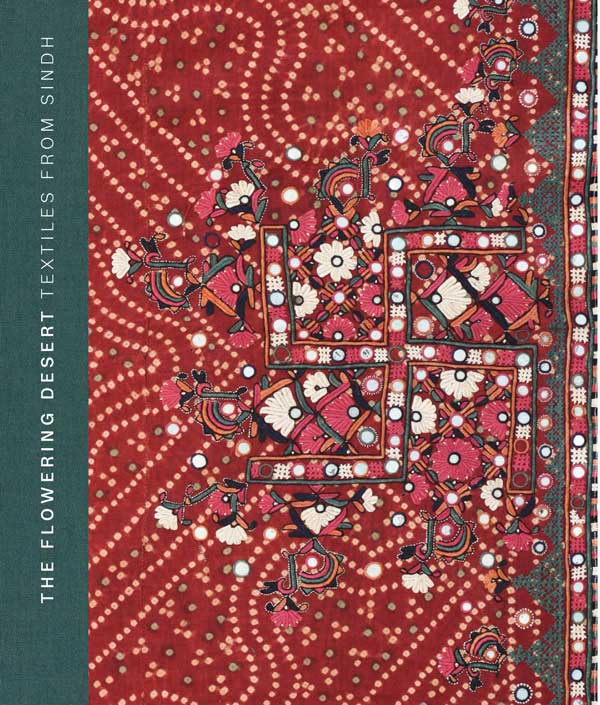
- The Flowering Desert: Textiles from Sindh (2019), published by Paul Holberton Publishing: Photographic documentation of over 120 Sindhi objects, combining technical detail with essays on motifs, stitches, and social history
Askari’s work also engages with contemporary concerns: sustainability and preservation of endangered crafts. Industrial textile production often substitutes cheap materials for artisanal skill, eroding traditional knowledge and creating environmental hazards. Promoting cultural and ecological sustainability and hand-made region-specific textiles, the exhibitions encourage visitors to appreciate slow creation, careful counting of threads, and the ethical dimensions of craft. In a world dominated by speed and disposability, this is a radical act of resistance that prioritises quality, heritage, and human labour over mass production. Whether at Mohatta Palace, The Haveli, or in the pages of her publications, Askari continues to honour the hands that made them and listen to the stories embedded in fibre and dye. As visitors engage with these textiles, they encounter not just objects but conversations across time.
Title Image: View from the exhibition, A Flower from every Meadow, (2017), Mohatta Palace, Karachi. Photo courtesy: Mohatta Palace Museum.
The author and Nasreen Askari were in several conversations for the puspose of this profile in 2025.
Bibliography
Needle’s Elegy: A Patiala Daughter’s Love Letter to Vanishing Phulkari in Pallavi Style Diaries, https://www.instagram.com/p/DLPr7dxy9YF/, 2025.
- Pallavi Style Diaries, https://www.instagram.com/p/DLPr7dxy9YF/
- Conversation between the author and Nasreen Askari, at the Haveli Museum, September 2025.
- Notes by the author at the press preview of Falak Sayr on December 8, 2025.
- Conversation, September 2025.
Rumana Husain

Rumana Husain is a dedicated author, art critic, artist, and educator, who has made significant contributions to storytelling, art, and social impact. She served as the co-founding Senior Editor of NuktaArt magazine from 2004 to 2014. She has written two critically acclaimed coffee-table books detailing the lives of Karachi's inhabitants, and is the author and illustrator of over 90 children's books, with four of them winning awards in Pakistan, Nepal, and India. Furthermore, she has authored hundreds of articles, travelogues, and reviews for various national newspapers and magazines.
There are no comments