

The Land Sings Back, an exhibition showing works of thirteen artists of South Asian, African, and Caribbean heritage at The Drawing Room Tannery Arts in London focuses on our relationship with the environment. Curated by Natasha Ginwala, the show explores themes in environmental justice, ecofeminism, indigenous knowledge, histories of colonial plantations, and mythologies that foreground origin-stories of the human-animal-vegetal world in post-industrial and post-colonial countries. The exhibition’s premise “brings into focus an ethics of reciprocity rather than extractive relationships with land during these times of war and accelerated toxicity”. 1 The exhibited artworks are a form of political action–they record history as it is experienced and present resistance in an attempt to nurture ecology.
Born in Mauritius and based in London, Shiraz Bayjoo’s assemblages consider the geographies of Mauritius, Madagascar, and the UK. A visually appealing work, Botanical Shrines (2024) mourns the loss of biodiversity while addressing its cause: plantations in the 17th and 18th centuries. The work is reflective of this relationship through its delicately drawn illustrations of vegetation on mahogany slabs holding natural materials and manmade objects/possessions. Other materials including coconut shells, seashells, faux pearls, and volcanic rocks explore the extractive nature of plantations as they strip the land and its maroon/creole communities of irreplaceable natural resources.

In another instance, Sri Lankan artist Jasmine Nilani Joseph chronicles dispossession as a consequence of the decades-long war between the Tamils and Sinhalese groups and the impact of ill-conceived government policies on minority rights that led to ethnonationalism in the country. Her installation DS Waiting Room (2024) uses 18 manilla folders, with drawings of camps, fences, and derelict architectural spaces. The work is presented on benches alongside a chiming analogue clock and highlights the plight of displaced families from the artist’s home district of Vavuniya and Mannar. This series is a response to the release of land in Jaffna by the Sri Lankan government in 2017.
In a sharp contrast with Joseph’s community focused work, Pakistani artist Anushka Rustomji desires to return to nature spirits and nature worship as a means to balance “life-forces, celestial bodies, rights of nature and seasonal cycles or regeneration”. 2 The artist takes inspiration from the mythological Yakshini–a Hindu and Jain deity associated with wilderness and fertility. The surreal and delicately drawn monochrome drawings in the ongoing series titled Flesh and Foliage (2023) represent plant-deity hybrid beings, where a tree stump morphs into a female form. Cognizant of the infrastructural chaos of her home city Karachi, Rustomji’s Gandharan female figure echoes the aerial roots and trunks of old Banyan trees in the metropolis. Her works capture urban infrastructure’s encroachment and entanglement in the biosphere as a point of contention.

Like Rustomji, Indian artist Manjot Kaur also considers interspecies hybridity focusing particularly on endangered creatures such as the Blackbuck, Great Indian Bustard, and Steppe Eagle from pre-partition India. The series Chthonic Beings – Mythological Assemblies for Multispecies Futures (2025) features three paintings, meticulously and vibrantly painted in gouache, depicting a world that is devoid of humans. Kaur writes, “Chthonic Beings serve as ecological custodians, companions of endangered species, protectors, nurturers, and caregivers, tending to and nourishing the wilderness they inhabit”.3 The works portray female beings with bird or animal countenances, relaying the concerns of endangered and extinct creatures in an effort to establish ecological jurisprudence that prioritizes nature over industrialization.
For instance, the painting Arriving on Feathered Shoulders depicts a Chthonic Being dressed in turquoise attire, holding a sitar, and perched on a Great bustard as it floats above the clouds. The being carries in its trail an entire eco-system consisting of acacia trees and winding vines, thus visually relaying the interdependence between the creature and its environment.

The Land Sings Back is a nuanced gathering of artworks from multiple nations that were ravaged by Western colonization. The exhibition elucidates the entangled connectivity of people, lands, mythologies, and paves the way for considered approaches to urban development in the future.
The Land Sings back, curated by Natasha Ginwala, ran at The Drawing Room—Tannery Arts in London from 25th September to 14th December, 2025.
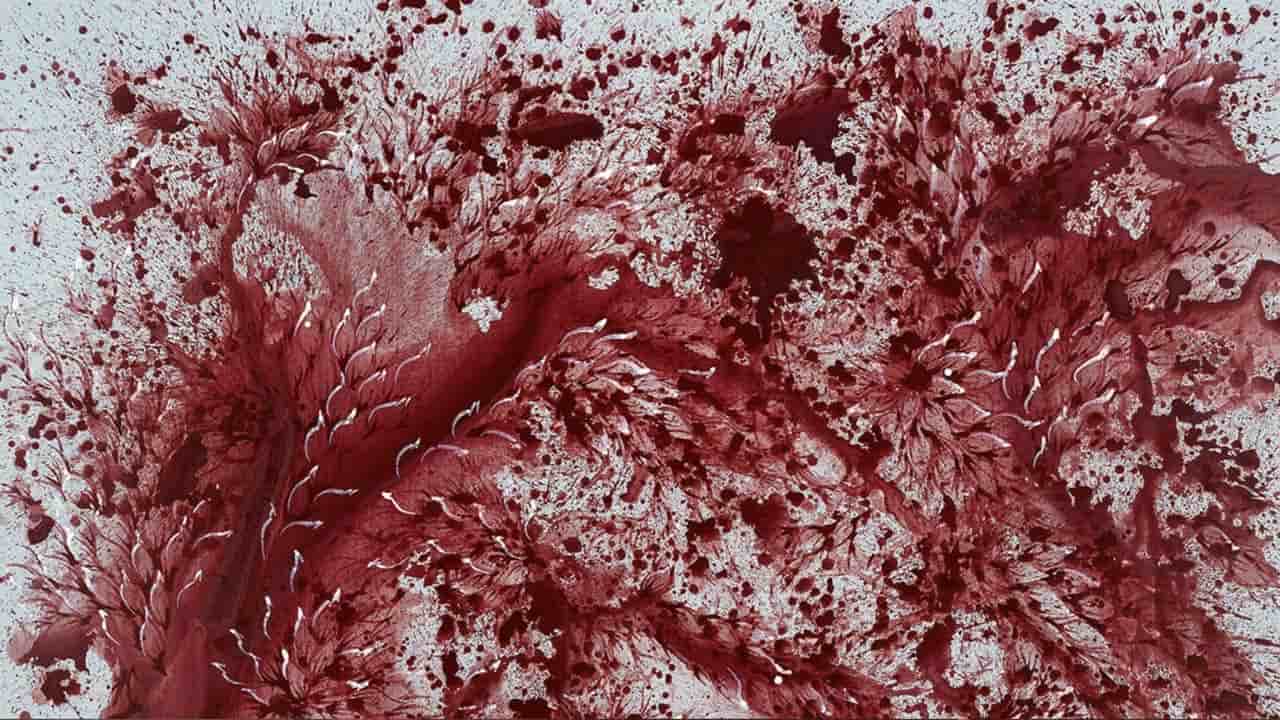
Title Image: Rupaneethan Pakkiyarajah, Border II (2024), watercolour, brush and ink on paper, each: 15 x 9.8 cm. Image courtesy of the artist.
Bibliography
The Land Sings back, (catalog), Drawingroom, Tannery Arts, London, 2025.
Kaur, Manjot. https://www.instagram.com/kaurmanjot14/p/DQG_-iqgNEC/
- The Land Sings Back (catalog), Drawing Room, Tannery Arts (2025), 3.
- Tannery Arts, 12.
- Manjot Kaur, Work Statement, Tannery Arts, 1.
Samar F Zia

Samar F. Zia is an artist, curator and writer based in London. Besides being a mother artist and maker, she authors critical essays examining cultural markers such as art and books. Zia holds an MA FA from Central Saint Martins, London and graduated with Distinction in BFA from Indus Valley School of Art and Architecture, Karachi. She regularly contributes to her Alma Mater UAL’s Alumni of Colour Association (AoCA) by curating exhibitions and events. She has been artist-in-residence at the Fitzrovia Community Centre where she curated multiple exhibitions. She is also a Trustee of the Fitzrovia Chapel. Zia is founder of Art Social where she facilitates bespoke creative workshops for youth groups and adults for various institutions across London. Zia regularly exhibits in both Pakistan and the UK. Zia has also participated in art fairs in UK such as the Affordable Art Fair and Fresh Art Fair. Besides being an independent curator and workshop lead, she has worked as Exhibition Guide at the Hayward Gallery. She has served as visiting faculty at Indus Valley School of Art and Architecture, Karachi and taught at Art Academy London.
There are no comments