
Stand anywhere in Karachi today and you will find roundabouts, fountains, and the occasional tarnishing monument. What you will not find are the bronze and marble statues that once stood in the city’s public squares. Their absence asks: what does a city do with the memory of those who shaped it, when that memory no longer fits the story it wishes to tell?
This essay does not mourn the British empire those statues served, and it does not dispute a newly independent state’s right to retire the likenesses of the monarchs who had ruled it. However, most of these figures were raised with the money and pride of Karachiites themselves, and they belonged to the city’s own record: a record of its Hindu, Parsi, Muslim, and Christian builders. In erasing them, the city destroyed part of its own archive, not the empire’s.
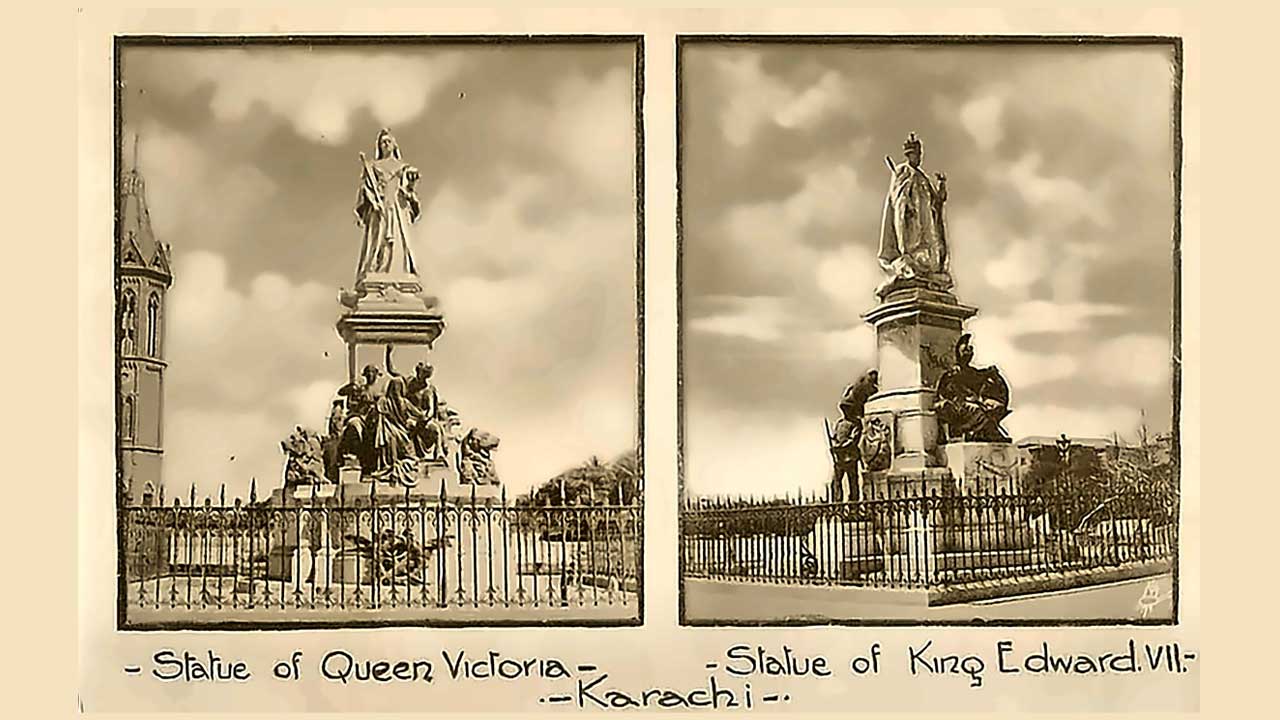
The grandest expression of this culture of commemoration stood in the gardens of Frere Hall on Abdullah Haroon Road. The Hall itself had been built in 1865 in the Venetian-Gothic style and named for Sir Bartle Frere, Commissioner of Sindh; it served as Karachi’s town hall, its concert venue, and its civic heart.1 Around it, gardens were laid out in 1887 where the city gathered for recreation and concerts under a cast-iron octagonal bandstand. And in these gardens, the city placed its two most prominent statues: Queen Victoria and King Edward VII.
The Victoria Statue was commissioned in 1902 at a cost of £6,000, raised by Karachi’s residents, the figure was sculpted by the distinguished Sir Hamo Thornycroft in marble, set on a marble pedestal with bronze reliefs and figures.2 It was shipped from London in 1905 and unveiled in March 1906 in a ceremony of elaborate imperial theatre: the statue hidden behind Union Jacks, a long red carpet laid from the carriage to a gazebo, speeches read before an audience of British officials, military personnel, and Karachi’s wealthy Hindu, Muslim, and Zoroastrian dignitaries. The gardens around it came to be called the Queen’s Garden, while the adjacent section, graced by the statue of King Edward VII, became the King’s Garden.3
Among the most prominent local figures immortalised in stone was Jamsheed Nusserwanjee Mehta. As Karachi’s president and later its first elected mayor, he revolutionised the idea of municipal administration by bringing piped water to the city, building new hospitals, developing the settlement of Jamshed Quarters, and overseeing the completion of the grand Karachi Municipal Corporation building on Bunder Road. Under his stewardship Karachi earned a reputation as a clean city. A statue of Jamsheed Nusserwanjee 4stood in the city as a material expression of civic gratitude, the kind of monument that cities erect when they believe certain contributions deserve to outlast their makers. 5
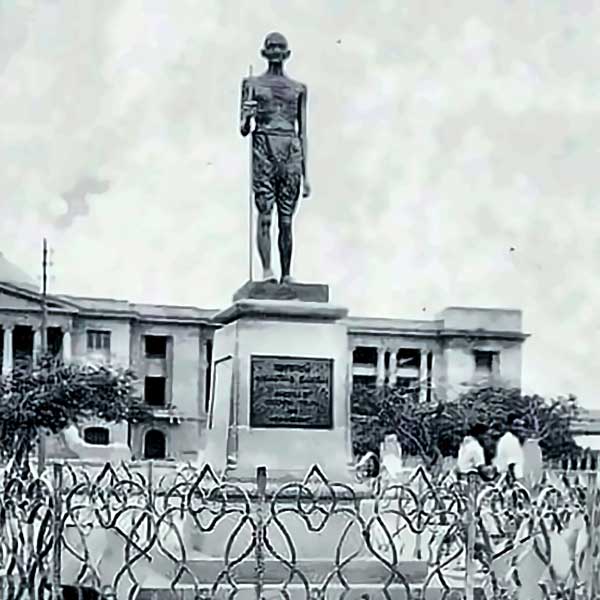
The Gandhi statue on Court Road (previously known as Kings Way) opposite the Sindh High Court building was a communal commemoration. It was commissioned in 1931 by the Indian Merchants Association of Karachi, a bronze life-size figure erected to mark Mahatma Gandhi’s visit to the city. The inscription on its plinth read: “Mahatma Gandhi — the reputability of freedom, truth and nonviolence.” 6 It was paid for by Karachi’s Hindu trading community, and it stood in plain view of the city’s highest court: a monument to nonviolence outside the house of law.7
The Gandhi statue on Court Road was endangered, though not destroyed, by the violence of the street. When communal riots broke out in Karachi in January 1948, Muhammad Ali Jinnah, fearing the statue would be attacked, asked his aide Yusuf Haroon to move it to safety. 8 It was sheltered for some weeks at the home of the Cowasjee family; the only damage it suffered in the whole episode was a broken pair of spectacles. It would be thirty-three years before its final resting place was settled: in 1981 the statue was handed over to the Indian Consulate in Karachi, and in 1988 it was installed at the Indian High Commission in Islamabad, where it stands to this day.9
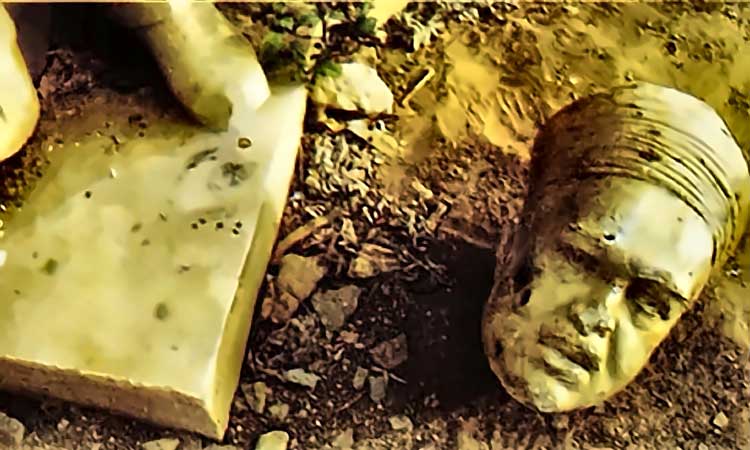
The statues of Queen Victoria and King Edward VII at Frere Hall survived the Partition riots but fell to the administrative decisions of a maturing republic. Both remained in place through the 1950s, through Pakistan’s 1956 declaration as an Islamic republic, and even through a state visit by Queen Elizabeth II in 1961. In 1962, President Ayub Khan issued an abrupt order for their removal, reportedly prompted by a forthcoming visit from Saudi Arabia’s King Faisal and by religious objections to figurative statues. 10 The removal itself was hurried and careless: the statues were hauled out of Frere Hall by the Karachi Metropolitan Corporation and dumped at a KMC warehouse and on the premises of the Karachi Water and Sewerage Board, an operation that cost several of them an arm, a head, or worse. 11 There was no inventory, no plaque, no public account of where the statues went or why.
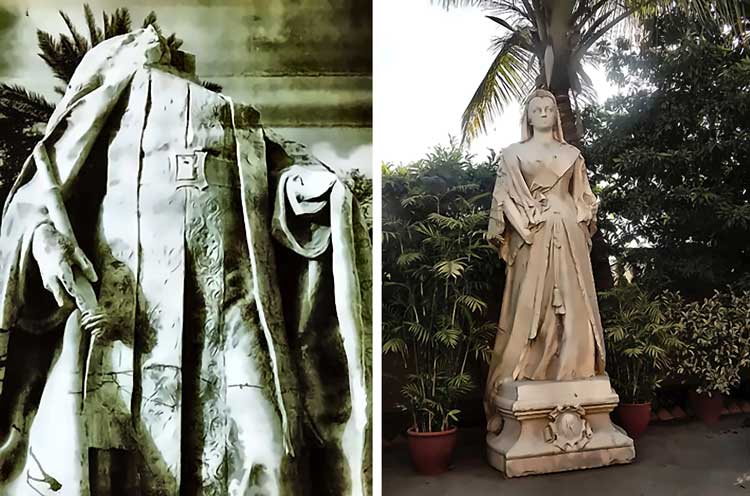
The Thornycroft Victoria now resides in the Mohatta Palace Museum in Clifton, technically preserved but removed entirely from public view.12 The Nelson monument at the Karachi Polo Ground was not removed13 but was systematically defaced: the engravings on the colossal black granite were filled in, erasing the text that gave the monument its meaning and identity. 14
The statue of Jamsheed Nusserwanjee Mehta faded from the public record. The Parsi community he belonged to was shrinking rapidly, its members emigrating to India and Britain. Without a community to insist upon his memory, the mayor of the city joined the growing list of figures that post-Partition Karachi had decided not to celebrate in public.
The two bronze lions that had once flanked the Frere Hall gardens were removed along with the royal statues.15 It is striking how little this process of removal was debated at the time. Karachi had been a city whose public identity was expressed through statues. By the mid-1960s, no new human statues of comparable civic ambition were erected in its place.
Some of this was a part of the decolonisation process. Pakistan was not unusual in taking down royal statues: newly independent states across Asia and Africa did the same through the 1950s and 1960s. India offers the clearest comparison, having removed statues of George V and his viceroys from New Delhi’s grandest avenues in the same period.16 A decolonising state owes no reverence to the likenesses of those who ruled it, and nobody seriously suggests Karachi’s citizens should have gone on saluting Victoria.
So why should a decolonising city have kept these statues at all? Because retiring a statue from honour and destroying the record of it are two different acts. Delhi’s imperial statuary was taken off its roundabouts and gathered in Coronation Park, where George V and his viceroys still stand, demoted and stripped of ceremony but preserved as evidence.17 A statue in a museum no longer commands respect. A visitor can see what the empire wished to look like and read why the country stopped honouring it. Karachi’s Victoria, by contrast, went into administrative storage and then into a museum collection few citizens will ever enter; the Edward statue and the bronze lions vanished from public accounting altogether; Albert lost his head in circumstances no one recorded.
That is where the removals stop being decolonisation at all. Gandhi was not a coloniser. His statue had been paid for by Karachi’s own Hindu merchants and honoured a leader of the subcontinent’s freedom struggle; the danger it faced in 1948 came from communal violence, not from any reckoning with empire. Nor was the fading of Jamsheed Nusserwanjee18 a blow against empire. He had spent his life building the city, not ruling it. At the same time, unease with figurative sculpture was growing, and the national identity then under construction had less room for the Hindu and Parsi builders of a Pakistani metropolis.
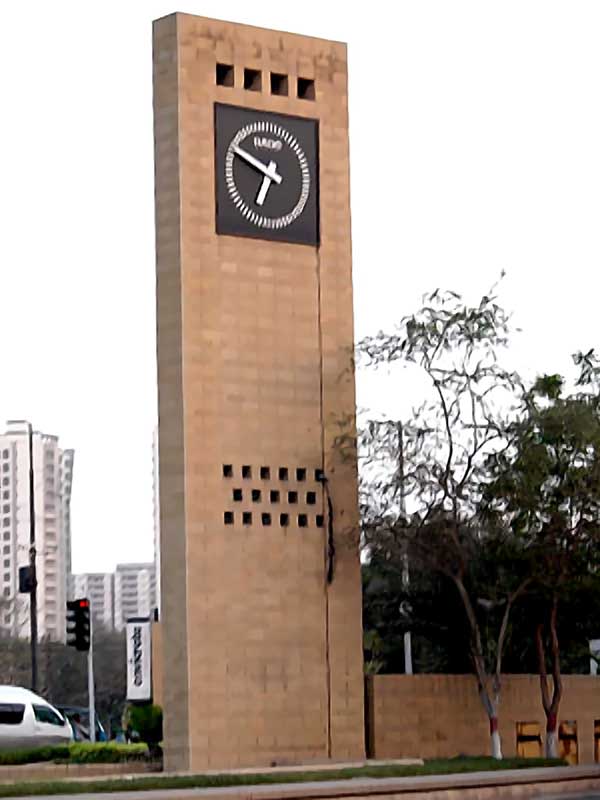
The Mohatta Palace holds Queen Victoria in its collection. The Indian High Commission in Islamabad holds the repaired Gandhi. The headless Prince Albert sits in storage somewhere. The Nelson monument stands mute, its engravings filled in. The site where Jamsheed Nusserwanjee Mehta’s likeness stood has long since been occupied by a commercial clock tower.
Karachi never demolished its colonial fabric. Frere Hall still hosts exhibitions and readers; the Sindh High Court still hears cases; Empress Market (named for the same Victoria whose statue was carted away) still trades; the KPT building still administers the port. The buildings were too useful to destroy, so they stayed. Today, the Frere Hall gardens remain among the city’s most used public spaces. There is no plaque to say what stood on the empty plinths, who paid for it, or why and when it was taken away.
The statues were not lost because the new state lacked the capacity to make public memory. It commemorated deliberately when it chose to: the Queen’s Lawn and the King’s Lawn became Bagh-e-Jinnah, and in 1960 President Ayub Khan laid the foundation stone of the Mazar-e-Quaid, the country’s founder’s mausoleum, on a rise overlooking the old city.19 The state could still build memory on a grand scale.
The pedestals that once held King Edward, Queen Victoria, Gandhi, and Jamsheed Nusserwanjee are empty and unexplained. The city still depends on the infrastructure its erased builders left behind. The removals swept away the city’s own philanthropists, and with them the public record of its Hindu, Parsi, and Christian communities. A city that cannot say why its pedestals stand empty has not decolonised its past. It has only forgotten it.
Title Image: Frere Hall, Karachi. The statues of Queen Victoria and King Edward VII stood in its gardens until the mid-twentieth century.
- “Frere Hall,” Wikipedia: The Free Encyclopedia, last modified March 22, 2026, https://en.wikipedia.org/wiki/Frere_Hall; “Karachi’s Iconic Frere Hall, Telling the Story of a City, Awaits Former Glory,” Arab News, July 24, 2022, https://www.arabnews.com/node/2128276/pakistan.
- “Statue of Queen Victoria, Karachi,” Yale Center for British Art, Yale University, accessed May 14, 2026, https://interactive.britishart.yale.edu/victoria-monuments/215/statue-of-queen-victoria; “Statue of Queen Victoria, Karachi,” Wikipedia: The Free Encyclopedia, last modified February 22, 2024, https://en.wikipedia.org/wiki/Statue_of_Queen_Victoria,_Karachi.
- “Prince of Wales Unveils Statue of Queen Victoria, Karachi, 1906,” The Friday Times, September 22, 2017, https://thefridaytimes.com/22-Sep-2017/prince-of-wales-unveils-statue-of-queen-victoria-karachi-1906.
- “In Memoriam: Jamshed Nusserwanji: The Builder of Modern Karachi,” Dawn, August 6, 2011, https://www.dawn.com/news/649943; “Jamshed Nusserwanjee Mehta,” Wikipedia: The Free Encyclopedia, last modified March 14, 2025, https://en.wikipedia.org/wiki/Jamshed_Nusserwanjee_Mehta.
- Akhtar Balouch, “The Real Father of Karachi,” Dawn, September 16, 2015, https://www.dawn.com/news/1113332; “Prominent Parsis of Karachi,” Parsi Khabar, September 4, 2013, https://parsikhabar.net/heritage/prominent-parsis-of-karachi/6775.
- Akhtar Balouch, “Gandhi’s Exile,” Dawn, January 30, 2014, https://www.dawn.com/news/1083771.
- Zahra Naqvi, “Karachi: The Dead Statues Society,” Herald, Dawn Media Group, March 15, 2019, https://herald.dawn.com/news/1398828; Mamun M. Adil, “Revisiting Kurachee,” Dawn, January 10, 2015, https://www.dawn.com/news/1155905.
- “How a Wax Statue of Gandhi in Islamabad Helps Pakistan Nurture a Sense of Being a Tolerant Nation,” Scroll.in, October 2, 2021, https://scroll.in/article/1006703/how-a-wax-statue-of-gandhi-in-islamabad-helps-pakistan-nurture-a-sense-of-being-a-tolerant-nation.
- “How a Wax Statue of Gandhi in Islamabad Helps Pakistan Nurture a Sense of Being a Tolerant Nation”; Mehr Farooqi, “Heroes Forgotten: Searching for the Dinshaws of Karachi,” Dawn, September 26, 2015, https://www.dawn.com/news/1207778.
- Naqvi, “Karachi: The Dead Statues Society.”
- Naqvi, “Karachi: The Dead Statues Society”; “Bringing Down the Statues,” Dawn, June 16, 2020, https://www.dawn.com/news/1563758.
- Fahim Zaman, quoted in “The Treasures of Mohatta Palace,” Dawn, February 28, 2016, https://www.dawn.com/news/1242390.
- “Bringing Down the Statues”; Naqvi, “Karachi: The Dead Statues Society.”
- Naqvi, “Karachi: The Dead Statues Society.”
- “The Treasures of Mohatta Palace”; Naqvi, “Karachi: The Dead Statues Society.”
- Tom Wilkinson, “Coronation Park and the Forgotten Statues of the British Raj,” South Asia @ LSE (blog), London School of Economics, August 28, 2019, https://blogs.lse.ac.uk/southasia/2019/08/28/coronation-park-and-the-forgotten-statues-of-the-british-raj/; “Coronation Park, Delhi,” Wikipedia: The Free Encyclopedia, accessed July 2, 2026, https://en.wikipedia.org/wiki/Coronation_Park,_Delhi.
- Wilkinson, “Coronation Park and the Forgotten Statues of the British Raj”; “Coronation Park, Delhi.”
- “In Memoriam: Jamshed Nusserwanji”; “Jamshed Nusserwanjee Mehta,” Wikipedia.
- “Mazar-e-Quaid,” Wikipedia: The Free Encyclopedia, last modified March 18, 2026, https://en.wikipedia.org/wiki/Mazar-e-Quaid.
Saqib Ahmed

Saqib Ahmed is a distinguished scholar and educator with a rich academic background and extensive experience in the field of Art history and cultural studies. He is currently pursuring his Ph.D. in Social Science (History) from the Department of History at the University of Karachi. Currently, he is diligently working on his dissertation titled "Encountering the Sacred through the Prism of Pluralism: A Historical Exploration of Religious Monuments in Colonial Karachi (1843-1947)." His dissertation reflects his commitment to unraveling the historical complexities of religious monuments and their significance in the colonial context. Saqib Ahmed's academic journey commenced with an M.A. in History (Heritage Studies) from the University of Karachi in 2014, where he graduated with first division honors. During this period, he also pursued a minor in Art & Architecture History & Visual Studies, highlighting his diverse interests within the realm of cultural studies. His intellectual curiosity extends beyond his formal education, with a keen interest in South Asian History, Heritage Studies, Visual Culture, Philosophy, Material Culture, Film Theory, and Art & Architecture History. Ahmed has not only excelled in academia but has also contributed significantly as an educator. His experience includes as a full-time lecturer at Indus Valley School of Art and Architecture (IVS) and various other institutions such as Visual Studies Department at the University of Karachi and in Social Science & Liberal Arts at IBA. Saqib Ahmed's academic achievements and extensive teaching experience exemplify his passion for knowledge dissemination and his dedication to shaping the intellectual landscape within the field of academia.
There are no comments