
Mohsin Shafi’s exhibition Between Two Worlds, presented at Kunsthalle Krems Museum in Austria, unfolds as a layered engagement with spiritual and metaphysical frameworks, resonating strongly with emerging South Asian readings of Sufi cosmology. Shafi’s artist residency in Niederösterreich program at the museum took place from December 2023 to January 2024 and culminated in this exhibition, which has been curated by Andreas Hoofer. Shafi engages with the notion of the “third space” (first developed by critical theorist Homi K. Bhabha), as a conceptual terrain where binaries dissolve — between East and West, past and present, masculinity and the non-binary, and the corporeal and the spectral. The exhibition’s engagement with the unseen is pronounced in its invocation of spiritual presence. Shafi evokes it through atmospheres of absence, echo, and repetition with a series of video works, self-portraits, and archival fragments that together form what the artist describes as a “living archive.” 1
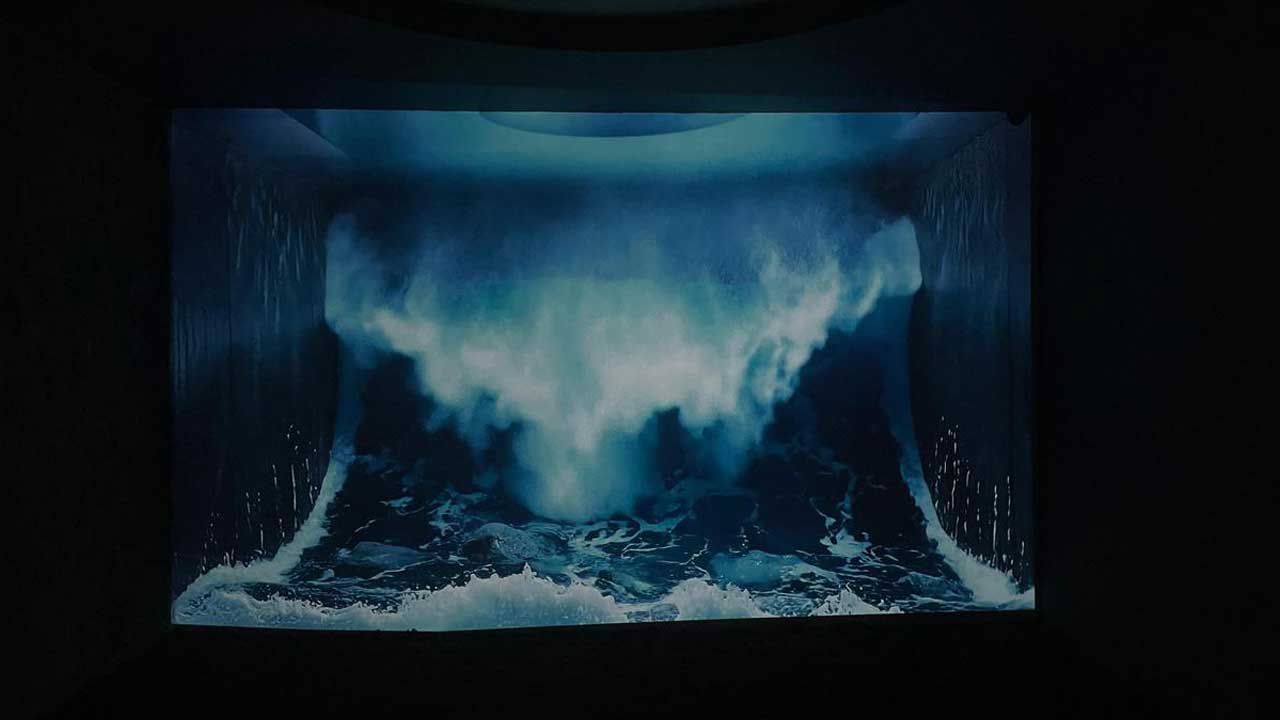
A centrepiece of the exhibition is the immersive audiovisual installation Malamatiyya (The Reprimanded), (2025). Drawing on the South Asian love story of Shah Hussain, a Sufi saint, and Madho Lal, a young Brahmin Hindu man, the work revisits non-normative forms of love that have been marginalized or erased in historical narratives. 2 The installation’s use of multiple video projections merged with audios of meditative repetitions and personal narrations creates an intimate yet unsettling atmosphere, inviting viewers to engage with elements of mysticism and South Asian history. The work is also a collaboration with Lahore based voice artist Zainub J. Khwaja, thus grounding the work in South Asian musical traditions reminiscent of devotional practices at Sufi shrines in Pakistan.
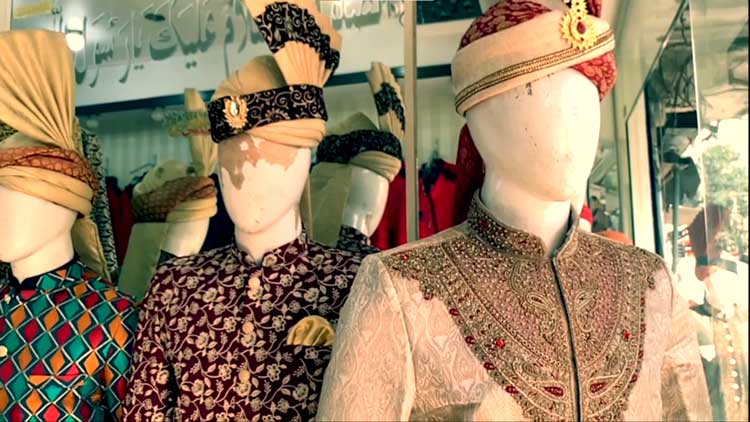
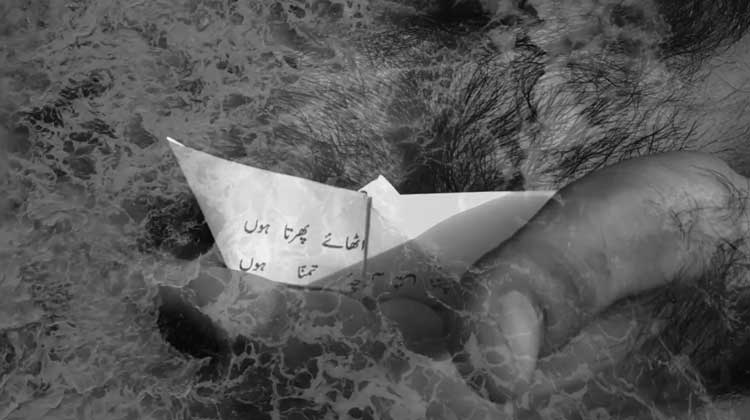
In Shafi’s work, we witness implicit representations of male companionship featured in non-traditional forms of masculinity. We see flower garlands wrapped around a male figure’s ankles and hairy calves of two seemingly male bodies standing closely and submerged in lapping sea waves in the work Malamatiyya, and a male torso with prominent abdominal hair overlaid with imagery of water in Wormhole. As societal norms in Pakistan tend not to acknowledge anything outside of heteronormative marriage structures, the imagery of brides and grooms in wedding attire has therefore often been featured in Shafi’s work, previously included in Theatre of Absurdities (2023) and The Anatomy of Becoming (2025). Videos of male mannequins in elaborately embroidered sherwanis and ornate turbans stand faceless and silent yet speak volumes about the restrictive demands imposed on young men in Pakistani society regarding acceptable representations of masculinity.
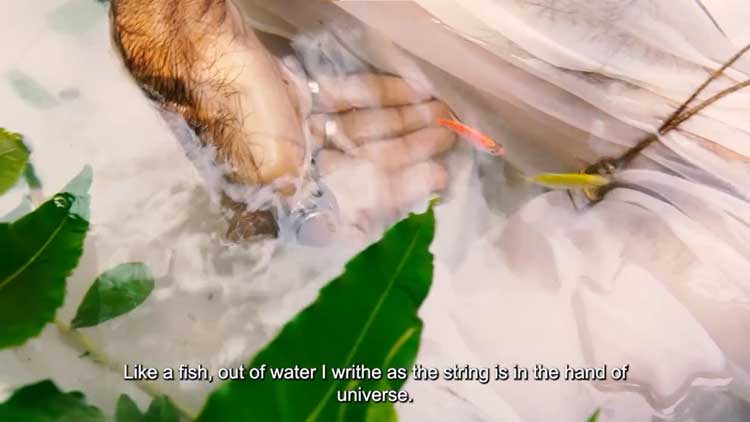
Exploring the subtleties of queer coded language, colours become a significant representational tool to reflect non-binary states of being. In the video performance Malamatiyya, the artist wears a Taqiyah (a traditional, rounded skullcap worn by Muslim most notably during prayer) with shifting colours of red, orange, yellow, green, blue, violet, and pink. Tiny fish representing the same colours swim around an unmoving male body submerged in shallow water.
Omar Kasmani’s ethnographic work Queer Companions (Duke University Press: 2022), focuses on Sufi shrine culture in Pakistan, by exploring the concept of “saintly intimacy” to describe affective relations between devotees and saints that exceed normative social frameworks. 3 These relationships, often articulated through idioms of love, longing, and companionship, are not easily reducible to heteronormative structures of kinship or desire. Shafi draws on these traditional forms of devotion which open a field of relational possibilities that can be productively understood as more fluid and non-binary states of being. As intimacy with the saint can take on deeply personal and affective dimensions; Shafi echoes this in his work by invoking romantic, even devotional intimacy through poetic narrations juxtaposed with non-normative visuals of male companionship.
He navigates these concepts through narrations of poetic readings in video works where he makes statements such as “I do not belong to those whose spiritual senses are closed off” and claiming to “make relations with spirits from beyond”. Throughout the work, he references this in-betweenness of companionship and isolation, the tangible self and the metaphysical other. Shafi’s evocation of such mystical presences further draws on saints in South Asian Sufi traditions that are believed to not be confined to their historical lifetimes; they are instead believed by devotees to remain spiritually present, accessible through dreams, visions, and shrine-based rituals, allowing for encounters that blur the boundaries between life and death, self and other. 4
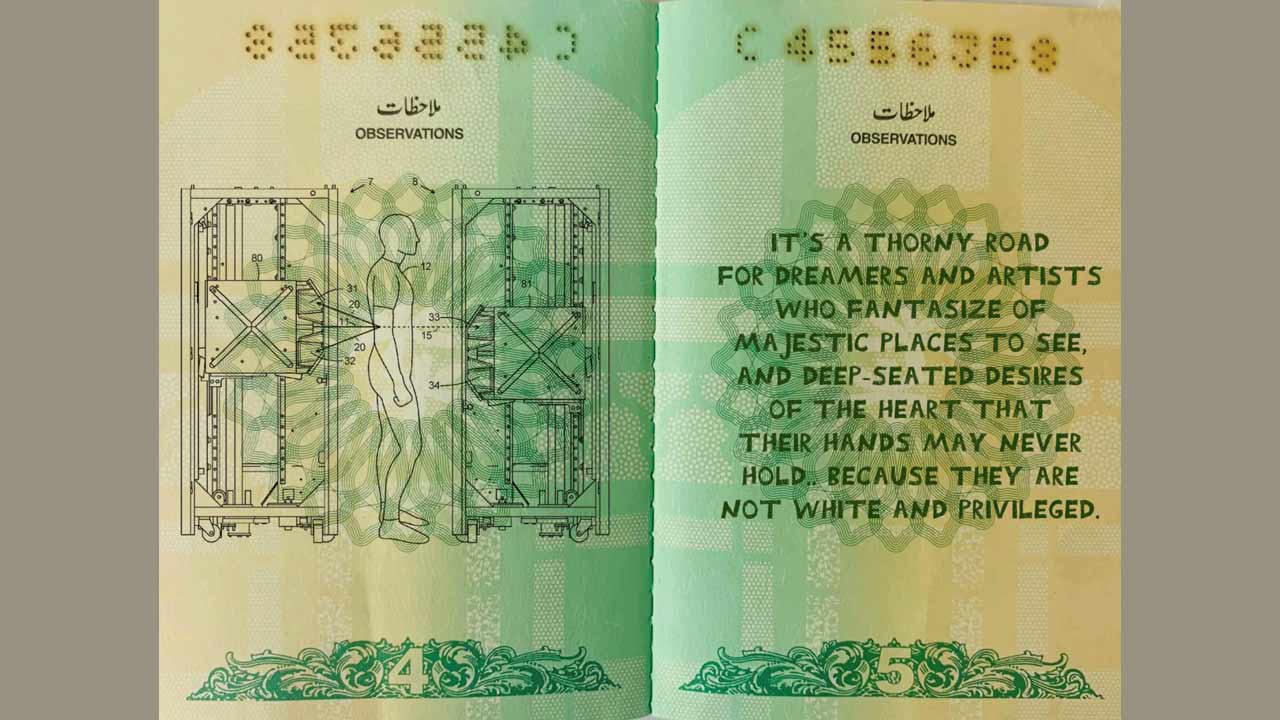
There is also an autobiographical thread about Shafi’s experiences as a Pakistani artist navigating Western institutional spaces in the exhibition. Marked by visa complications and racial profiling, the works complicate the romantic notion of artistic mobility, revealing instead the uneven power dynamics that shape global art circuits. In The Joy of Being Detained at International Airports (2025), he presents replica passports that evoke and exaggerate the stereotypical image of a Pakistani passport-holder, as men with thick beards and turbans with assault rifles are sprawled between travel stamps. Bhabha’s concept of the “Third Space”, or the “hybridity” that emerges when distinct cultures, identities, or spaces intersect, is once again referenced as Pakistanis living in global landscapes often find themselves dealing with the realities of travel bureaucracies, compared to the privileges afforded to those with a different passport.5 One of the replica passports aptly reads: “It’s a thorny road for dreamers and artists who fantasize of majestic places to see, and deep-seated desires of the heart that their hands may never hold. Because they are not white and privileged.”
By weaving together elements of Sufi cosmology with contemporary artistic practice, Shafi creates a language through which questions of identity, belonging, and desire can be explored in their full complexity.
“Between Two Worlds” by Mohsin Shafi was curated by Andreas Hoofer and presented at Kunsthalle Krems Museum in Austria and from 22nd November 2025 – 6th April 2026.
Title Image: The Joy of Being Detained at International Airports, Mixed media, size variable, 2025
Bibliography
Bhabha, Homi K. The Location of Culture. London: Routledge, 1994.
Boivin, Michel. “Shah Husayn and the Cult of Madho Lal Husayn.” In The Sufi Paradigm and the Making of a Vernacular Knowledge in Punjab. New York: Palgrave Macmillan, 2020.
Ernst, Carl W. Eternal Garden: Mysticism, History, and Politics at a South Asian Sufi Center. Albany: State University of New York Press, 1992.
Kasmani, Omar. Queer Companions: Religion, Public Intimacy, and Saintly Affects in Pakistan. Durham: Duke University Press, 2022.
“Mohsin Shafi: Between Two Worlds.” Kunsthalle Krems. Accessed July 1, 2026. https://www.kunstmeile.at/en/exhibitions/mohsin-shafi.
- (Author unknown), “Mohsin Shafi: Between Two Worlds”, Kunsthalle Krems (date unknown), https://www.kunstmeile.at/en/exhibitions/mohsin-shafi.
- Michel Boivin, “Shah Husayn and the Cult of Madho Lal Husayn,” in The Sufi Paradigm and the Making of a Vernacular Knowledge in Punjab (New York: Palgrave Macmillan, 2020).
- Omar Kasmani, Queer Companions: Religion, Public Intimacy, and Saintly Affects in Pakistan (Durham: Duke University Press, 2022).
- Carl W. Ernst, Eternal Garden: Mysticism, History, and Politics at a South Asian Sufi Center (Albany: State University of New York Press, 1992).
- Homi K. Bhabha, The Location of Culture (London: Routledge, 1994).
Noor Butt

Noor Butt is a Pakistani artist, writer, and educator based in Canada. Her professional portfolio includes the Karachi Biennale Trust, Vasl Artists’ Association, and Qatar Museums. Recipient of the Inception Grant by Art Incept, she has been published in ArtNow Pakistan, The Karachi Collective, and Hybrid - Interdisciplinary Journal of Art, Design, and Architecture. She has taught art history courses in the Liberal Arts program at IVS, and currently works as an Artist Educator at ‘Arts for All’ in the Hamilton Conservatory for the Arts, ON, Canada. She holds a BFA from the Indus Valley School of Art and Architecture, and an MA in History of Art from the University of London, Birkbeck College.
There are no comments