We are twenty-five years into the new century, and despite all the curbs on freedom of expression Contemporary Art has successfully navigated the deeply fraught terrain and become an integral part of the country’s cultural consciousness. Curatorial practice has supported this by creating a space for emergent art genres, engaged with problematic national narratives and resisted colonial canons. Carefully curated discourses have amplified concerns like climate change, urban issues, erasures and our unresolved relationship with indigenous knowledge.
The following is a list of exhibitions, held since 2000, which has been selected by me to give an idea of choices made by curators. It focuses primarily on Karachi and is designed to give you a snapshot of the scene:
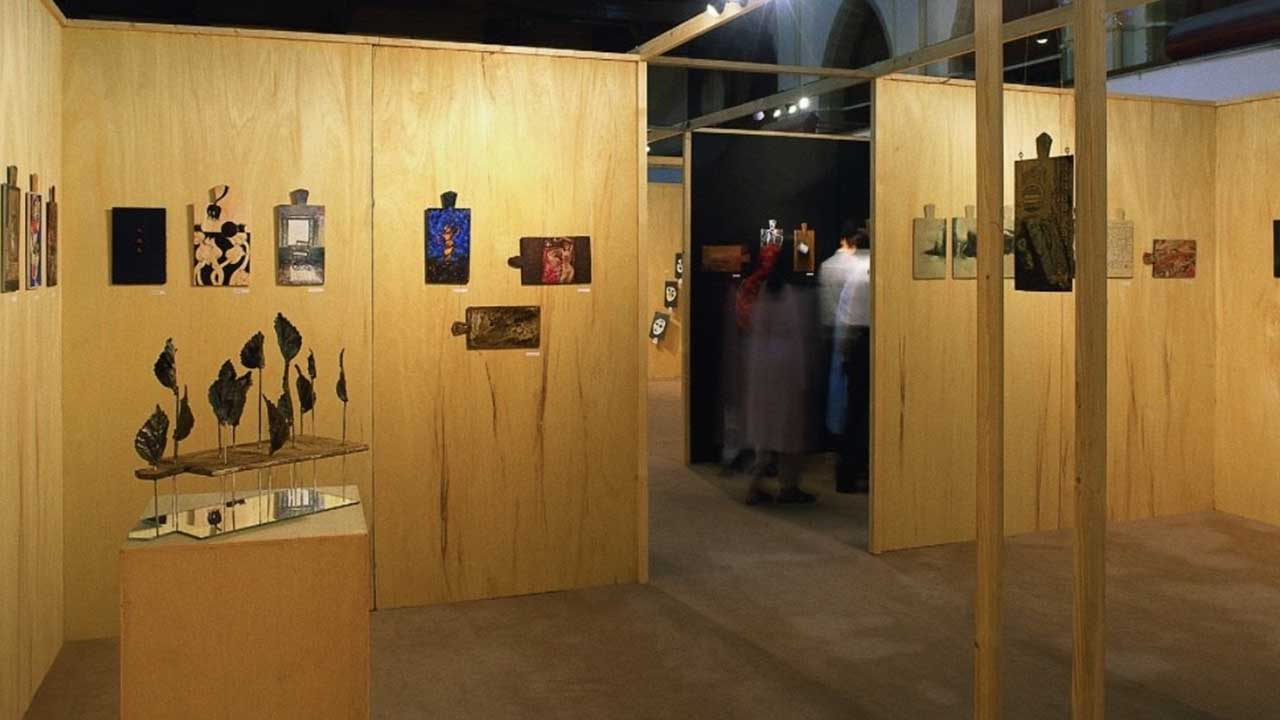
The Takhti Show in 2001 was about the art community coming together to pay homage to one of its own. It was dedicated to the influential artist Zahoorul Akhlaq who was brutally shot with his daughter in Lahore (1999). A group of artists, art critics and art educators in Karachi, invited over 200 artists and art students linked to Zahoor. The only brief was to let their memory of the artist guide them to create a work on takhti, the wooden tablet that the artist had used extensively in the 1990s. The generosity of the art community that gave its time and works gratis, marked a watershed moment. It showed the way forward with self- reliance as proceeds from the blind auction of exhibits funded the logistics and temporary pavilion for the show designed by Habib Fida Ali at Frere Hall. This exhibition with its many firsts, also heralded a break from dependency on state run cultural institutions that have become increasingly politicized since the 1980s and lost their professional capacity. Individuals, non -profit and commercial galleries in the next few decades were to bring new energy and professionalism to fill this void.
Another acknowledgment of mentors came sixteen years later at a show at Koel Gallery. Curated by Noorjehan Bilgrami and Mohammed Zeeshan it was dedicated to the ustads of Mirpur Khas, Sukkur and Hyderabad. Their work hung with the works of their students— some of whom are acclaimed artists today— to highlight the living legacy of the dedicated mentors who continue to work and teach, in marginalized places. When Amin Gulgee curated his first Performance Art show at his non-profit gallery it caused a tectonic shift with the raw energy of sound, body movements, fragrance, colors and lights that produced a multi-sensory experience, not seen before in Pakistan. As similar shows followed it become a catalyst for the Performance Art Movement in the country. Riffat Alvi, the founder Director of the VM Gallery, a trust-run institution, founded in the late 1980s, was the first to formally enable young artists with shows, so when she established the annual Emerging Talent Exhibition, it was seen as a welcome addition. This showcase of works by young graduates from across Pakistan became a springboard for national talent in the decades that followed.
The wedge that Modernism had driven between art and craft, high art and low art was being questioned by Contemporary Art that embraced hybridity, artisanal skills, appropriation and innovation. The academia in Pakistan, however was slow to respond with discursive and practical initiatives to integrate the craft legacy. The search for a common ground between contemporary art and artisanal practices was taken up by ASNA that held ‘Maati ki Sargoshi’(1999), a survey show of over 400 clay crafts from major pottery centers and villages. As a founder of ASNA, I was one of the curators of the show along with Meher Afroz and Shanaz Siddiq. The accessible location of Frere Hall was chosen to spark public conversations with walkthroughs, researched talks and student visits for two weeks.
Conversations that connected urban development with Climate Change were just starting with Shehri and IUCN in the forefront when NuktaArt, Pakistan’s Contemporary Art Journal, initiated a residency and exhibition under the umbrella of One Mile Square, an international project of British Council. With its focus on the newly built causeway of Mai Kolachi across the Mangrove wetlands near Boat Basin, the artists presented their research on its impact on the Mangrove, its marine ecosystem and the katchi bastees (informal settlements) that had been excluded from its development plans. The artist-led workshop in the bastee school and a study of its changing landscape through paintings, immersive photographic installation and video gave a powerful voice to the narratives silenced in the making of Mai Kolachi. At the Poppy Seed Gallery, the show ‘Whose Afraid of Theory?’ (2010) engaged the critical layer embedded in the visual as the curator, Sumbul Khan chose to look at art’s theoretical architecture. She invited a group of art critics to work with artists to explore local interpretations of established theoretical frameworks that influence art practice.
‘Exhausted Geographies’ (2015) was a mapping of Karachi with a dissident lens. When the first venue denied them space due to possible reprisals by the establishment, it was Riffat Alvi of VM Gallery who lent them her gallery. ‘Exhausted Geographies, the first of its series, according to the curators Shahana Rajhani and Zahra Malkani it was ‘a radical engagement with politics of representation and map making in order to explore and produce new ways of seeing and imagining cities in the global south’. The deeper investigation problematized the received narratives of rights, land distribution and disenfranchisement. Some shows that addressed contemporary history and its selective documentation were ‘Artists Voices: Body’ and ‘Artists Voices: Calligraphy’ curated by Amin Gulgee and Sheherebano Hussain (2006). It was a deep dive into the politics of representation midwifed by the extremist policies of General Zia ul Haq and its subsequent mutation of the social gaze and notion of artistic freedom. ‘Pakistan’s Radioactive Decade: the 70s Show’ (2016) was a curatorial project to open a debate on the contentious decade of the 1970s with its conflicting memories and histories. The artists who were drawn from different generations brought their own interpretations to the show curated by Amin Gulgee and myself. Retrospective of iconic artists become even more vital in the absence of a well-documented art history in post-colonial societies. This restores the sense of continuity and complicates colonial forms of knowledge making.
For the retrospective ‘Sadequain: the Holy Sinner’ in 2001, the curators Hameed Haroon and Nasreen Askari successfully brought several hundred works together for the audience to experience his extraordinary practice. Sadequain ‘s profound epistemic insights and the Master’s persistent search for an iconography best suited to project his angst, left a significant impact on visitors, who often returned, again and again to see the show. The first edition of the Print Triennial was yet another meticulously researched show by Romila Kareem at VM Gallery. It’s collection of forgotten portfolios told the story of contemporary printmaking in Pakistan. With prints from the 1940s to present day, it spoke to audiences at multiple levels: the changes in techniques and imagery over decades and the underlying fortitude of several generations of artists who kept printmaking from disappearing into the shadows.
My own curation of the 50 years retrospective of the oeuvre of Meher Afroz titled ‘… connecting internal and external time…’(2025) for Chawkhandi Gallery was an attempt to bring together the oeuvre of a socially and professionally committed artist and present it through the prism of her lived experiences. This was among the few retrospectives of living artists with a long and diverse trajectory. The body of work was supported with an archive of photographs, invitations of shows, catalogues and books on her. The documentary specially made for the event, brought Meher’s voice into the show to underline the importance of the partnership between the artist and the curator.
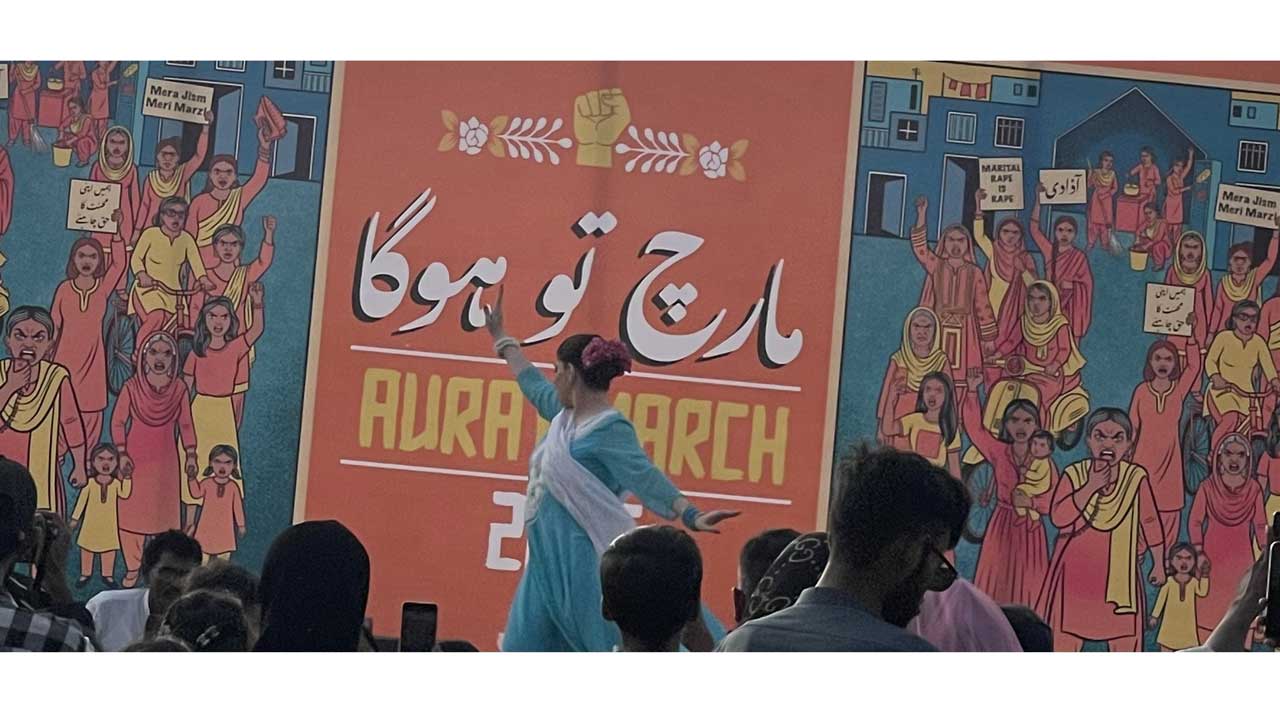
Curating in the public venues requires a certain kind of social and aesthetic framework that can sensitively communicate across class, levels of awareness and exposure, political and ethnic plurality. In the last fifteen or so years curators have stepped into the public space, both metaphorically and physically, to transform the way art is received by mainstream audiences. Pioneers of this grassroots in-situ exhibition, was the Dhaba Collective which paved the way for interventions by Vasal, La Jamia and Awami Collective among others. The Biennales in Karachi and Lahore, Public Art Festival continue to expand the scale with install art in accessible parks, heritage sites and zoos. The themes of these shows often act as a bridge to engage all who share the urban space. Curation has had a vital contribution in introducing new ways of seeing art, generation of research and critical knowledge. It has taken art to new audiences and enabled difficult conversations and interface. It’s important to note that the most impactful shows come from curators willing to deal with questions that connect art with urgent transformations, not shy to push the limits of genres and understand resistance to Coloniality. These shows disrupt the social architecture of self -censorship with creative intelligence.
Title Image: A section of the display, ‘The Takhti Show’, 2001. The show brought Karachi’s art community together to honor the legacy of Zahoorul Akhlaq, whose life was tragically cut short in 1999. Over 200 artists, critics, and students created works on takhti, the wooden tablet he cherished, letting their memories of him shape each piece.


There are no comments