
Sadequain’s works have been most widely targeted and finding genuine provenance of his paintings is an immense challenge. Sadequain was incredibly prolific and gave away his paintings to friends, institutions, and strangers rather than keeping inventory in the form of a ledger. His Quranic calligraphy with elongated and energetic strokes are widely replicated. Fake Sadequain calligraphies are often sold in local markets and online platforms, sometimes for just a few thousand rupees, but high-end fakes frequently infiltrate respectable galleries. His complex, surrealist, line-heavy figurative works from the 1960s and 1970s including the Cobweb and Cactus series are also often forged.
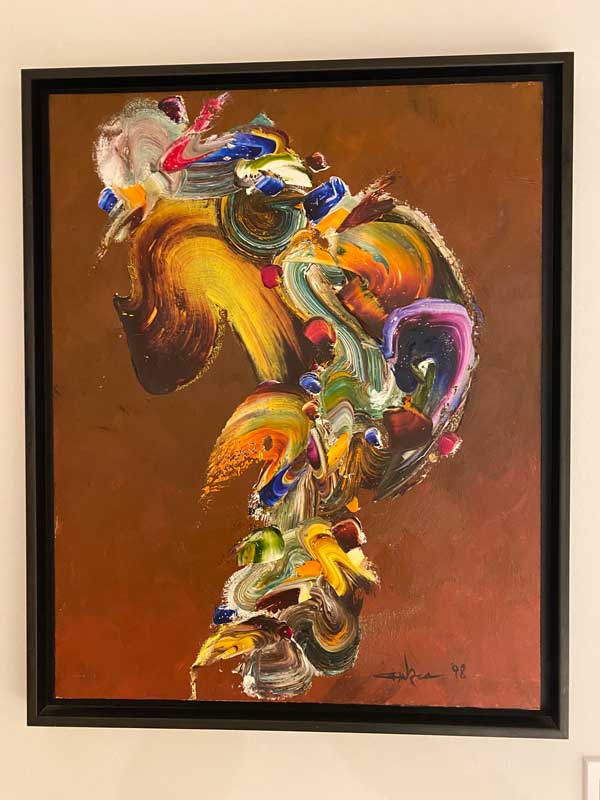
Gulgee’s high-energy and texture-heavy abstract works make him a lucrative target for counterfeiters, particularly because his original works command high prices. Forgers try to mimic his sweeping, kinetic brushstrokes and heavy layers of paint mixed with gold and silver leaf and his seeping, fluid interpretations of Islamic script over vibrant, multi-layered backgrounds. Original Gulgee paintings have an incredibly complex and rhythmic layer of impasto that is difficult to replicate. His fakes often look muddy, lack the fluid speed of his actual brush stroke and palette knife execution, or use newer metallic paints that do not age correctly.
As the creator of the “Chughtai Style” (a unique blend of traditional Mughal miniature painting and Art Nouveau), Abdur Rahman Chughtai’s works are highly coveted and scarce. Forgers frequently use pages from original mid-century publications of his books, like the Muraqqa-i-Chughtai or Naqash-i-Chughtai, treating the paper or colourizing black-and-white plates to make them look like original and hand-painted wash masterworks. Chughtai utilized incredibly delicate and translucent layers of watercolour wash that required immense patience and specialized paper. Forgers often struggle to replicate his ultra-fine, single-hair brush outlines, resulting in lines that look slow, deliberate, or shaky under a magnifying glass.
Finally, an important figure in Pakistan’s post-independence modernist movement, Ahmed Parvez’s vibrant, chaotic explosions of colour including floral abstracts and still life paintings are heavily replicated. Because Parvez lived a volatile Bohemian life and often traded quick explosive works on paper to pay for daily expenses or hotel stays, there is an influx of fast, poorly executed crayon and gouache fakes that mimic his late-1970s style. While Parvez’s work looks spontaneous with his internal sense of colour balance and spatial composition, his fakes usually look messy rather than intentionally chaotic.
Other frequently counterfeited artists include Jamil Naqsh with his pigeons and reclining female nudes and Ustad Allah Bux with his romanticized oil landscapes and depictions of Punjabi folklore.
When I am approached for advice on authentication and valuation, I generally go with my initial instincts and ask myself the following key questions: Does the work look right on face value? Are the signs of aging of canvas and the stretcher normal? Do the lines, strokes, and use of colour conform with the artists’ style, palette, and period? If I am satisfied, I then request additional information. Where the gallery or collector got the painting from? Who has owned it before? Who bought it from the artist? Which gallery consigned and exhibited it? And lastly, who have they shown it to?
I will now share some examples of unauthentic works that I encountered recently of Zainul Abedin and Ismail Gulgee.
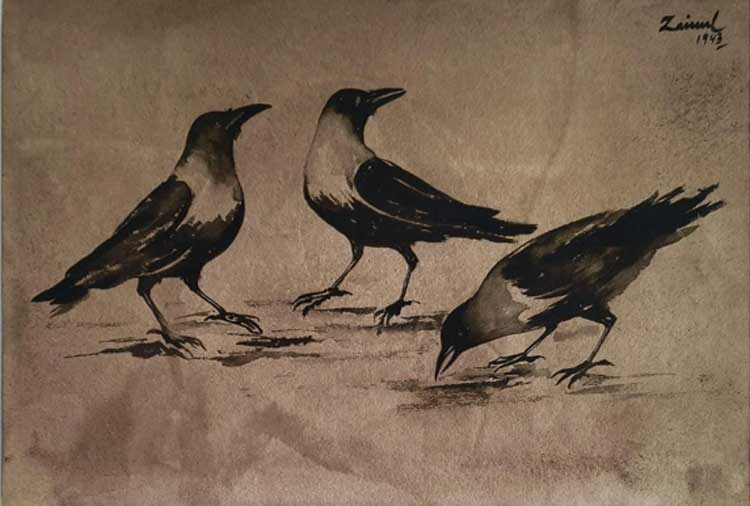
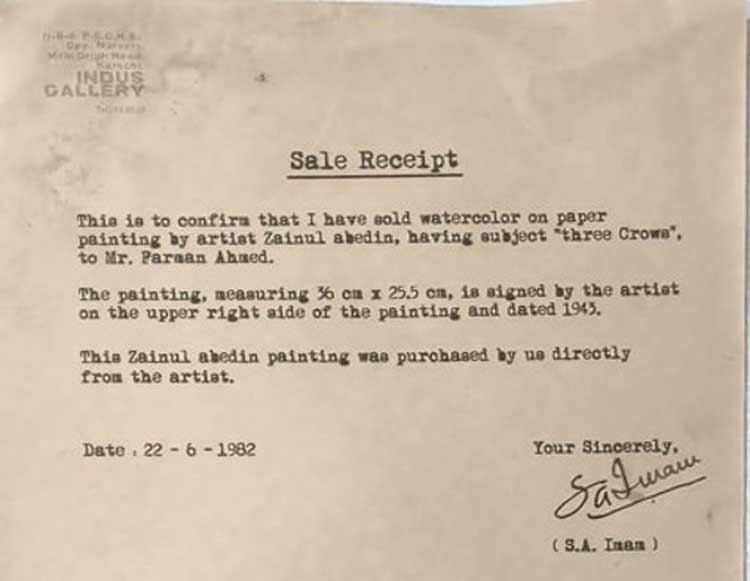
Zainul Abedin’s Three Crows allegedly painted in 1943 was offered by a vendor in Delhi on eBay to me along with an original receipt of purchase from the Indus Gallery in Karachi. The work was signed and dated 22-6-1982 by the highly respected gallery owner and Pakistani artist, Syed Ali Imam. The subject in the painting were three crows, and it was signed “Zainul” and dated “1943” in what looked like Zainul Abedin’s hand. On the surface, it looked highly convincing. However, upon further investigation, this painting turned out to be a fak.
Consulting with experienced Bangladeshi artists in Toronto and comparing the work with other similar works completed by the artist in the 1940s, which received global acclaim as part of his “Bengal famine series,” I first looked at the art itself. The painting very closely matched the style and hand of Zainul Abedin. The paper and size also checked out to be in the range of works produced by the artist in that period. Upon further analysis, I uncovered some major differences in the way Zainul Abedin delicately applied paint and shading using the wash technique he had so well mastered that led to my decision that this painting was a counterfeit.
Paintings by Gulgee are often an easy target for the forgers and the Pakistani and international art market is flooded by his counterfeits. A gallery/auction house in Prague, Czech Republic by the name of Art Torg is featuring works on their website that are awful fakes of his work. It would be interesting to know where these works are being sourced from.
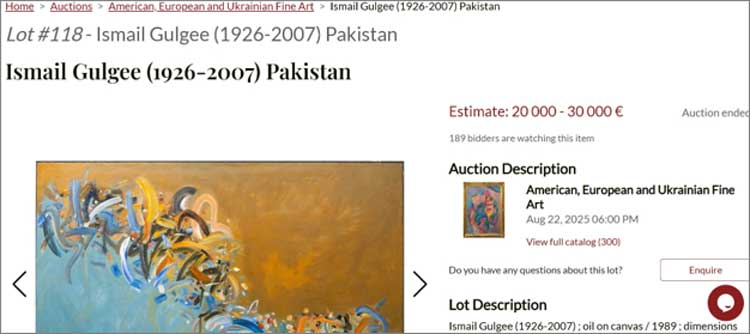
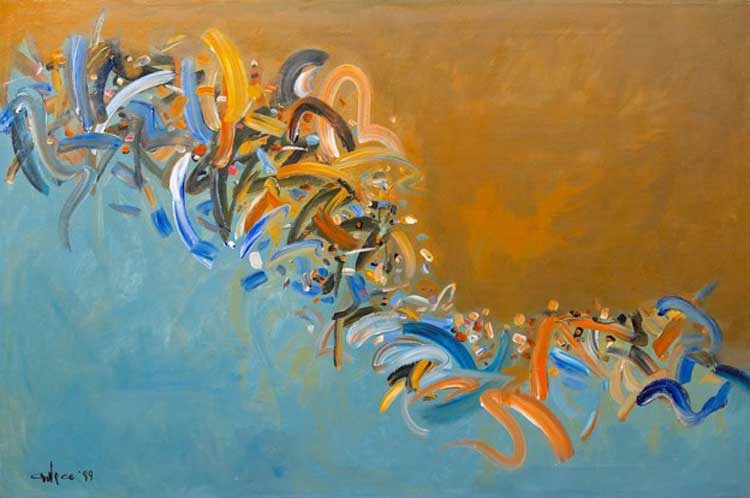
Gulgee came up with a unique painting style in modern Hurufiyya (the use of Arabic calligraphy within modern art) by fusing Western abstract expressionism (gestural painting) with the spiritual discipline of Islamic calligraphy. Instead of traditional, rigid calligraphic scripts (like Naksh or Thuluth), Gulgee used sweeping and fluid brushstrokes. In the fabulous recent publication Gulgee Museum: The Handbook (2025) curated by Amin Gulgee and edited by John McCarry (Lightstone Publishers), his son, multidisciplinary artist and curator Amin writes,
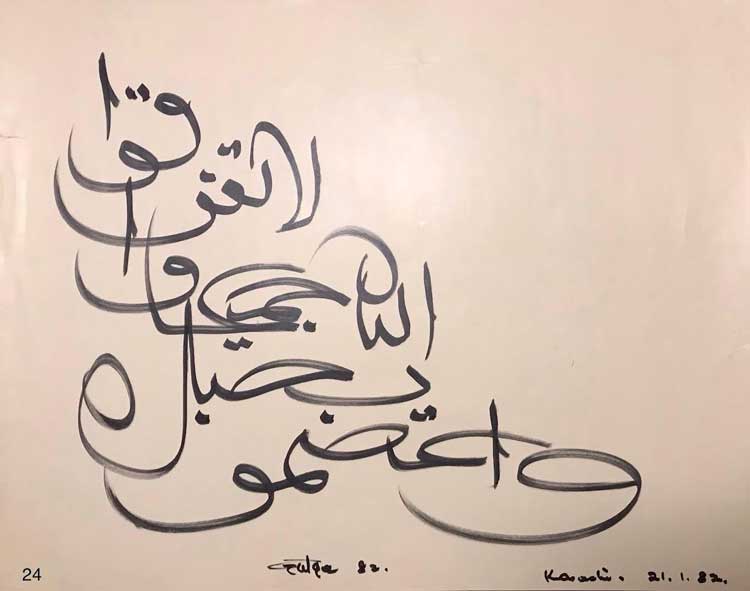
“When Gulgee completed his painting engaging in text for the Second Islamic Summit in 1974, he was inspired to explore calligraphy further. For the next seven years, he immersed himself in its study and practice to better understand it. He spent hours alone in his studio with his pen and books. It was important for him to be able to acquire the skill to render myriad Arabic scripts. Gulgee would often display his expertise by writing calligraphy on paper for friends.” 3
One such example of Gulgee’s mastery over calligraphy can be seen in Figure 6, created at Elite Printing Press in Karachi on 21.1.1982 for its proprietor Mr. Ahmed Mirza Jamil.
The sweeping loops and varying ink density convey a sense of divine energy and rhythmic movement. Soon after, Gulgee started merging Islamic calligraphy with his gestural abstract expressionism. “A merge occurred. He began using the brush as a gigantic Qalam. His gestural brush strokes dominated the canvas with the smooth areas created by the knife becoming details” continues Amin, in his essay. 4. It is this gestural brush stroke used by the senior Gulgee, as he dipped his brush in multiple colours and executed his motion on canvas in one stroke, which makes it extremely difficult to replicate.
There is a dire need for enhanced legal frameworks and enforcement mechanisms to combat the production and sale of counterfeit art in Pakistan and internationally. Strengthening or supplementing intellectual property laws and implementing stricter penalties for infringement can serve as deterrents to counterfeiters. Art Historian Samina Iqbal and critic Salima Hashmi conducted a yearlong study in 2022-2023 leading to publication of a report titled “Art Reproduction in Pakistan” supported by the Art South Asia Project and the British Council. The study examined the extent and circulation of “incorrect” artworks in markets in Pakistan and abroad, as well as in private collections. It identified the sources through which these works are disseminated and examined the various tactics used to establish their authenticity, which in turn facilitate their sale. It has examples of Sadequain’s counterfeits produced and authenticated by the Sadequain Foundation, and reproductions of Shakir Ali, F.N. Souza, Allah Bux and Zahoor Ul Akhlaq.
Iqbal and Hashmi in their report concluded by writing that “this lucrative business is being run through extensive and sophisticated networks of art dealers, galleries, artists, exporters, and even institutions which deal in the execution and marketing of fraudulent art..” 5
The unchecked circulation of fakes and forgeries poses significant structural, economic, and cultural threats to the South Asian art market. Modern and contemporary masters are particularly vulnerable due to uneven cataloging infrastructure, gaps in provenance records, and high market demand. This can lead to an erosion of confidence between the investors and the collectors. Furthermore, widespread proliferation of fakes frightens international auction houses and dealers, institutional investors, and corporate collections. Hesitation leads to reduced liquidity and stagnant market growth.
Saturation of forged works in the primary and secondary art markets depresses the market value of authentic works. When buyers cannot verify authenticity, they discount the prices they are willing to pay across the entire oeuvre of an artist. Consequently, resulting in higher overall transaction costs, as buyers and auction houses must now spend large sums of money on forensic testing, chemical pigment analysis, and legal vetting before completing acquisitions.
On the non-monetary side, this trend causes distortion of art history and canon. When forgeries enter museum collections and academic retrospectives, they distort the understanding of an artist’s stylistic evolution. If unaddressed, the proliferation of fakes risks isolating South Asian Art on the global stage. To build resilience, the ecosystem is increasingly turning toward scientific authentication, Blockchain-based certificates of authenticity, and the publication of comprehensive catalogues raisonnés to safeguard legacy and market value.
I am hopeful that following publication of the report “Art Reproduction in Pakistan” and subsequent dialogue relating to legal recourse and enforcement, the administration in Pakistan and other jurisdictions in South Asia, will take concrete steps to bring about a positive or decisive change in this matter. Until then, the best we can do is ensure that prospective art buyers and sellers are better informed about the proliferation of fakes in the market and perform their due diligence before purchasing or selling a significant work of art.
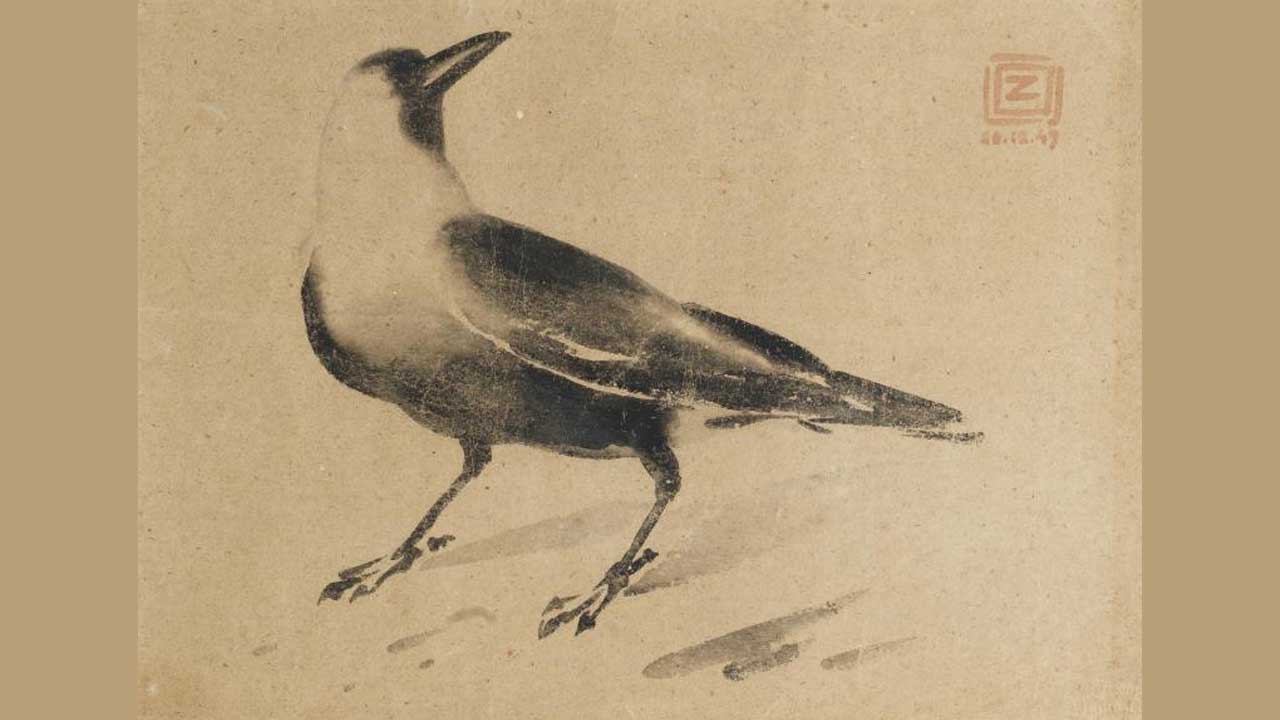
Title Image: Figure 3: Zainul Abedin, Study of a Crow, watercolour on paper, 26.1 x 36.6 cm, 1949 (original)
Source: Zainul Abedin | Study of a Crow (1949) | MutualArt
Bibliography
Corollo, Elisa. “Trophy Collections and Luxury Spending Powered Christie’s and Sotheby’s Record Half-Year Results.” The Observer, July 15, 2026.
Gulgee, Amin, ed. Gulgee Museum: The Handbook. Curated by Amin Gulgee and edited by John McCarry. Lightstone Publishers, 2025.
Iqbal, Samina, and Salima Hashmi. Art Reproduction in Pakistan. British Council, Art South Asia Project, 2023.
Rabb, Maxwell. “$17.9 Million Raja Ravi Varma Painting Sets New Record for Indian Painting at Auction.” Artsy, April 2, 2026.
- Elisa Corollo, “Trophy Collections and Luxury Spending Powered Christie’s and Sotheby’s Record Half-Year Results,” The Observer, July 15, 2026.
- Maxwell Rabb, “$17.9 Million Raja Ravi Varma Painting Sets New Record for Indian Painting at Auction,” Artsy, April 2, 2026.
- Amin Gulgee, Gulgee Museum: The Handbook, ed. John McCarry, curated by Amin Gulgee (Lightstone Publishers, 2025), 54.
- Gulgee, The Handbook, 54.
- Samina Iqbal and Salima Hashmi, Art Reproduction in Pakistan, British Council, Art South Asia Project, report published in 2023, page 40.
Ali Adil Khan

Ali Adil Khan is an art critic, curator, writer and collector. He has organized and curated numerous exhibitions in Canada and abroad, served as an advisor to the Royal Ontario Museum, the Aga Khan Museum, Ontario Arts Council, Canadian Community Arts Initiative and the Art Gallery of Mississauga in Canada. He is the founder and director of Shehla and Adil Giving for Arts (SAGA) Foundation and the South Asian Gallery of Art (SAGA) and a proud supporter of Karachi Biennale 2022 and 2024. He received his education in Karachi and Austin, and now lives and works in Toronto, Canada. He currently serves as the Vice Chair of the Oakville Galleries Board of Directors and is a member of the Acquisition Committee of the Art Gallery of Mississauga in Canada. Over the last 20 years, he has painstakingly built a noteworthy collection that includes Modern and Contemporary artists from India, Pakistan, Bangladesh and Sri Lanka.
There are no comments