
Manchhar is Pakistan’s largest freshwater lake. Once an expansive, life-giving body of water that sustained fisheries, migratory birds, and floating villages for generations. Located west of Sehwan Sharif, the lake historically collected monsoon waters and mountain streams before draining into the Indus. Its seasonal fluctuations structured livelihoods and belief systems alike. For centuries, the Mohanna lived on the lake, fishing, trading, raising families in floating settlements whose architecture embodied intimate environmental knowledge. Today, the lake is shrinking not only in size, but in vitality.
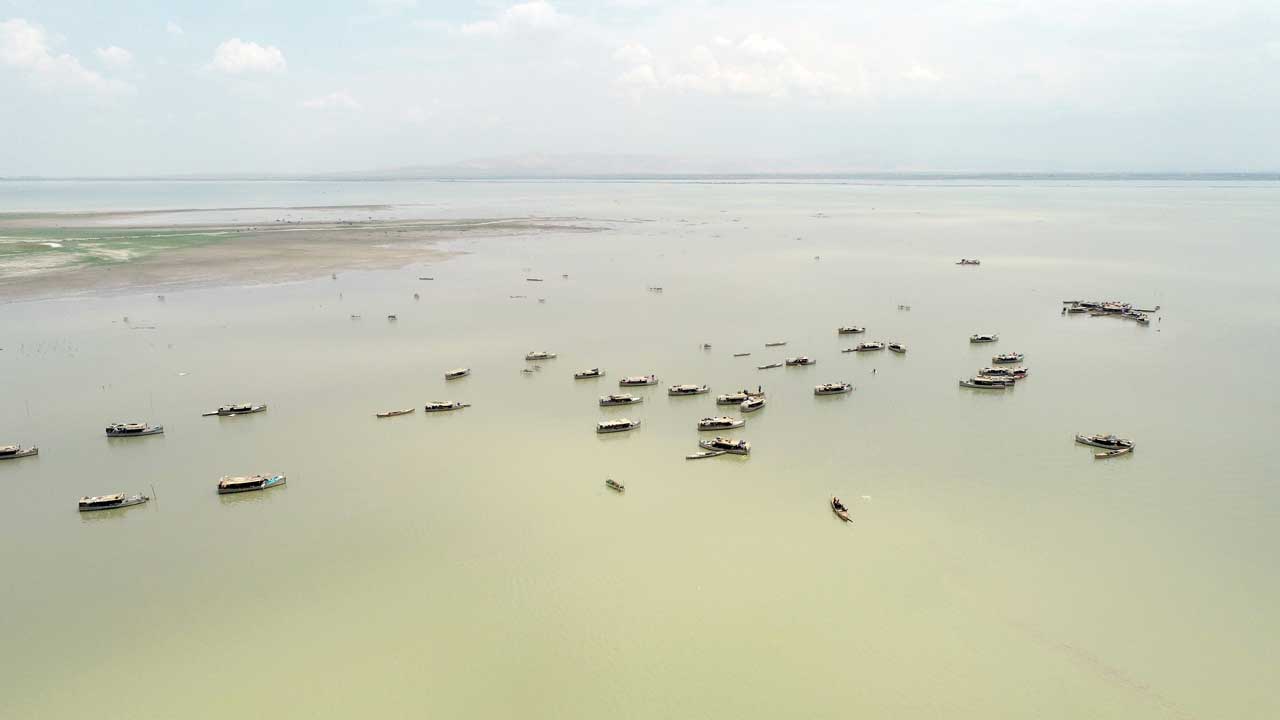
Polluted inflows, reduced freshwater supply, and decades of neglect have transformed Manchhar into a toxic basin. Drainage schemes such as the Right Bank Outfall Drain redirected saline agricultural runoff and industrial effluent into the lake, while freshwater inflows declined. Fish stocks collapsed. Birds stopped coming. From nearly 450 houseboats— thousands, many decades earlier— only forty-four now remain. The Mohanna population on Manchhar has dwindled to just 375 people, across 65 families. Fishing has become unsustainable. What appears, at first glance, to be adaptation is in fact a slow unravelling.1
The Mohanna is an indigenous Sindhi fisherfolk community whose name carries uncertain etymological origins. They have long been described in folklore and ethnographic writing as “people of the wetlands” or “bird people.” These descriptions reflect their intimate knowledge of migratory birds and lake ecologies, including fishing practices historically said to involve trained birds. Yet such poetic framings risk romanticising a community whose displacement has been gradual, structural, and largely invisible.2
For the Mohanna, leaving the lake is often described as a choice. It is not. What has occurred instead is a gentle but relentless pushing away, as the lake becomes unliveable. Like Manchhar itself, the community has not vanished. It has become harder to see, harder to locate, harder to account for.
The Manchhar Lake Art Residency must be read against this background— not as an isolated cultural intervention, but as an extension of a longer project of documentation, advocacy, and ethical engagement. Manchar Lake Mohannas -Safeguarding the Last Surviving Houseboat Village from Extinction, led by Prof. Dr. Anila Naeem and Architect Farida Abdul Ghaffar at NED University of Engineering & Technology, sought to record the galiyo as living structures rather than static heritage artefacts. Funded by the UK Cultural Protection Fund, the project foregrounded the houseboats as repositories of environmental intelligence – structures shaped by water, weather, labour, and social life.
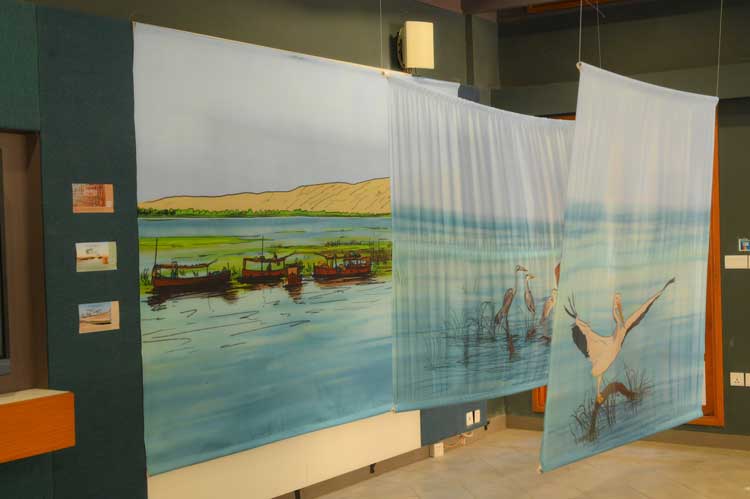
Its public culmination, Manchar Lake Mohanas – Sailing Towards Revival (January 2026), hosted at NED University’s City Campus, brought together research, documentation, and art. Curated by Ayla Hasan and Safeer Ahmed of NED’s Heritage Cell, the exhibition resisted narrative resolution. Manchhar was not framed as a problem to be solved, but as an ongoing, unresolved, and ethically demanding condition. Visual material, conversations, and projected imagery mapped the project’s trajectory while foregrounding the Mohanna community’s everyday experiences.
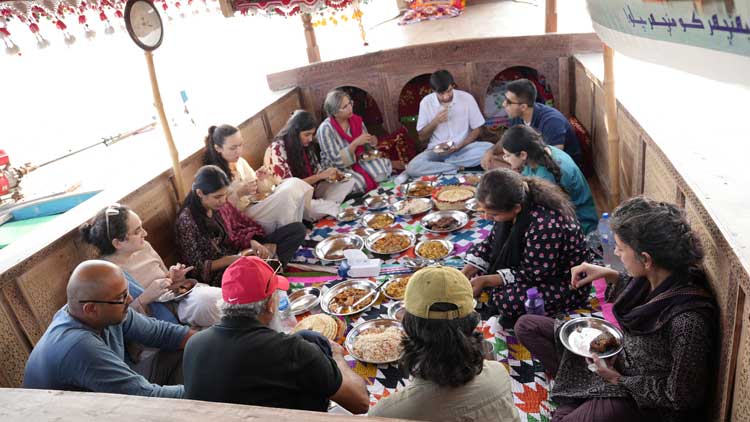
This refusal of closure carried into the art residency itself. Held over five days in November 2025 and concluding with an exhibition in the ‘Chimney Room’ curated by Sohail Zuberi, the residency emphasised process over product and proximity over spectacle. Zuberi’s practice is shaped by sustained engagements with urban change, inequality, and spatial politics, including his Archaeologies of Tomorrow projects and commissions for the Karachi Biennale. It was particularly attuned to Manchhar’s condition of slow violence: ecological harm that unfolds incrementally, without rupture, and is therefore easily normalised.
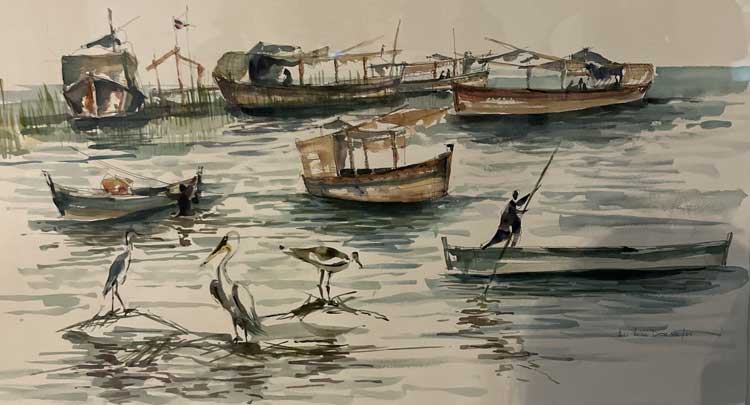
Artists and architects responded to Manchhar through painting, installation, mapping, and participatory workshops. Architects Ali Raza Dossal and Mariyam Iftikhar organised time around fishing seasons rather than calendar months, foregrounding cyclical knowledge systems eclipsed by bureaucratic time. Their series of paintings “capture the dynamic ecology of Manchhar Lake across different season, highlighting the fluctuations in water levels, migratory bird patterns, and fishing seasons that shape the daily lives of local communities.”
Using watercolour on paper, their works explored shifting greys and blues, echoing both sky and water, uncertainty and depth. The choice to centre fishing seasons rather than months was itself a political act, privileging and restoring local ways of understanding time against imposed notions of time.
Their indigo-toned paintings organised not by the Gregorian calendar, but by the indigenous seasonal rhythms of the lake, looked like this:
- Sawan (Monsoon: July–September) – rising waters, storms, instability
- Macchi Maran (Fishing Season: October–March) – abundance, movement, livelihood
- Sukkal (Dry Season: April–June) – shrinking waters, intensified pollution
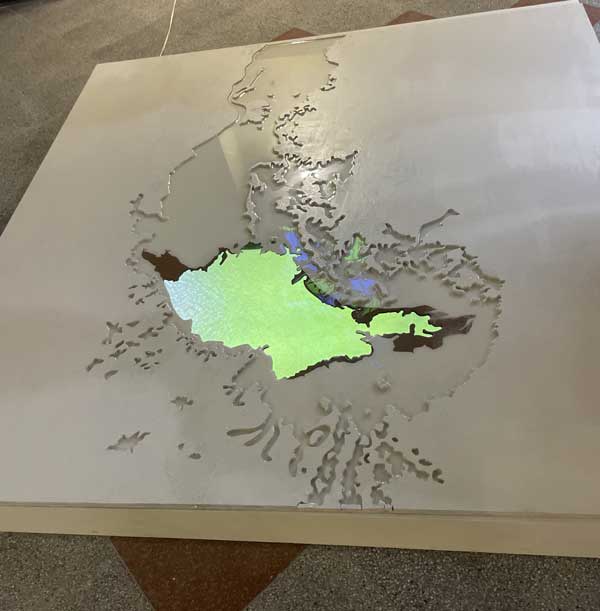
Climate adaptation practitioner Namra Khalid’s multimedia maps, “Cartographies of Submergence” (oil paint and laser engraving on wood, and video) traced the ever-shifting edges where land meets water, examining how Manchhar absorbs the accelerating impacts of climate change and vulnerability due to human injustices, alongside the indigenous resilience, refusing narratives of passive victimhood.
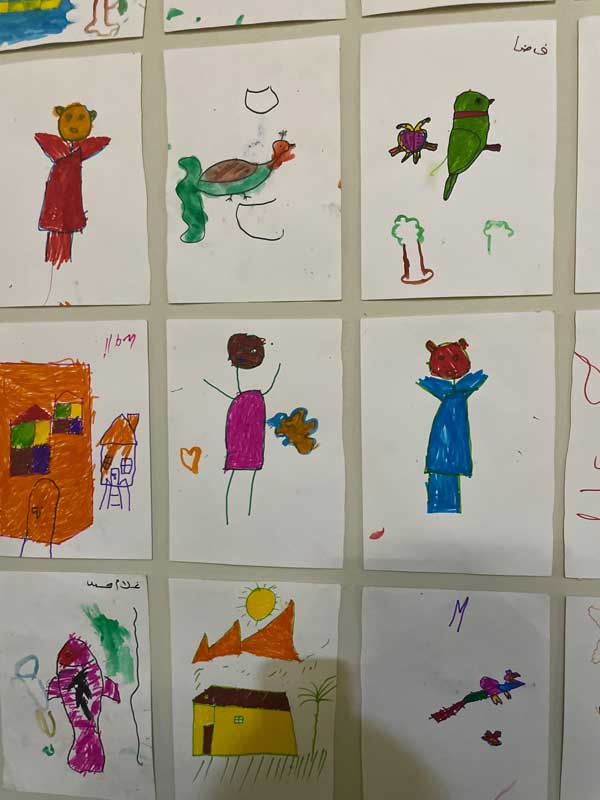
Workshops with Mohanna children, led by Namra Khalid, Amna Rahman, and Samina Hassan Laghari, became sites of quiet rupture. For many of the children, aged two to twelve, this was their first encounter with watercolours, markers, or paintbrushes. Coming from a “boat school” with limited resources, painting became both play and inscription. Drawing from motifs etched into wooden boats and imagining futures beyond precarity, the children wrote themselves into a story that has too often rendered them invisible.
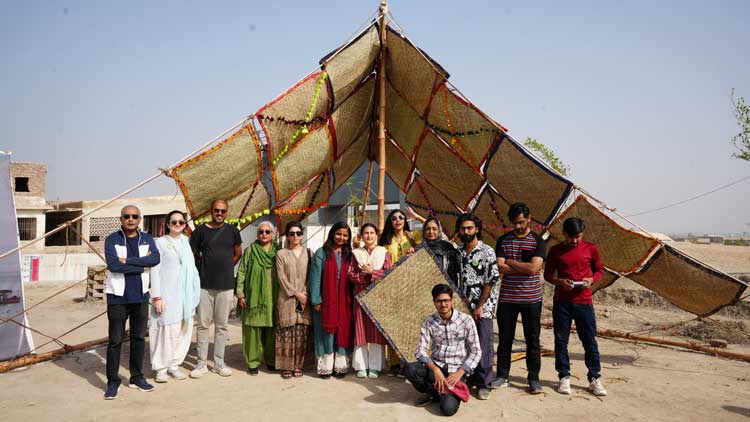
The Patchwork Pavilion, assembled from mats woven by Mohanna women and erected on the lake’s edge, offered temporary shelter and collective space. Conceived and designed by Dossal and Iftikhar, the pavilion functioned as a proposition: that community itself is a form of architecture: fragile, adaptive, and sustained through shared labour.
Several works articulated the condition of precarity with particular force. Muhammad Rajub’s Floating Ecoland envisioned a mobile structure shaped by shifting landscapes, offering a resonant metaphor for Mohanna existence, where boats function as land, movement ensures survival, and stability is provisional.
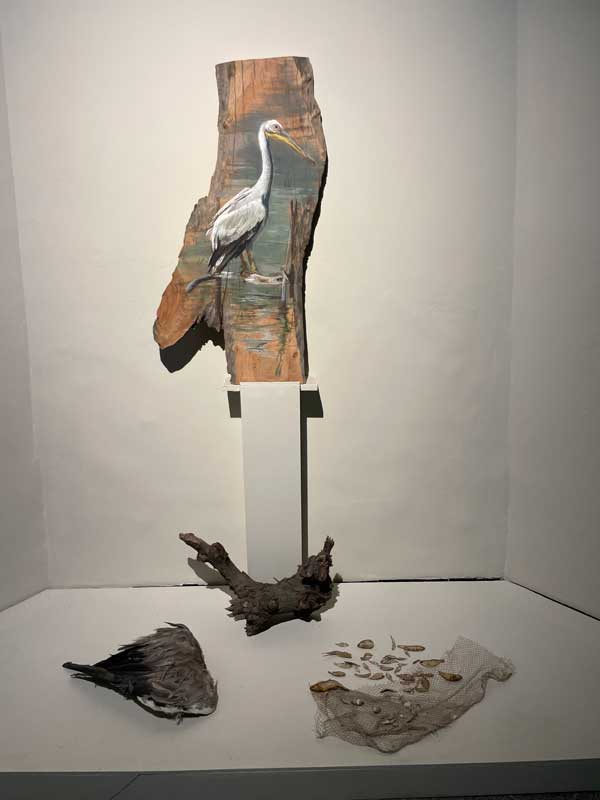
Amna Rahman’s When the Birds Forgot to Fly captured the quiet horror of ecological decline: pelicans growing smaller, bodies adapting to scarcity. Disappearance, the work suggested, does not arrive dramatically. It seeps in.
Much of the work produced during the Manchhar Lake Art Residency does not attempt to reconstruct what has been lost. Instead, it dwells at the threshold, between presence and disappearance, memory and erosion. The artists engage with Manchhar not as a stable landscape, but as one in retreat, where forms persist even as the conditions that sustained them fade. In this sense, the art does not rescue the lake from disappearing; it bears witness to its approach.
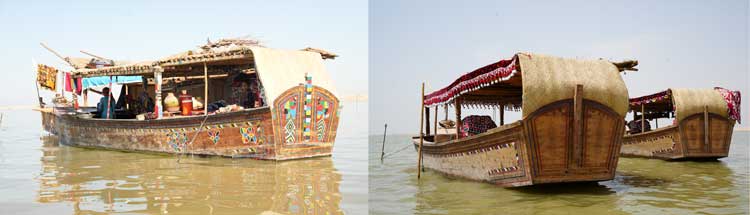
In Sufi belief, ghaib does not imply absence. It refers to that which has slipped beyond human perception but still existing, and no longer accessible. Manchhar appears to be entering this state. Not erased, not gone, but withdrawing. Its waters grow hostile. Its birds arrive in fewer numbers. Its floating homes thin year by year. The disappearance of the houseboats has been gradual, almost polite. One is repaired less often. Another is abandoned after a storm. A third is dismantled and reused on land. From nearly 450, only a few dozen remain. They have not collapsed dramatically; they have slipped away, one by one.3
Landscapes do not pass into the unseen by divine will alone. They are pushed there by neglect, by policy, by indifference. Manchhar’s waters still move. Its people still remember. Its birds still arrive, however tentatively. What remains is not a question of loss, but of accountability. Whether Manchhar will continue as a living ecology or recede into memory depends less on acts of remembrance than on acts of refusal…the refusal to normalise slow disappearance, the refusal to mistake endurance for consent, and the refusal to let a lake, and a people, slip quietly beyond reach.
Title image: Aerial view of the floating houseboat village on Manchar Lake.
Photo credit HC-DAPNED 2024-26
- Manchhar Lake’s long-term ecological decline has been widely documented. Pollution from saline agricultural runoff, municipal sewage, and industrial effluent – particularly through man-made drainage systems such as the Right Bank Outfall Drain and the Main Nara Valley Drain – has severely reduced water quality, fish stocks, and bird life. See Paradise Lost: How Toxic Water Destroyed Pakistan’s Manchar Lake, Agence France-Presse (AFP). See also studies by the Pakistan Council of Research in Water Resources (PCRWR), which classify Manchhar Lake water as unfit for drinking due to biological contamination, including coliform bacteria.
- For historical and ethnographic perspectives on the Mohanna community, including discussion of their name and cultural transformations, see Sindhological Studies, Vol. 25 (2009). Ethnographic and folkloric accounts often describe the Mohanna as “people of the wetlands” or “bird people,” reflecting their ecological knowledge and synchronisation with migratory bird cycles. While evocative, such framings risk obscuring material histories of displacement driven by environmental degradation, reduced freshwater access, and changing fishing rights. Exhibition text from: “Manchar Lake Mohannas – Safeguarding the Last Surviving Houseboat Village from Extinction”
- The gradual disappearance of Mohanna houseboats reflects a broader pattern of slow ecological attrition rather than sudden collapse. From nearly 450 houseboats in recent decades, only a few dozen remain today. This decline has been attributed to long-term pollution, reduced freshwater inflows, and policy neglect, resulting in the progressive uninhabitability of the lake. See AFP (Agence France-Presse) reporting and PCRWR (Pakistan Council of Research in Water Resources) studies cited above.
Rumana Husain

Rumana Husain is a dedicated author, art critic, artist, and educator, who has made significant contributions to storytelling, art, and social impact. She served as the co-founding Senior Editor of NuktaArt magazine from 2004 to 2014. She has written two critically acclaimed coffee-table books detailing the lives of Karachi's inhabitants, and is the author and illustrator of over 90 children's books, with four of them winning awards in Pakistan, Nepal, and India. Furthermore, she has authored hundreds of articles, travelogues, and reviews for various national newspapers and magazines.
There are no comments