
When I first came across the title Interrupted Reveries, I found myself pausing to think about the display. The curator Fatma Shah translates this title as ‘Khwab o Khayal’ in Urdu. And this reminded me of the French philosopher Gaston Bachelard, who wrote in his book, The Poetics of Reverie (1960), “We do not dream in order to escape reality; we dream in order to be able to stay.1 A reverie, as Bachelard articulates, is beyond idle daydreaming. It is a productive, poetic mode of consciousness—inward, and unburdened by linear time or rational structure. To interrupt a reverie is not a neutral gesture but rather a deliberate rupture.
The exhibition was displayed at Mehta Mansion in Lahore and acted as a collateral show for The NCA Triennial 2025. Shah’s curatorial note frames the notion of the interrupted reverie through contemporary media, digital systems, and our massive needs for validation that constantly disrupt our attention through nudges like our phones lighting up.
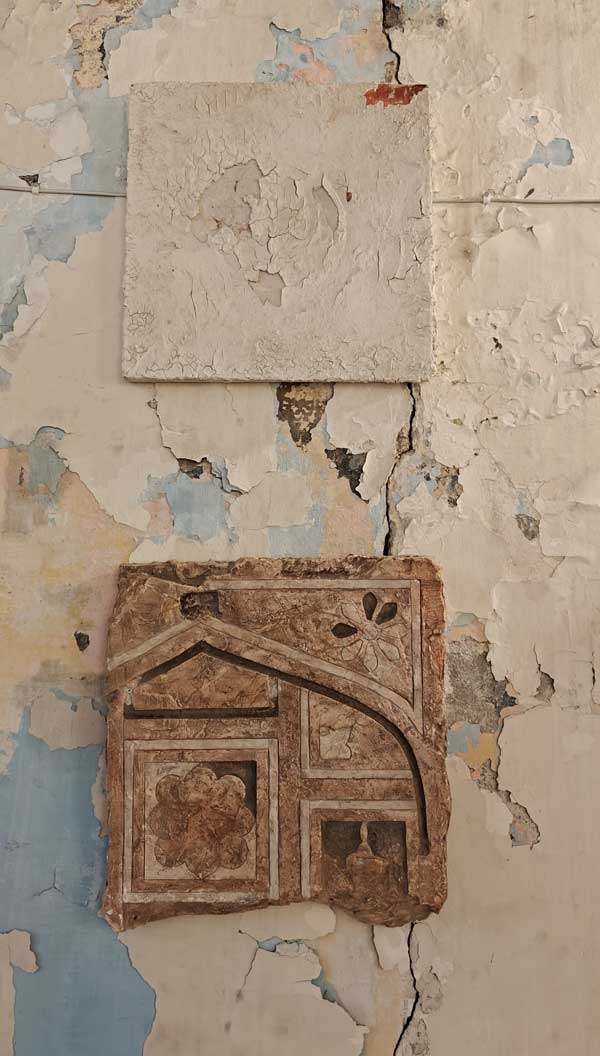
Maryam Jahanzeb Baig’s painted clay and wood panels are among the exhibition’s most resolved works. From a distance, they resemble architectural fragments however, on the surface, they look wounded with scratches and stains, accumulated like evidence of the past. Her engagement with the walled city heritage sites and the markings visitors leave behind avoids nostalgia. These are witnesses to human presence and casual acts of trespass. Fingerprints and accumulated residue become visible records of how the present marks and alters the past. The layered paint behaves like a palimpsest2 where the personal traces of the visitors gradually write over one another.
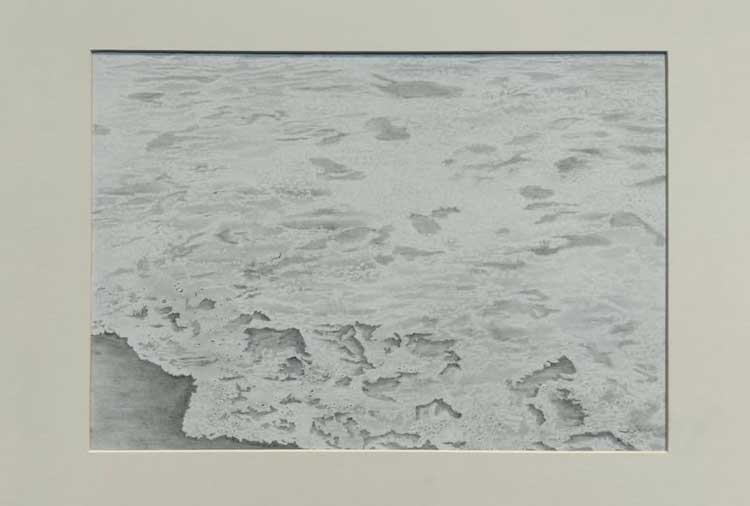
Kainat Ghazanfar’s skillful drawings of water, as seen in Untitled (2025), might be (physically) the softest works in the exhibition, but they lingered with me the longest. The transient nature of water is conceptually aligned with the exhibition’s theme. Attempting to capture a wave itself is an interruption. However, this subtlety risks dissolving away, without sufficient conceptual dilemma complicating the artwork. Still, these drawings provide a moment of breathing for the viewers. In an exhibition about distraction, that physiological shift feels relevant.
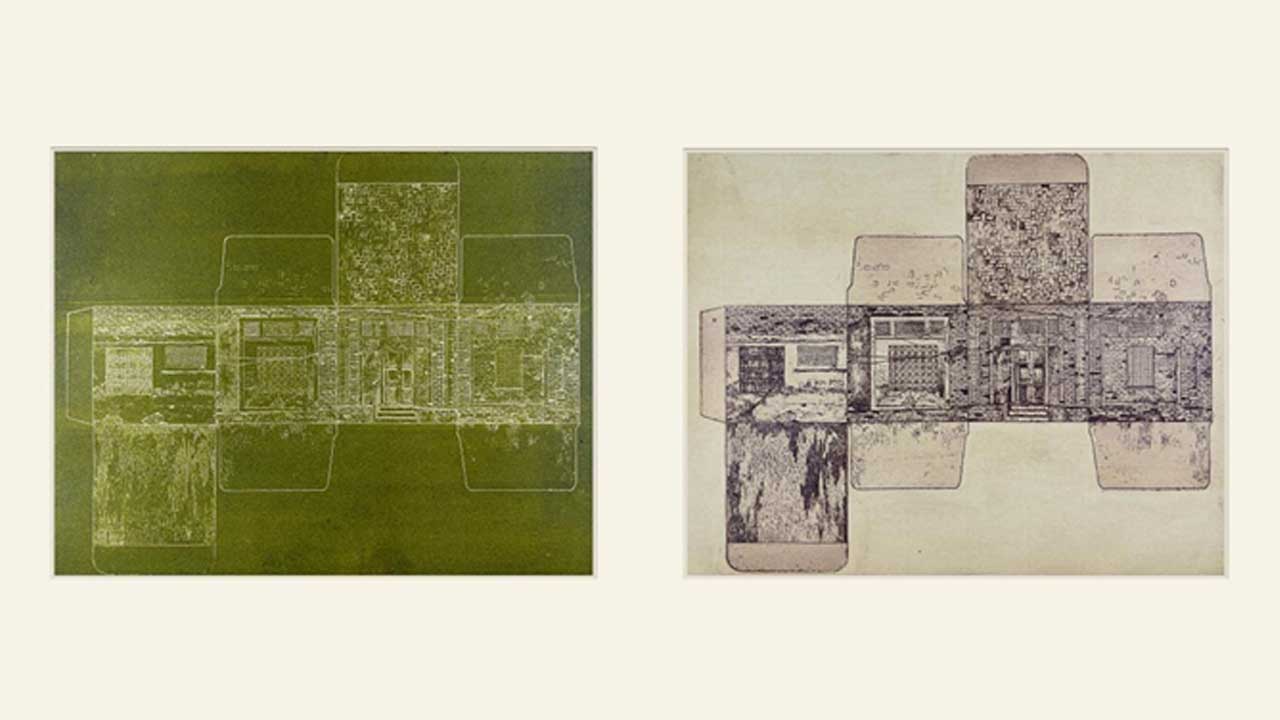
Hamza Bin Faisal’s muted interiors present the house as a container of memory. The cliché of the empty room is familiar and some of the compositions approach predictability. Yet the artist resists sentimentalizing these spaces. Faded browns tones, quiet corners, and absence of narrative detail keep the paintings observational rather than emotionally overstated. Bachelard wrote about the house as the first universe of memory,3 and Hamza paints precisely that; rooms as containers of time.
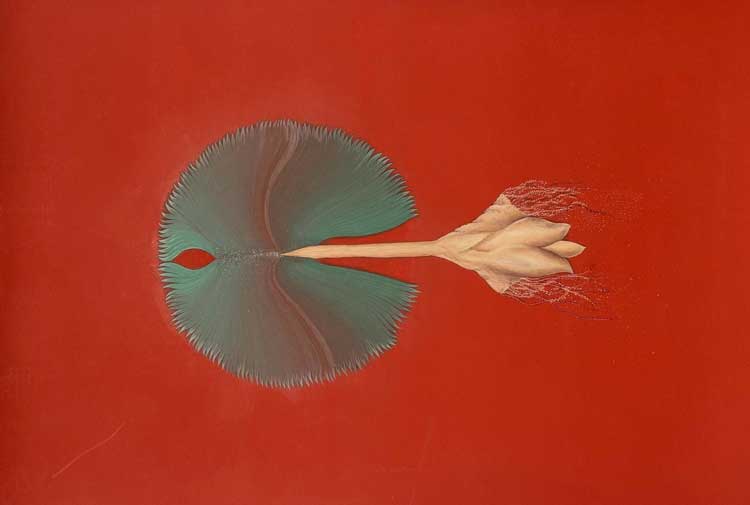
Where several works lean toward the idea of fragility, Bareera Sajid’s gouache works draw from botanical traditions of Mughal manuscript painting. Bareera avoids a simple continuation of historical styles. Instead, her plants are carefully rendered, which reminded me of colonial botanical drawings, where cataloguing flora served both scientific curiosity and imperial control,4 with meticulous brushwork and disciplined compositions. Her pencil studies, graphite sketches, and stained paint pots were particularly effective in demonstrating control rather than the reverie slipping away.
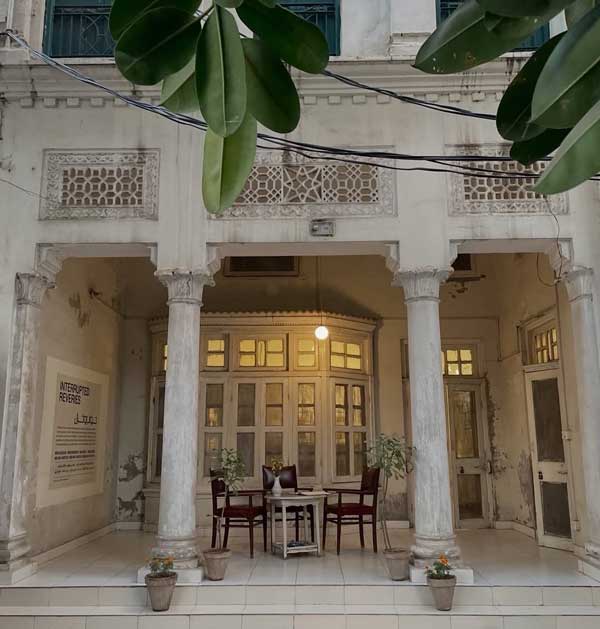
The exhibition’s most successful gesture may be Fatma Shah’s use of the Mehta Mansion itself. Rather than neutralizing the colonial-era house into a white cube, she allows its aging plaster and chipped paint to collaborate with the artworks. Baig’s weathered panels echo the scuffed walls and Sajid’s botanicals converse quietly with the fading textures. The exhibition might have benefited more from positioning its most confrontational works directly beside the somber ones, allowing viewers to feel that contrast rather than infer it. The works demonstrate how aesthetic resolution can coexist with conceptual objectivity. Interrupted Reveries suggests that the act of staying might be resistance, per se. And perhaps, that is enough.
The exhibition titled “Interrupted Reveries” was curated by Fatma Shah and displayed at the Mehta Mansion, 11 Temple Road in Lahore, as a collateral to the NCA Triennial 2025 from 15th November to 7th December 2025.
Title Image: Hamza bin Faisal, At Close Quarters, 21 x 28 inches, line etching and top roll-on archival paper, 2025.
All images are credited to the gallery and the author.
Bibliography
Bachelard, Gaston. The Poetics of Reverie. Translated by Daniel Russell. Boston: Beacon Press, 1971.
Bachelard, Gaston. The Poetics of Space. Boston: Beacon Press, 1964.
Huyssen, Andreas. Present Pasts: Urban Palimpsests and the Politics of Memory. Stanford, CA: Stanford University Press, 2003.
Thomas, Nicholas. Colonialism’s Culture: Anthropology, Travel and Government. Princeton, NJ: Princeton University Press, 1994.
- Gaston Bachelard, The Poetics of Reverie, trans. Daniel Russell. p 8
- Andreas Huyssen, “Present Pasts: Media, Politics, Amnesia,” on the palimpsest as a metaphor for urban memory.
- Gaston Bachelard, The Poetics of Space, (Beacon Press, 1964), 24.
- Nicholas Thomas, Colonialism’s Culture: Anthropology, Travel and Government (Princeton University Press, 1994), on botanical cataloguing and empire.
Sumbul Natalia

Sumbul Natalia is a Lahore based visual artist, writer and researcher. She graduated in Visual Communication Design from College of Art and Design, Punjab University and holds an MPhil in Cultural Studies from the National College of Arts, Lahore. She currently serves as a lecturer in the Visual Communication Design Department at National College of Arts, Lahore and is a PhD scholar in Art and Design (studio practice) at the Punjab University. Natalia has been part of several group shows locally and internationally and has participated in various residencies and conducted curatorial projects. She regularly writes for different magazines including ArtNow, The Karachi Collective, Aleph Review, Nigaah Art, ADA magazine and The Friday Times.
There are no comments