The Iran, Israel and USA war has become increasingly about digital imagery, fake news, AI generated scenes as a part of its war strategy. The television and digital news channels churn out information that is too much to absorb and process, rationally. Cities in rubble, drones and missiles in the air, infernos and smoke have begun to dominate the screens. Pictures of assassinated leaders and their witch hunt with little regard to human rights conventions that have been signed by the attackers, are prophecies of a lawless future. Where do ordinary human beings stand in this chaos of violence. Often reduced to body statistics, a number that escalates as fates of soldiers and civilians are decided in war rooms.
A time long before television, when photography was still nascent, the iconic Guernica foregrounded the tragedy of the small town in Northern Spain that was bombed to oblivion during the Spanish Civil War. The name of the town would have slipped into the cracks of history if Picasso had not chosen to speak out in 1937. Guernica with its cubist depiction of silent screams, broken bodies and terror from the sky has become a timeless symbol of the brutality of war. It’s not an easy painting to spend too much time with as the images seep into your head and snatch back the veil over endless crimes of war.
Bashir Mirza in the 1990s with his anti- nuke paintings spoke out against the French testing of nuclear capabilities in the Pacific. He dedicated it to the memory of the American nuclear bombs dropped on Hiroshima and Nagasaki that wiped out the two town in the 1940s. It burnt to death thousands and left many more disfigured and crippled. Scarred generations with radiation, and poisoned land where only contaminated crops could grow for decades. Today when nuclear bombs are more powerful and in the hands of many countries at war, a repeat of the conscienceless attack on Japan by America, almost a century later, doesn’t seem such an impossibility.
Zahoorul Akhlaq, after his visit to the bomb sites in Japan was haunted by them and for many years, the nuclear mushroom cloud became a reoccurring motif in his art. I remember standing in front of the singed pictures, maps and remnants from the burnt homes at the Hiroshima Museum and feeling an intense sadness at how both the victims and the perpetrators would never be able to be fully human again.
London based activist painter Afshan Shoaib, in her moving anti- nuke protest in the 1990s, depicted a generation of nuclear war survivors, with their mutated bodies and waxen faces, trapped in the irreversible condition of radiation sickness. The artists’ response to the long running Vietnam War came in different forms, the dissident works that no museum would show at that time, are now surfacing in retrospective shows. They reveal a deep anguish and moral questioning of the conflict that lasted from 1965 to 1975 before it ended with tens of thousands dead, and a victory for the Vietnamese people.
Artists in war torn countries give visibility to destruction of lives and homes by using the ruins as their canvas. Painters called ‘ArtLords’, in the towns of Afghanistan, are painting mural on the walls of bombed homes and public building. This archive of a people’s memory of the war is an important gesture that problematizes the linear media narrative that for long has essentialized their way of being.
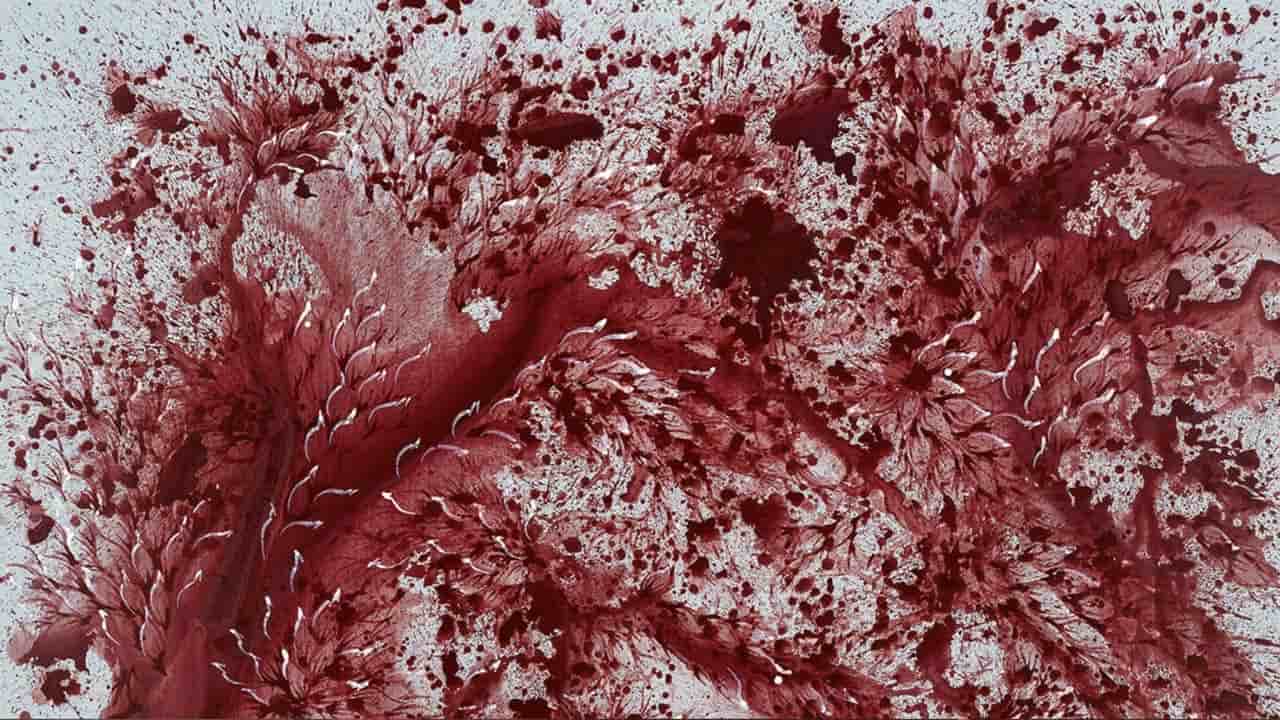
The violence on the Pakistani people by extremists’ groups was never seen as a full-fledged war yet its violence killed and maimed thousands. Its brutalization of Pakistani society drew response from artists. The most brutal and visceral interpretation depiction came from Imran Qureshi who created paintings with a pigment that was the exact shade of fresh blood. These huge works on paper were often imprints of body, limbs and sometimes just splashes that seemed to have left behind by injured up bodies. These were his disturbing catalogue of the human cost of asymmetrical war.
Palestinian artist Jenin Yaseen work that faced censorship at Royal Ontario Museum in 2025 was about how even dead bodies are held hostage by Israeli forces that deprives the human being of timely last rites. This act of disrespect for the dead further strips away the human dignity held sacred by all belief systems.
This dehumanization of the living and the dead, in battles, air strikes and assignations may be a strategic plan for war mongers, but for the artist who occupies the same vantage point as the vulnerable, will always be about the pain of the individual, the community and loss of humanness.
Title Image: Imran Qureshi, detail form ‘The Garden Within’, 2014, Acrylic on canvas, 137×198.1cm, Collection Guggenheim Abu Dhabi



There are no comments