

In a world preoccupied with certainty, Sara Aslam’s work offers something quietly radical: permission to remain in flux.
Across the globe, cities are growing at unprecedented rates, with over 56% of the world’s population now living in urban areas, a figure expected to rise to nearly 70% by 20501. In Asia alone, more than 2.3 billion people currently reside in cities, often within standardized, high-density developments or sprawling suburbs that prioritize efficiency and uniformity over cultural or ecological sensitivity2.The toll is more than environmental though. It is the fading of history, the loss of identity, and the quiet vanishing of life’s untamed, unpredictable beauty3.
Within these neatly drawn lines and precise plans, Sara Aslam moves gently aside. As the chosen artist for Ecologies of Diversity: Plants, Art, Film, she resists the urge to settle too soon or fix her vision too firmly. The project brought Aslam from the soil of Gumchi Bagh in Tumair, Pakistan, to the archival corridors of the Royal Botanic Garden Edinburgh. Her process was enriched by her interactions with schoolgirls at Azm e Nau in Tumair, where she led a plant-pressing workshop, and by mentoring from Professor Kerstin Stutterheim, who helped Aslam shape her archival and artistic inquiries. The residency was not about producing tidy outcomes. Instead, it invited a deeper reckoning with interconnection: between land and lineage, craft and memory, seed and story4.
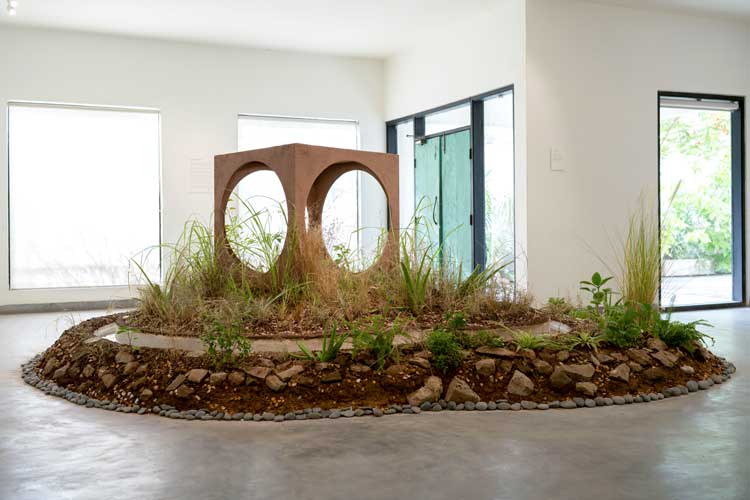
In Aslam’s evolving practice, plants are never mere specimens. Throughout her work, a sensitivity to materials stands alongside a deep commitment to listening to plants, places, and people. They emerge as collaborators, carriers of memory, and quiet agitators of inherited landscapes. This sensibility comes to life in her first installation for the exhibition, titled Island – Conceiving Ecotopia. Here, Aslam composes a compact, living terrain consisting of wheatgrass, mint, bougainvillea, and aloe vera pressed up from a carefully constructed soil bed. Some are wild, gathered from the waysides of her research journey; others are domesticated. Yet together, they root and rise in uneasy harmony, nurtured by a blend of earth drawn from both Karachi and the residency site. This soil is not singular; it holds many layers and speaks to deliberate choice.
Suspended above this microcosm is a red-plastered architectural form, acting as a cubic canopy with arched openings, embedded with a seashell and stones. It hovers like both shelter and satellite, quietly echoing Aslam’s inquiry into microclimates, soil typologies, and the migratory nature of seeds. The structure does not impose order but invites a question: What might it mean to build an ecosystem that embraces hybridity, improvisation, and mutual survival?
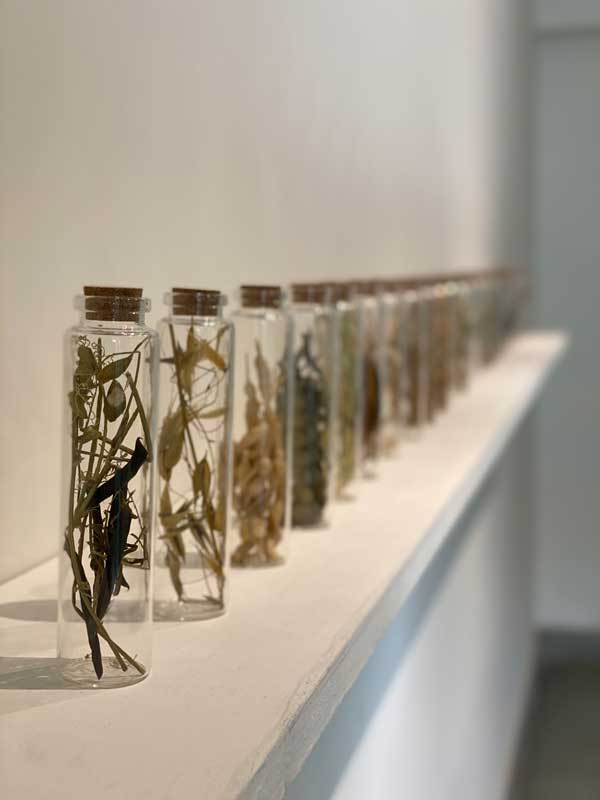
As one lingers on the question of future ecologies, the eye is drawn to a quieter arrangement and a contemplative counterpoint to the living terrain. In the Specimen Archive, Sara Aslam moves from the fertile to the fossilized, offering a line of glass vessels, each holding a fragile memory. Dried plant cuttings, curled, crisp, sometimes hauntingly intact, stand suspended in time, neither fully alive nor truly gone. There is a stillness here that feels devotional. Collected during fieldwork, these fragments are not embalmed in preservation fluid; instead, they are left to decay as they will and allowed the dignity of slow disappearance.
If Conceiving Ecotopia imagines a speculative future where coexistence blooms from hybridity, then the Specimen Archive mourns and memorializes. It is a gesture toward what cannot be kept, despite our best efforts. To collect, in Aslam’s hands, is not to fix a thing in place, but to hold it just long enough to watch it transform.
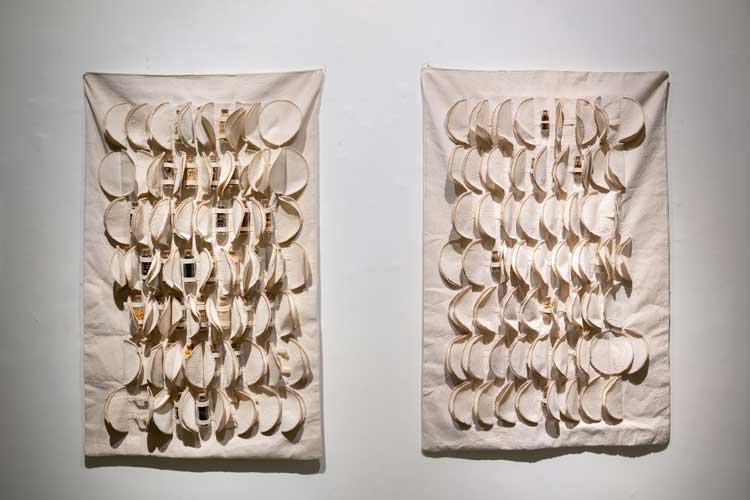
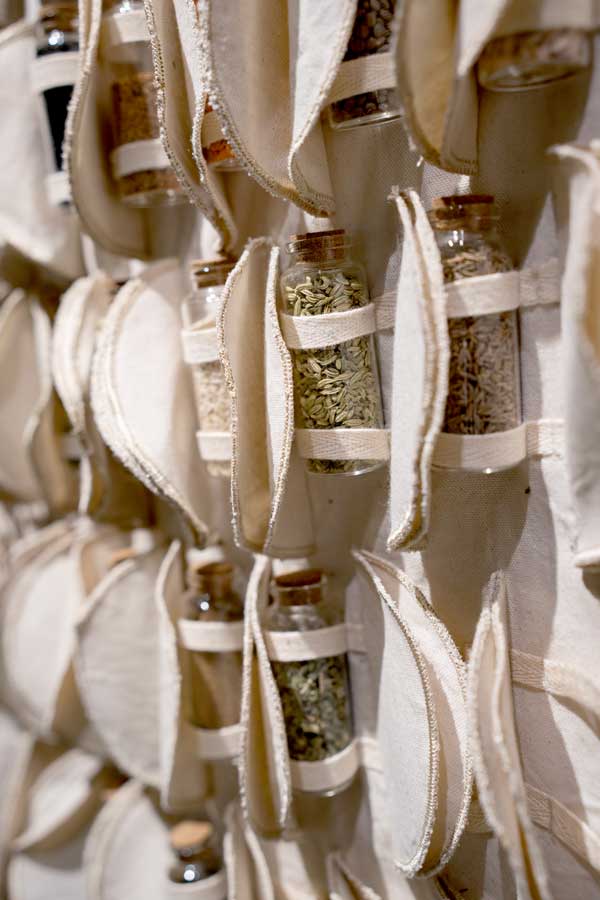
Beyond studying the existence and transformation of plants, Aslam is deeply invested in how we, too, are shaped and altered through our relationships with them. In Life Kit – Portable Essentials, Sara Aslam turns toward the domestic and the diasporic, stitching a quiet intimacy into the folds of cloth and the weight of memory. Suspended on the wall like soft altars, two textile panels hold a constellation of circular pockets, each of which becomes a cradle for tiny glass bottles. These bottles are delicate reliquaries, filled with inherited knowledge, rituals of care, and the scents of home. There’s a tenderness in the way ingredients such as turmeric, dried petals, spices, are housed. It suggests a toolkit not for utility alone, but for comfort, for grounding, for healing. The form evokes a traveler’s companion and a vessel for the essentials one might carry across borders, across time.
For Aslam, these objects are clues toward a different kind of future. Her practice is grounded in a question she often returns to: what if? What if we imagined a reality where our lives depended more intimately on plants, on herbs, and on the wisdom they carry? In Life Kit – Portable Essentials, that alternate reality begins to take shape as a gentle proposition. Inspired by seeds from Gumchi Bagh, gifts from friends, and materials gathered from home, Aslam’s Light Kit also becomes an unfolding map of relationships. The cloth expands like memory itself, always making room for more.
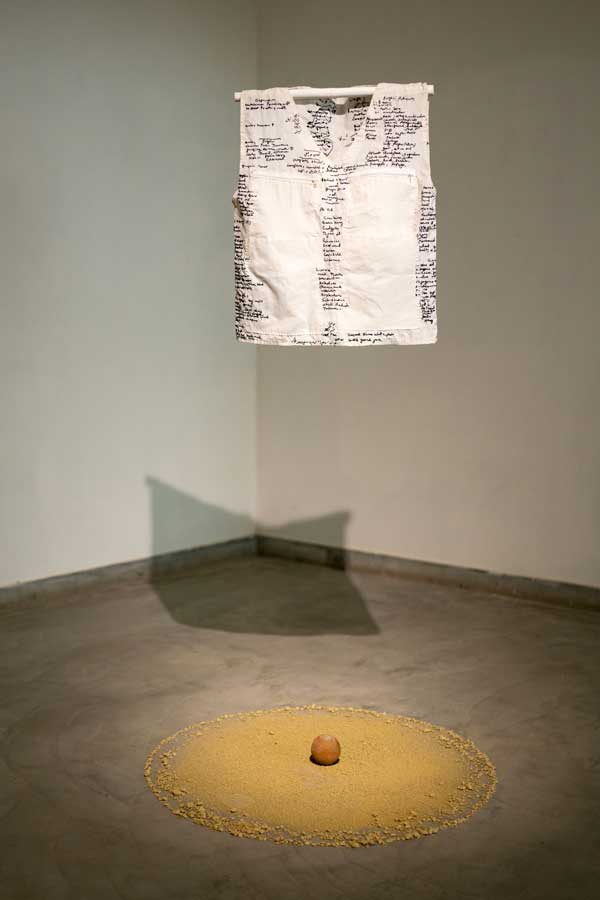
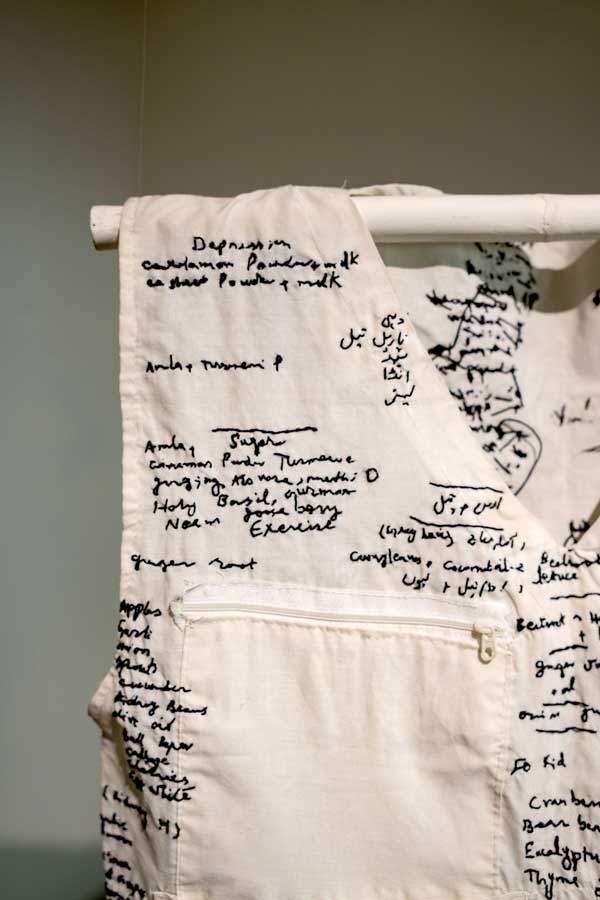
Complementing this is an embroidered cotton vest, a traditional undergarment once worn close to the body, often used to conceal valuables or sacred items beneath layers of clothing. In her reimagining, the cotton vest becomes a vessel for something equally precious: memory. Delicately embroidered across its surface are fragments of her mother’s handwritten notes which include recipes, herbal remedies, quiet instructions for care and recovery. These are intimate forms of knowledge passed down through touch, practice, and repetition. Rendered in thread, they are lifted from the ephemera of paper and preserved in cloth, closer to skin, closer to heart. This cotton vest evokes a lineage of care often erased from formal histories and is a reminder that knowledge is not always codified in books or institutions, but encoded in the everyday rituals of survival and affection. To wear this vest is to carry those rituals forward, to let the body become the bearer of soft resistance and intergenerational continuity.
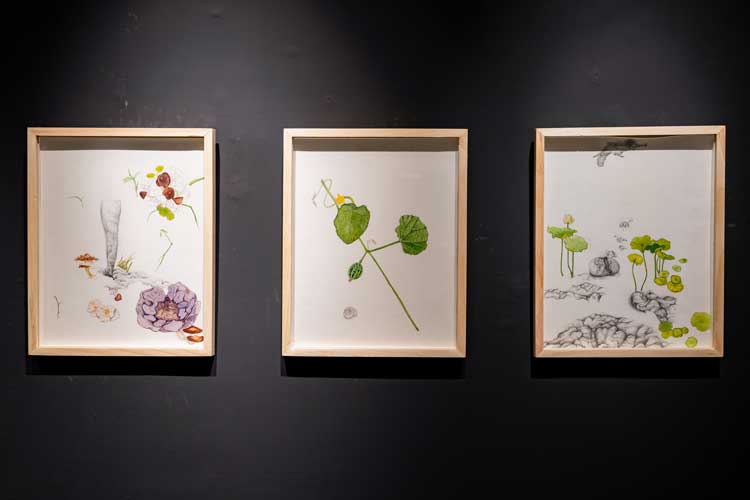
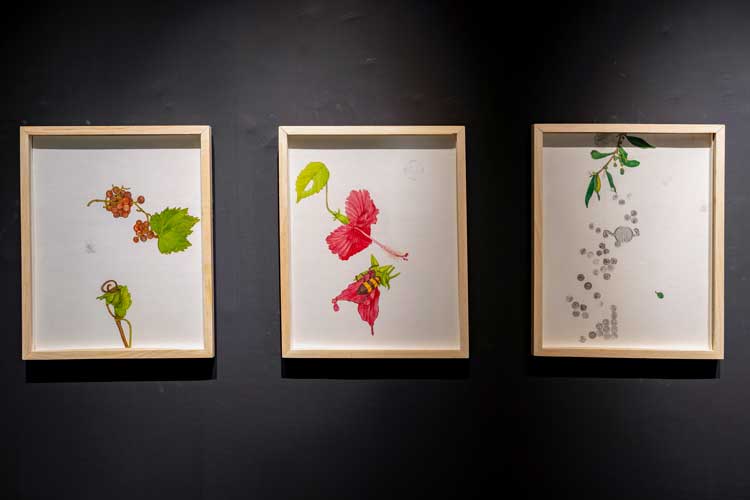
The vest’s intimate stitching of memory finds its echo in Aslam’s botanical drawings, where careful observation meets a poetic reimagining of plant life. In this introspective series, Sara Aslam traces the entangled lives of plants through a quiet, reverent gaze. Her drawings borrow from the language of botanical illustration, yet depart from its taxonomic rigidity. Instead, she renders a soft taxonomy of memory, dream, and the uncanny. Executed in a miniature-like style that nods to South Asian scientific traditions, these works fuse meticulous study with speculative layering. Mushrooms bloom beside lotuses, bitter gourds share space with creeping vines, and lichen-like growths unfurl next to surreal anatomical forms. These may seem like impossible pairings, but are deeply intentional ones. In some drawings, leaves and fruits are rendered with crisp clarity; in others the outline fades into blankness or smudges into dreamlike shadow. This tension between presence and absence speaks to the porous boundary between scientific documentation and poetic imagination.
By this point, it becomes clear that the exhibition does not present a single archive, but several. One is personal, held in the notebook, the dress, the stories shared by her mother and grandmother. Another is ecological, made of plants, soil, and natural materials gathered from the farm in Tumair and other sites. A third is more fragile, made from memory. Drawings of plants or small events that passed too quickly for a camera are made visible through careful sketching. In these drawings, memory becomes a form of record-keeping.
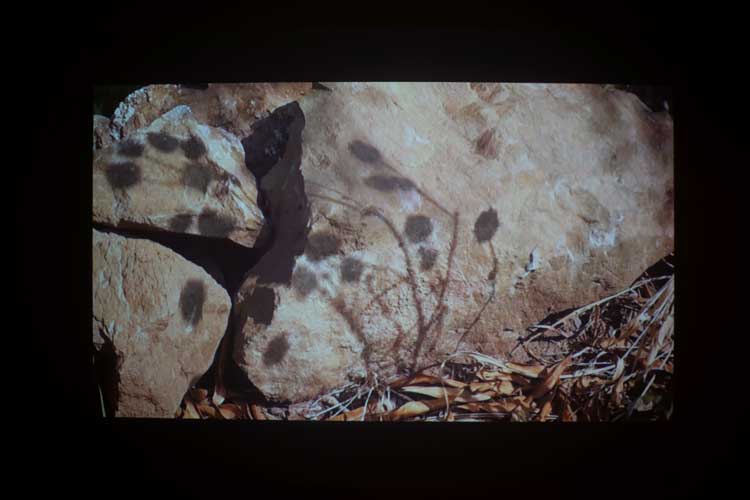
This layered approach to archiving finds a parallel in the film at the heart of the exhibition, where meaning unfolds not through narration, but through texture, rhythm, and attention to the momentary. The film does not lead the viewer with a clear story. Instead, it moves slowly, through sound, light, and small details. It asks the viewer to stay with each moment, to pay attention, to let meaning build gradually.
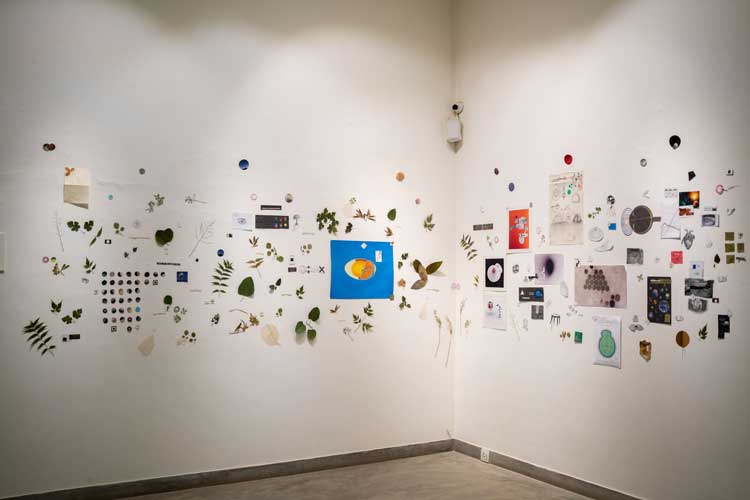
While the film draws the viewer inward through stillness and sensory detail, Aslam’s sprawling mind map charts a terrain of interconnected ideas. Spanning two walls, this sprawling mind map overflows with images, notes, fragments, and speculations. It is part blueprint, part personal archive, part philosophical inquiry. With no fixed beginning or end, it invites us into Sara Aslam’s active process of thinking through what it means to live, and to imagine, within contemporary conditions.
Every sketch, phrase, or clipping is a micro-response to the complexities of home, city, ecology, and society. The installation acts as a site for thought experiments and offers possibilities for resolving or simply surviving moments of tension, crisis, or wonder. These aren’t tidy solutions. They are speculative proposals, alternate routes, reminders of how the mind loops back, detours, and resists closure.
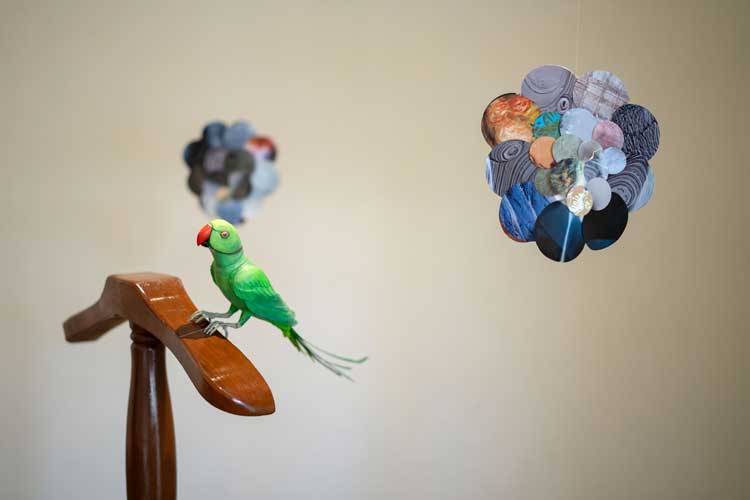
At the heart of the room, a live parrot perches, trained to repeat the word “art.” This simple act becomes haunting in its repetition. The bird, a symbol of mimicry and memory, performs a meditation on how language, and especially the language of art, is learned, repeated, and internalized. What begins as playful becomes unsettling. The parrot mimics what it hears, and in doing so, echoes the ways we absorb ideologies and fixed narratives.
Sara Aslam poses a question that often fades as we grow into the structures of wider community life: Is repetition a form of learning, or a kind of erasure? Perhaps there comes a point when routine solidifies into rigidity, making us less receptive to new possibilities. This question lingers in the space, brought to life through a subtle but persistent movement. A live element, such as the parrot, disrupts the stillness of the mind map and it renders the room strangely animate, slightly absurd, and quietly profound. What appears static begins to shift, echoing the very tension between pattern and change that Aslam seeks to explore.
Sara Aslam’s solo show, ‘The Ecologies of Diversity: Plants, Art, Film’, was exhibited at Koel Gallery, Karachi, from May 6th to May 24th 2025.
Title Image: (Detail) Island – conceiving Ecotopia.
Images © Haya Faruqui, courtesy of Koel Gallery. All rights reserved.
- 68% of the World Population Projected to Live in Urban Areas by 2050, Says UN | UN DESA | United Nations Department of Economic and Social Affairs. https://rb.gy/audebn
- Jones, Gavin W. “Patterns and Trends of Urbanization and Urban Growth in Asia.” Urbanization and Sustainability in Asia: Case Studies of Good Practice, edited by Brian Roberts and Trevor Kanaley, Springer, 2019. https://doi.org/10.1007/978-981-13-1537-4_2
- Theodorou, Panagiotis. “The Effects of Urbanisation on Ecological Interactions.” Current Opinion in Insect Science, vol. 52, April 2022. https://doi.org/10.1016/j.cois.2022.100922.
- Ecologies of Diversity: Plants, Art, Film. Koel Gallery. 2025. E-catalog
Zunera Rashid

Zunera Rashid is a visual artist based in Karachi. Her practice centers on collage and the exploration of female narratives through found print media. A Fine Art graduate from the Indus Valley School of Art and Architecture (2024), she draws inspiration from Karachi’s bustling paper markets, working with printed ephemera. Her work challenges traditional portrayals of femininity by reconstructing overlooked materials. Zunera has exhibited at VM Art Gallery and Sambara, and her research is published in the Urban Repository Archive.
There are no comments