The Paris based International Association of Art Critics (AICA) carried out a Freedom Expression Survey in the summer this year, with participants from fifty-nine countries. The results were far from optimistic as numbers reflected widespread censorship: 44% of the respondents confirmed that they experienced censorship in some form or the other, while 79% of the participants said that they practiced self-censorship.
This gives us an insight into the threat art professionals face as self-censorship continues to normalize.
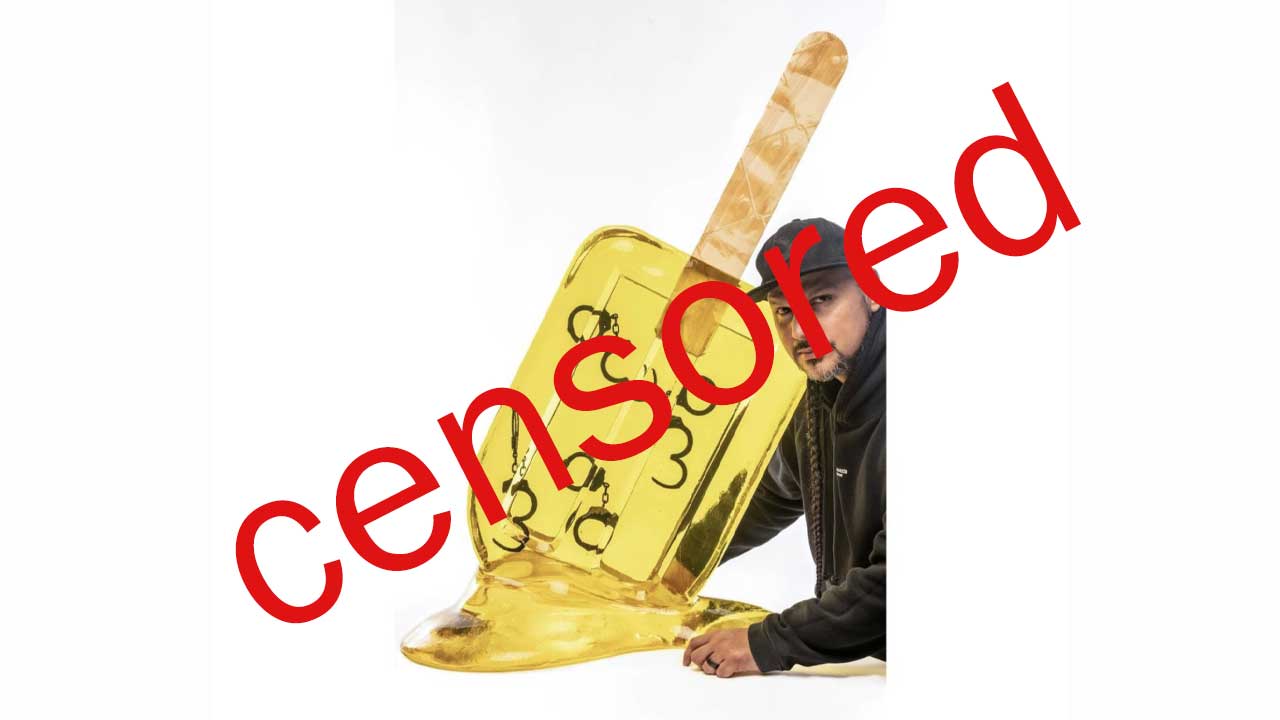
The means to control the narrative have become frequently violent as draconian policies and laws muffle dissent in all forms. Art museums and national galleries that were once bastions of discursive plurality are now under attack. In the United States of America paintings and sculptures that represent the Black population and Indigenous people are being covered or removed by political Executive Orders. Recently, the exhibition Ni de Aquí, Ni de Allá (it’s neither from here nor from there) of Mexican American artist Victor “Marka27” Quiñonez was cancelled at the University of Northern Texas because it celebrated the experiences and resilience of immigrants. In an interview to National Coalition Against Censorship, the artist states, “It is about empowering people. It’s about pride. It’s about reflection. It’s about taking what you’ve learned growing up and using it to your best ability to uplift everybody around you”.
Conditions in Latin America are no different. The Colombian President Abelardo de la Espriella announced a “cultural counter-revolution” as objects and materials were removed from the National Museum displays, though later reinstated following protests. According to their Ministry of Culture’s submission to a Bogotá court, sixty-three items were removed, including those related to LGBTIQ+ communities, women’s rights, the history of political violence, and the 2016 Peace Agreement. When the erasure of history by removing precious historical objects takes place, institutions begin to lose their relevance and legitimacy.
An interesting case of censorship from South Africa about revisiting history to reclaim the dignity of the black body emerged this year. Works of artist Steven Cohen in a retrospective titled Long Life were covered up by the IZIKO Museum due to cultural sensitivities. This controversial case raised questions regarding the representation of the black female body and the colonial gaze. The critics condemned the objectification of the body as exploitative, especially as the model was a black domestic worker—Cohen’s childhood nanny and frequent collaborator Nomsa Dhlamini. The inclusion of Dhlamini’s nudes was seen as structural and institutional persistence of racism. In the end, a compromise was reached and the works were covered. This seems to have been solution of sorts, as the presence of the works kept the critical debate on colonial transgressions alive. Freedom advocates in African countries point to a systemic failure to recognize freedom of expression as a citizens’ right. Authoritarian governments often justify censorship in the name of cultural practices while allowing those who carry out acts of violence to act with impunity.
The Venice Biennale and Documenta have not been free of controversies. Earlier, the Documenta 16 Finding Committee was dissolved as all six members resigned after one of its members, Indian curator Ranjit Hoskoté, was labelled anti-Semitic by the German media because of his signature on a Pro-Palestinian petition that protested a Mumbai event linking Zionism and Hindutva in 2019. Germany faced a great challenge as large scale action was taken against all who voiced their support for the pro-Palestinian BDS (boycott, disinvestment and sanction). The government used extra constitutional laws to cancel events or exclude artists from state funding.
In Japan, people protested a law criminalizing the defamation of the national flag. Their concern was not with respecting the flag, but with the law’s vague wording, which threatened freedom of expression, particularly if applied retroactively. The law also raised concerns for public art collections, where artists had used the flag for decades to express social and political dissent.
While in Eastern Europe the rise of the pro Right politics in Georgia has led to strong protests by artists, filmmakers, and theatre artists. This has led to violence in the streets. One of the protest leaders shared that along with the protest they are carefully documenting all the performances, poster art, and actions as evidence of this dark period.
After WW II, UN’s cultural wing UNESCO worked with governments to protect freedom of expression. In recent decades however, we have seen the failure of the UN to act against all who violate its mandate. To address the threat to artistic freedom, the art community has begun to look for support at professionally led initiatives. Freemuse commissions annual censorship reports from countries to offer solidarity through regular dialogue among activists. Forensic Architecture is an interdisciplinary group that uses art as an investigative and political medium. Its research investigates alleged human rights violations by states and corporations on behalf of civil society groups. Silenced, Not Stopped: AICA’s Toolkit for Resisting Censorship is gaining global traction as art professionals seek to understand the diverse and complex forms of censorship and how to counter them through international legal networks, pressure groups, and artistic rights advocacy organizations. The National Coalition Against Censorship works with institutions to mitigate the impact of censorship policies on art practitioners and brings visibility to cases through its Collective Courage project.
We are now faced with two choices. One is to remain under the radar through self-censorship, waiting for the world to reset. This may come at a heavy price, as the landscape of resistance could be severely disrupted by then. The other is to work with advocates of freedom of expression and draw on the 1980 UNESCO Recommendation concerning the Status of the Artist. The Recommendation asserts that member states have a duty to protect, defend, and assist artists and safeguard their freedom of creation. It establishes freedom of expression and communication as essential prerequisites for all artistic activity, placing the responsibility on member states to ensure that artists receive the protections guaranteed by international and national human rights legislation. By participating in advocacy campaigns, we can help keep the beacon of hope alive for ourselves and others.
Title image: Victor “Marka27” Quiñonez, Limón Guilty Flavor, I.C.E. SCREAM SERIES, 2025. Photo by Street Theory Studio, courtesy of the artist. The word ‘censored’ is added on the request of the author of this article and is not part of the original image.


There are no comments