Recently I was asked at a local university about the future of art and creativity in the age of Artificial Intelligence (AI). As someone who belongs to the pre-computer generation, all the memories of the 1990s— when a computerized manufacturing industry threatened redundancy in factories and offices— came back. I remembered seeing the transformation that followed the advent of the ‘thinking’ machine and its impact on our ways of doing things.
Along with these fears and setbacks also came new opportunities like the Silicon Valley, a phenomenon replicated across the planet. Startups in the twenty first century have begun to cater to new needs we never knew we had, and ways of doing things not explored earlier. Today, it’s difficult to imagine a world without digital tools and applications.
Once again, with AI we are stepping deeper into the unknown digital universe. Besides the curiosity, it has also created a sense of unease in many fields. In visual arts, animation has been hit by AI as jobs are disappearing and other creatives fear the same. While it’s the artist that still creates the concept, AI becomes an effective tool to carry out the thousands of detailed illustrations from the man-made template and codes it into a seamless animation. It’s cheaper too, as AI does not carry the responsibility of supporting households.
When the first AI generated artwork was put up for auction at Sotheby’s it called on the world to look closer at the limits of appropriation. All the overlap and slippages have begun to raise questions about creative autonomy. To get some clarity we need to reflect on the fundamentals that separate the machine from us humans. What is the genesis of creativity in humans, how it incubates, germinates into art, poetry, fiction and music. I like to think of AI as an intelligent knowledge bank that can respond to the information it has stored in its mega systems, it can select and analyze but new connections of a complex, original and superior kind are beyond its capacity as it creates within the echo chamber. Inspiration is an energy fueled by the person’s innate ability to think with originality, a subconscious process that emanates from our DNA. A layered blueprint that we all carry within us that has become dense, nuanced and honed over time with the stimulus it receives through all the senses. Intuition is informed by emotional and physical, mental and spiritual resources both received and what we experience in life. We may not fully know how it functions simultaneously at multiple levels but we recognize it as ‘a gut feeling’ and ‘something that feels right’. This is what signals the artist to stop at a particular point, create a signature style and make choices.
The conscious and subconscious radars scan and assimilate the microscopes signals within our memories that range from the mental, emotional and physical. Remember skills are all about muscle memory connected to the mind.
AI does not have DNA or several millennia deep memory and evolution. Nor the grasp of the complex entanglement of conscience, social values and ethics that inform the intangible process of human creativity. What AI has is a super powerful memory of books and images created by humans with the power of their own imagination. AI can respond to questions and prompts but will never be able to compete with millions of humans, who each have the power to reimagine each book many times over, through the lens of their own lived experiences and intuition.
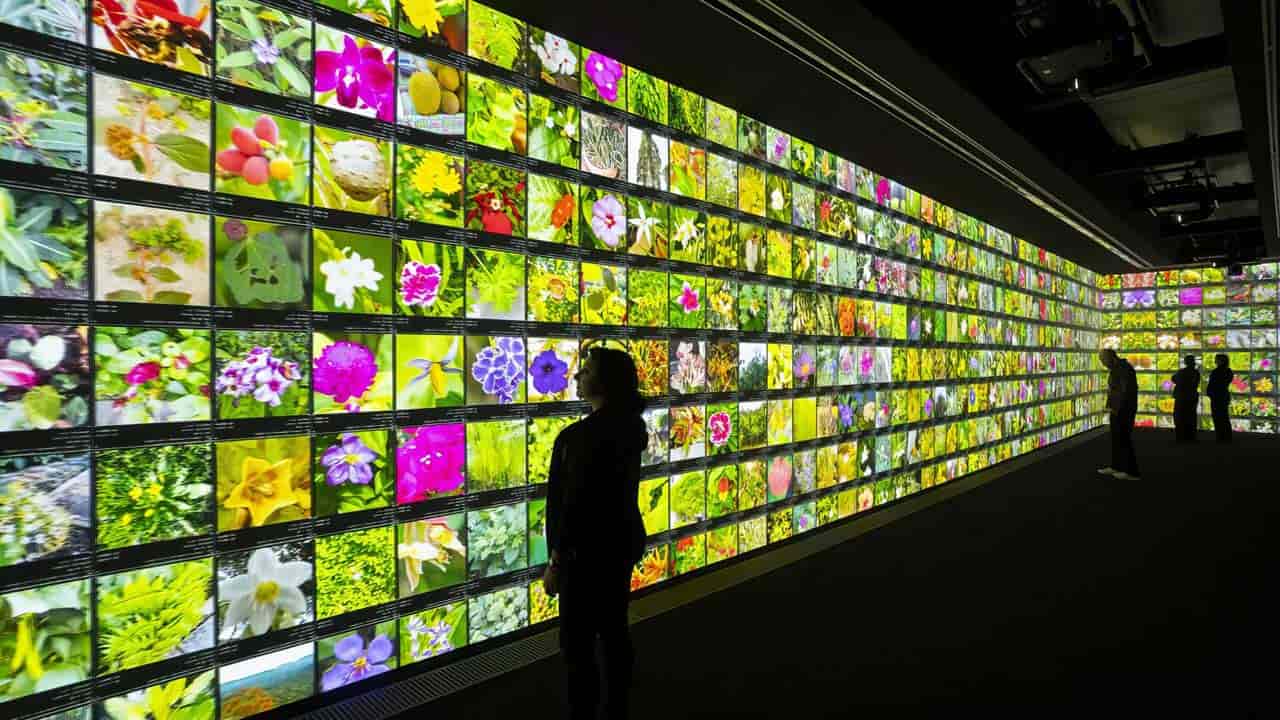
Image Credit, ‘Echoes of the Earth: Living Archive’, Rafik Anadol
Refik Anadol



There are no comments