
It was a quiet revolution the day artists gave materiality agency. Hyperbolically speaking of course, since it did not happen in a day, artists were investigating and employing the power of materiality long before it gained recognition in mainstream art criticism. American critic Clement Greenberg was pejorative in his dismissal when he said, “Given that the initial look of non-art was no longer available to painting, since even an unpainted canvas now stated itself as a picture, the borderline between art and non-art had to be sought in the three-dimensional, where sculpture was, and where everything material that was not art also was.”1 But other American artists like Robert Rauschenberg and Frank Stella were coherent in their goal of pursuing art’s anthropomorphic properties. Rauschenberg states, “I think a painting is more like the real world if it’s made out of the real world.”2 In the exhibition Nisbat Road to Troutman Street at Sanat Initiative, Khalil Chishtee has constructed a body of work that bears testament to the streets of his life; first in Lahore, then in New York; imbuing from both an expansive and unconventional view of an existence of immeasurable reality.
Knowing Chishtee’s history of using plastic trash bags as his medium, it is unsurprising to see him continue his practice with consistent structural and thematic consistency. He was told during his art school days he would not succeed as a painter because his perception of colour was skewed. Yet his skill in the representation of the human body was incomparable. Sculpture became his refuge from the naysayers who themselves may have gone on to become great artists, who were ironically not known for the use of colour in their own work. Chishtee recounts that when he first came to New York several decades ago, the mountainous piles of trash bags overwhelmed his senses. Though it filled him with distaste, he decided to use the detritus as the resource for his work. Over the years, he has made life-sized representational figures, singular or in groups; men, women and children out of little else but trash bags, a craft glue gun and a heat gun. These forms are remarkably lifelike and radiate an extraordinary aura; a raw psychological presence. Some look vulnerable while others monumental, but they are all unflinching explorations of the human psyche.
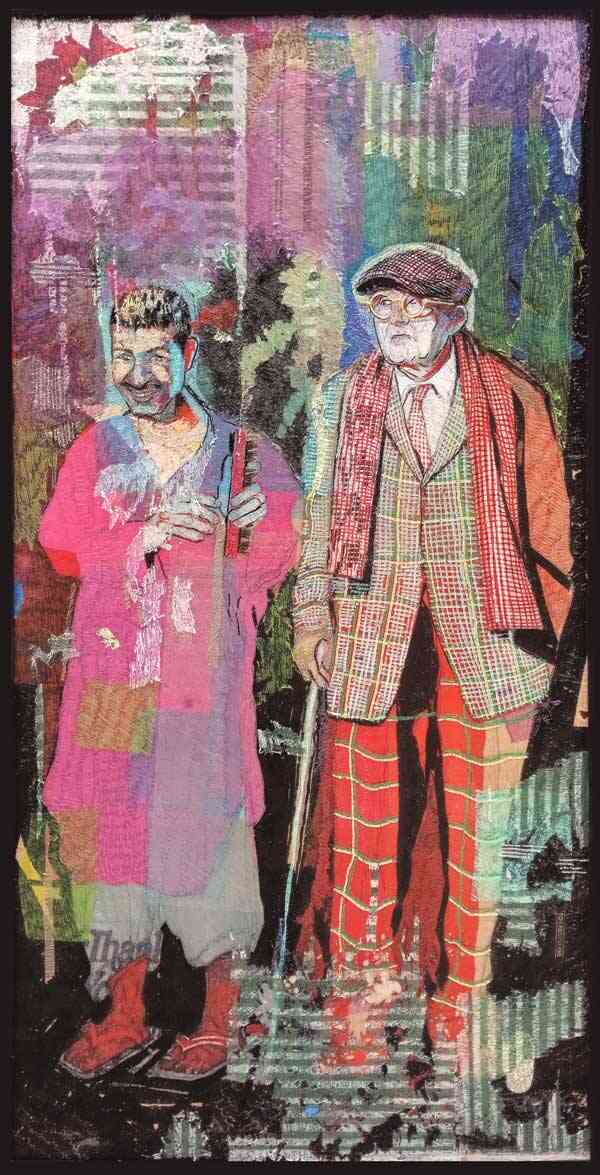
Over two decades later, Chishtee has reframed the investigation into his medium. This time, the plastic bags are flattened on board, then layered and scratched, scraped and ripped, and layered again as if recalling years of memories, events, experiences. The cohesiveness of the artwork stems not only from its materiality but also the mnemonic interposition of the artist. The surface work is scrupulous in its detail. The painting Men with Brushes (2026) is sardonic—British painter David Hockney (d. 2026) stands beside a smiling Pakistani street vendor who would brush your shoes for a few rupees. The plaid of Hockney’s coat is restructured from lines of different coloured plastic, cut and glued down. Other checkered patterns on figures or smiley face plastic bags in the backdrop were sourced from neighbourhood bodegas and dollar stores.
Chishtee’s strain of rebellion against conformity, both as a personality trait and as an artist challenging norms, does not reveal itself overtly but as subversive undercurrents within a larger refined, well-articulated aesthetic commentary. It is significant that his materiality is a pivotal engagement of his art but unlike other artists who use elements that are ephemeral and formless to indicate temporal notions (for instance, Icelandic Danish artist Olafur Eliasson, who uses mist, light and air to create atmospheric properties), Chishtee’s plastic is not a mutable, procedural or performative configuration. In fact, in an organic decaying world, the plastic will outlive us all.
German art historian Deitmar Rübel, in his essay Plasticity: An Art History of the Mutable (2012), writes about the process when new materials were being introduced into mainstream art;
“These unformed materials not only represented an attack on the artistic formats of established art — the staged rebellion of material against obsolete art forms—but they were also the expression of a protest that hoped to abolish the present social order. This can also be seen in the ‘new materialism’ of the last two decades, through which interest has transferred from social structures to concrete things.”3
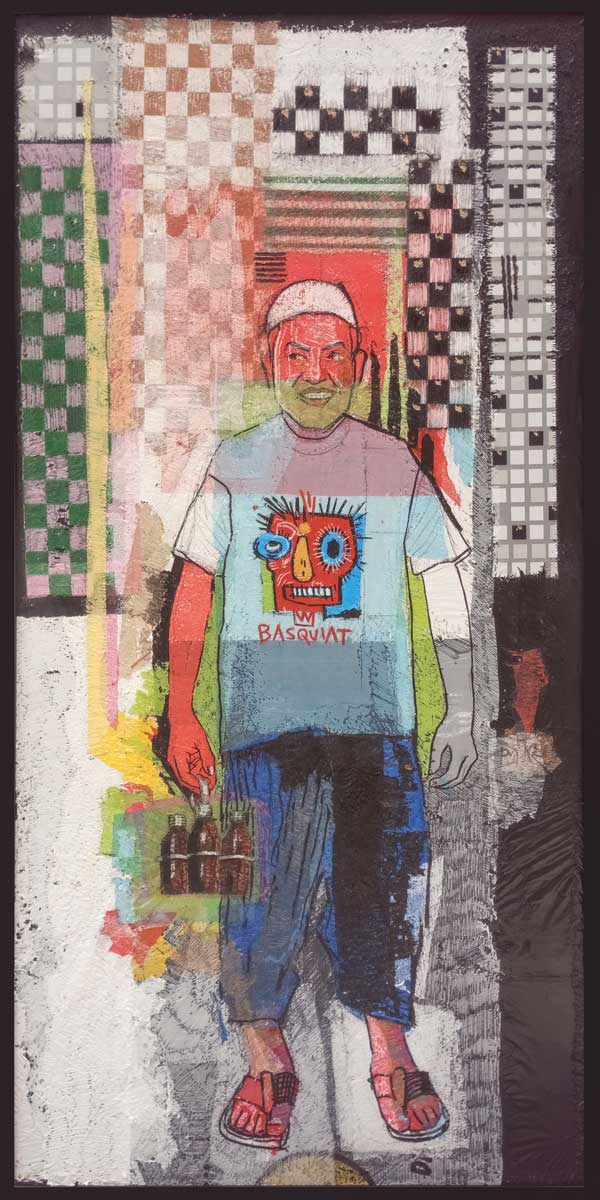
There’s the element of graffiti in Chishtee’s new works; long considered the annoying intrusion into contemporary art, it is vital to the heart of the current thematic framework. American artist Jean-Michel Basquiat’s (d. 1988) art on the T-shirt of Chishtee’s figure, titled Neo-Expressionist Maalshia (Masseur) (2026), does not go unnoticed. Wearing the shirt is a figure only found in the backstreets of Pakistan, clanging his bottles of oil, calling to customers wanting a head massage. Chishtee’s graffiti days stem back to his teens when activists used to persuade him to paint portraits of their political heroes on street walls because his rendering skills were renowned in the neighbourhood. Chishtee does not actually indulge in street graffiti himself, but in a city like New York, both street art and graffiti are inescapable.
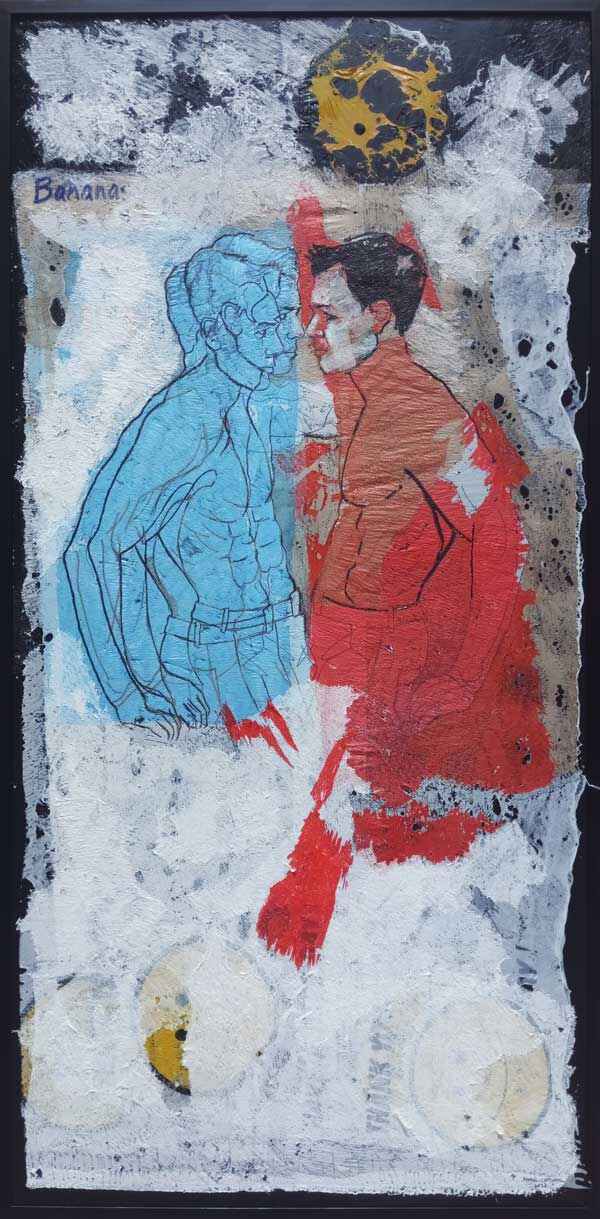
Portrayals of the diverse human condition in his current figures are provocatively eclectic. These are people entrenched in their little lives, distracted by material wealth or ensconced in a frenzy of their own making. People are happy in their refusal to speak against atrocity or injustice. People always engage in some power play. These are people from Chishtee’s past, present, future—people he has not yet met. These familiar and unfamiliar people, the graffiti, the ubiquitous plastic bags which Chishtee frames like a bricklayer to build his narrative upon are elements that bring him full circle from Lahore’s Nesbit Road to New York’s Troutman Street. This notion lies at the core of his work—the immersive sphere that engages and never leaves. The friend that stays.
Khalil Chishtee’s solo show titled ‘Nisbat Road to Troutman Road’ showcased at Sanat Initiative, opened on September 8, 2026, and continues till October 17, 2026.
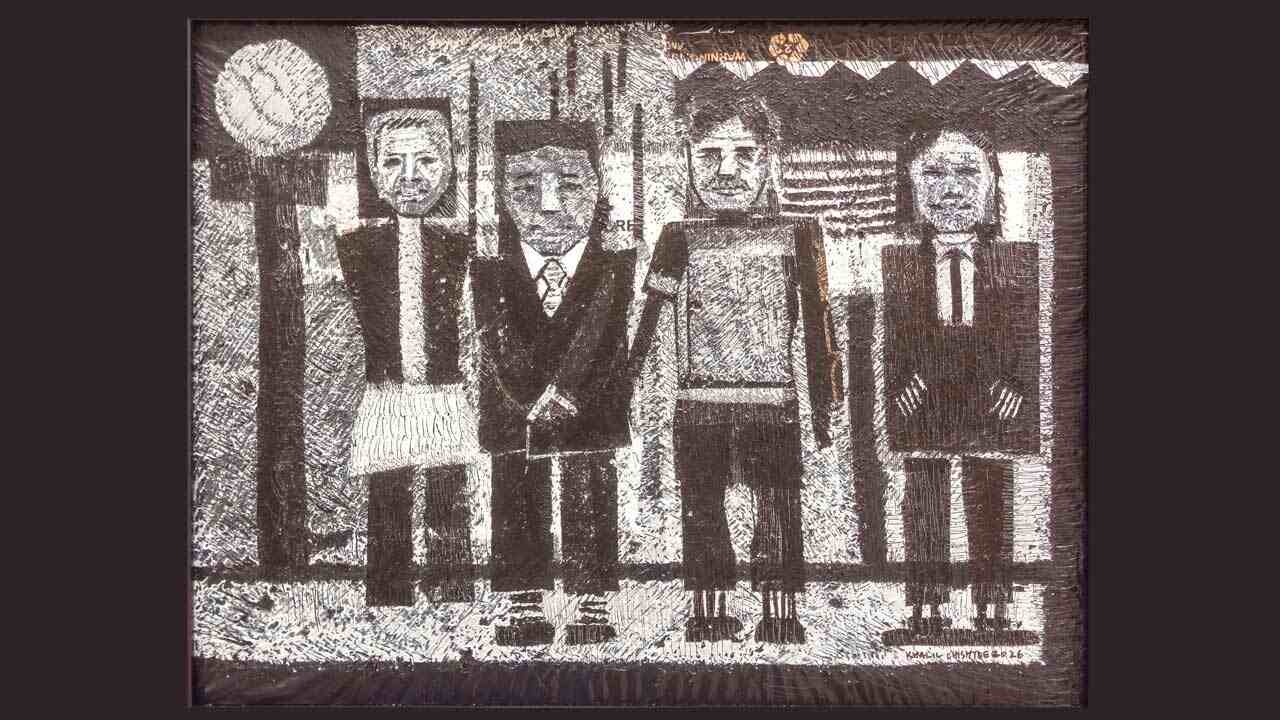
Title Image: Block Party, Khalil Chishtee, black and white trash bags, 15 x 12 inches, 2026.
All images are copyrighted to Sanat Initiative.
Bibliography:
Greenberg, Clement. “Recentness of Sculpture.” In Minimal Art: A Critical Anthology, edited by Gregory Battcock, 180–86. Berkeley: University of California Press, 1968.
Rübel, Dietmar. “Plasticity: An Art History of the Mutable.” In Materiality: Documents of Contemporary Art, edited by Petra Lange-Berndt, 94–103. London: Whitechapel Gallery; Cambridge, MA: MIT Press, 2015.
Tomkins, Calvin. “Moving Out.” The New Yorker, February 29, 1964. https://www.newyorker.com/magazine/1964/02/29/moving-out .
- Clement Greenberg, “Recentness of Sculpture” (1967), reprinted in Gregory Battcock, ed., Minimal Art: A Critical Anthology, p. 182.
- Calvin Tomkins, “Moving Out,” The New Yorker, February 29, 1964, https://www.newyorker.com/magazine/1964/02/29/moving-out .
- Dietmar Rübel, “Plasticity: An Art History of the Mutable,” in Materiality: Documents of Contemporary Art, ed. Petra Lange-Berndt (London: Whitechapel Gallery; Cambridge, MA: MIT Press, 2015), 96.
Nafisa Rizvi
Nafisa Rizvi is an art writer and independent curator. She has curated shows of Pakistani artists in Dubai (Stop Play Pause Repeat in 2012) and Philadelphia (They Really Live the Real Reality in 2015). She has edited and contributed to the book on artist Imran Mir What you See is What you See, and likewise to the monograph on artist Asim Butt, Rebel Angel. Nafisa Rizvi has contributed an essay in the popular book on Pakistan’s contemporary art The Eye Still Seeks edited by Salima Hashmi and published by Penguin India. She writes continually for newspapers and magazines internationally and in Pakistan.
There are no comments