
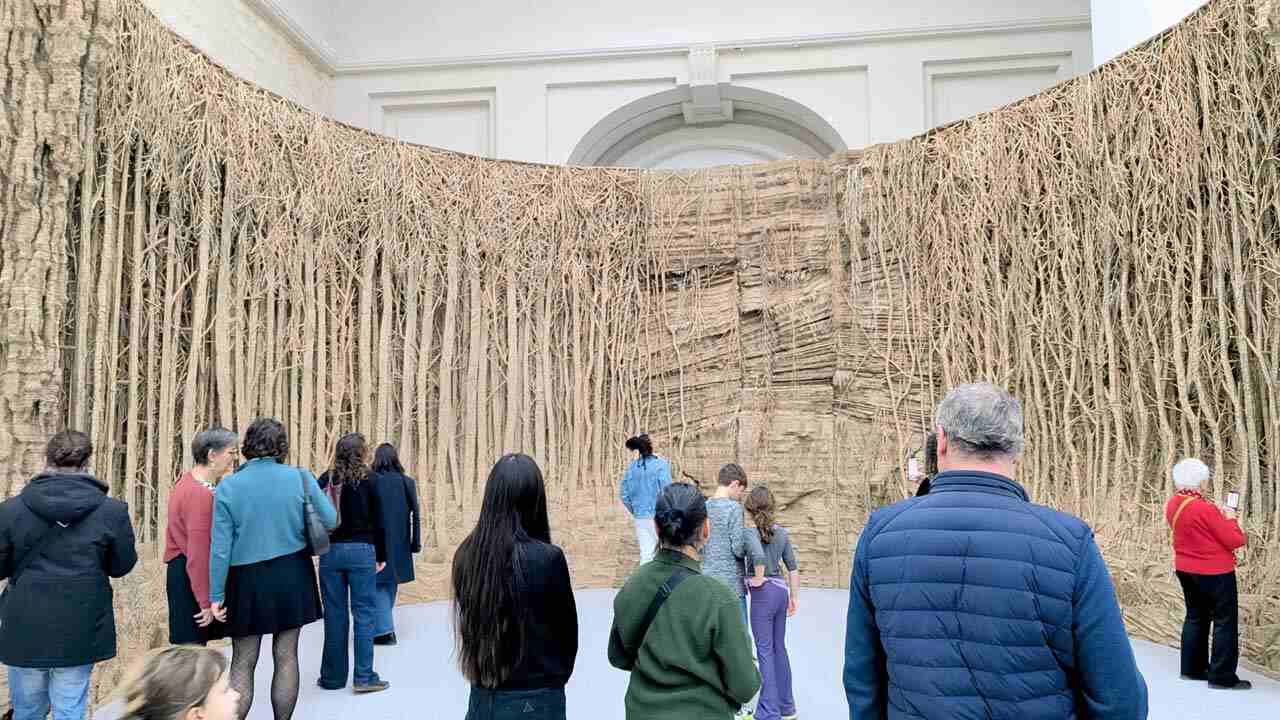
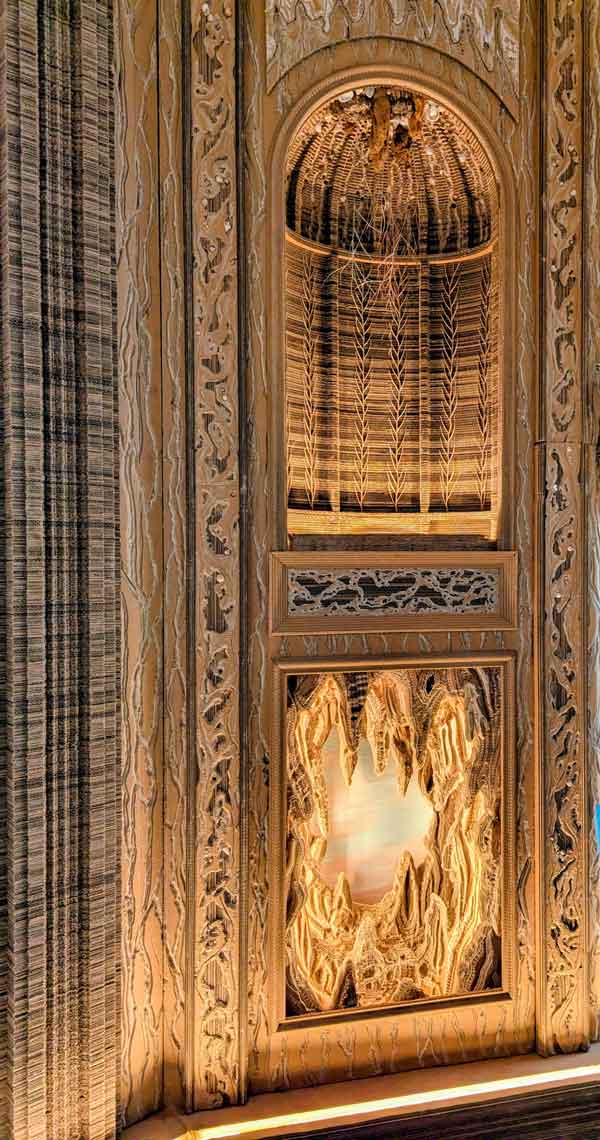
Eva Jospin’s exhibition at the Grand Palais in Paris forebodes disaster. The installations loom large and intimidating, holding viewers at a distance, as their delicate details secretly beckon. Along the gallery, we are propelled to promenade around smaller sculptures and into larger ones. At first glance, they appear to be chiselled stone but are in fact composed almost entirely of carved and layered cardboard. Grottoes, architectural follies, and forest-like structures emerge from this banal material with astonishing precision and a lace-like delicacy. Occasional glints of colour interrupt the monochrome, with silk embroidery, beads, and shells sparsely embedded within the surfaces.
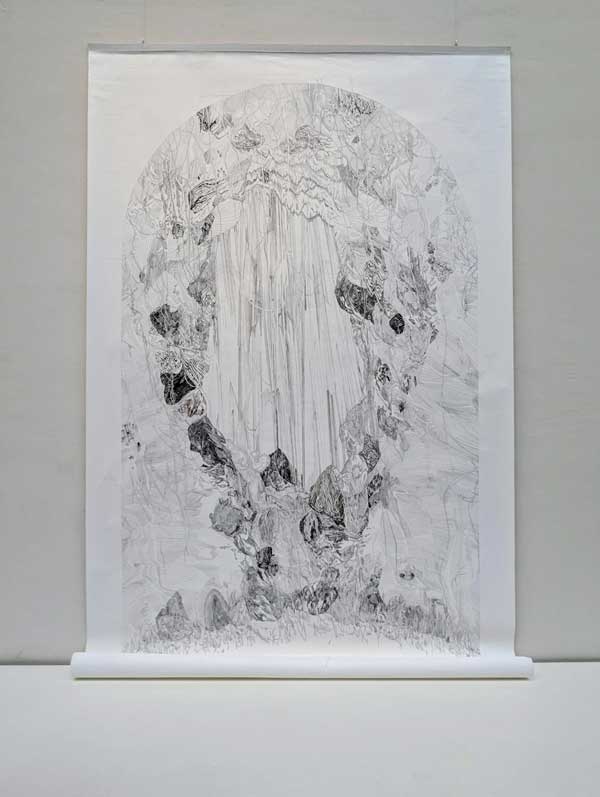
For nearly two decades, Jospin (born 1975, in Paris) has explored a path between the architectural and the sculptural through her works drawn in ink on paper, embroidered in silk, cast in bronze, and several layers of cardboard. These meticulous artworks span in scale, from tabletop-sized sculptures to immersive installations occupying vast interiors.
Grottesco, the exhibition title, refers to the renowned and accidental discovery of the Domus Aurea—the buried palace of the Roman Emperor Nero. Because the rooms resembled grottoes, the decorative style uncovered there became known as “grotesque,” characterized by the fantastical intertwining of architecture, vegetation, and imaginary creatures. Jospin takes up this notion: architectures half-swallowed by nature, columns sprouting roots, ruins emerging from dense forests, and constructed worlds in constant conversation with nature.
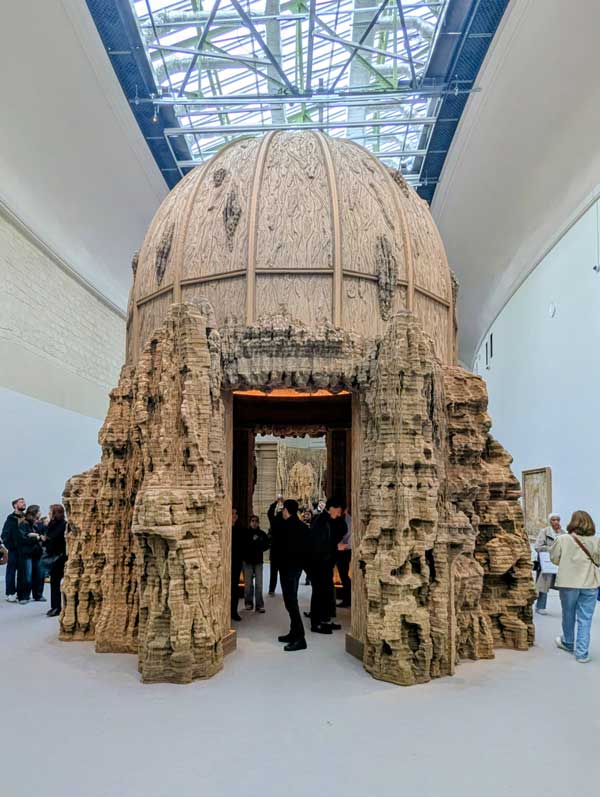
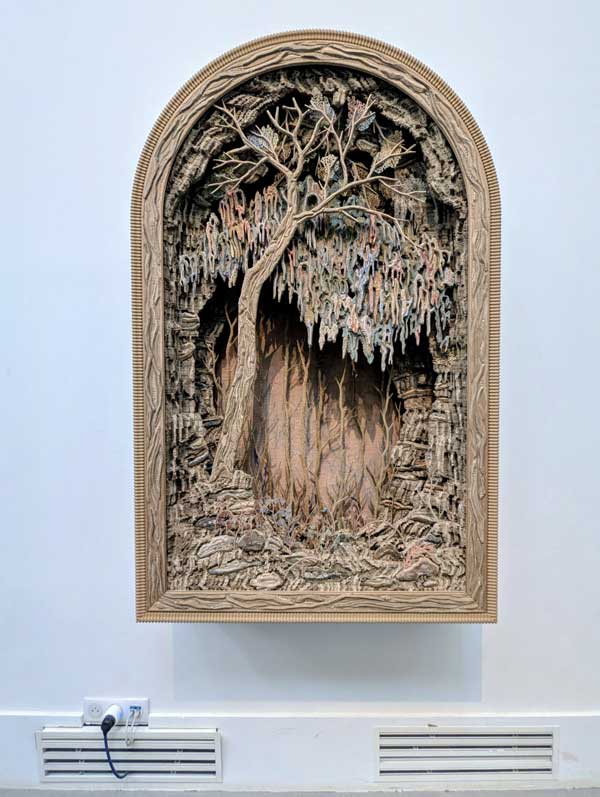
Cardboard is intensely ordinary and barely registers; packaging and disposable containers of everything from groceries to electronics—so mundane we have forgotten to notice it. Under the artist’s hands, the very same banality becomes geologically significant. Cut, layered, and sanded, its corrugated veins exposed to mimic bark and rock, and its sandwiched edges fashioned into eroded cliff faces. The striking transformation of the mundane to the monumental fascinates, not only for the skill with which cardboard has been manipulated to create the form but also with the artistic choice to leave its materiality undisguised and apparent.
One of the exhibition’s most compelling works, Duomo (2025), is a towering rotunda that visitors can circumambulate and enter. The exterior is sculpted to resemble eroded stone while the interior evokes an archaeological fragment—unexpectedly discovered, its origins forgotten. Nearby, at different scales, our eyes wander through imagined pathways cut into structures that resemble mountain ranges, with edifices carved into the rockface. At the far end of the gallery, the work Panorama (2025) curves along the wall, densely tangled vegetation letting certain details emerge while others remain permanently, purposefully, hidden. Taken together, Grottesco is a meditation on ruins, the entanglement of human creation and natural reclamation, softened by time into something beautiful.
I am reminded of The Present is a Ruin Without the People (2016), an architectural vignette sculpted from discarded textiles, by Pakistani American artist Ruby Chishti. While Jospin’s sculptures collaborate between the manmade and the natural via continuing temporalities, Chishti’s work is immediate. Dramatic and insistent on the present conditions of ruin, her artwork is made of garments, carrying traces of the people they clothed. It is the abruptness of her fragile textile topography that haunts The Present is a Ruin with the human cost of displacement. Grottesco, on the other hand, allows a romanticization of a distant future where beauty reigns.
But we are looking today, at a moment when war and environmental disaster are eradicating the fabric of cultural heritage with increasing speed, from historic monuments to contemporary urban landscapes. Can we really imagine a beautiful future, faced as we are today, with ruin?
Jospin’s stakes are deliberately different. While Chishti, in her own words, is “inspired by socio-political narratives of exile, dislocation, trauma, destruction,” 1 Jospin states that she is “simply asking a question that remains unanswered.” 3 Her engagement with similar narratives is directed towards a transforming world due to the climate crisis. This occupation with environmental degradation is shared by Pakistani artist Naiza Khan in her work Hundreds of Birds Killed, part of a larger project titled Manora Field Notes (2019). In Khan’s installation, ruin is already inescapably unfolding, reframed through the lens of ecological and economic collapse, and linked with the tension between traditional production and colonial extraction. Her brass maps fused with found objects are a far cry from Jospin’s cardboard constructions both in material value and literal and figurative weight. The metallic permanence of Khan’s work contrasts starkly with the rendering of ruin by both Jospin and Chishti.
As one walks through Jospin’s cardboard worlds in Grottesco, it is difficult not to think of the fragility of the architectures that surround us. We can reflect on how our urban landscapes might appear centuries from now—overgrown and fragmented. Our present, an archaeology for the future generations, may be hidden beneath layers of vegetation and sediment by then. Will it hold our stories? Or would those stories, optimistically coalesced with nature’s own histories have created something completely new?
Eva Jospin’s, ‘Grottesco’, ran at Grand Palais, Paris, from 10 December 2025 till 29 March, 2026.
Title Image: Eva Jospin, Panorama, 2025, carboard, wood.
Bibliography:
Grand Palais. “Entretien avec Eva Jospin.” L’Expo Longo, 2025. https://www.grandpalais.fr/sites/default/files/2025-12/dossier-pedagogique-eva-jospin-claire-tabouret.pdf.
South Asia Institute. “Interview with Ruby Chishti.” South Asia Institute. Accessed September 10, 2026. https://www.saichicago.org/dialogues/ruby-chishti-1.
- Interview with Ruby Chishti, South Asia Institute https://www.saichicago.org/dialogues/ruby-chishti-1
- Entretien avec Eva Jospin, L’Expo Longo, Grand Palais, 2025
https://www.grandpalais.fr/sites/default/files/2025-12/dossier-pedagogique-eva-jospin-claire-tabouret.pdf
Asma Husain Florençon

Asma Husain Florençon is a Pakistani architect and interior designer based in Paris, France. Her built projects have been widely published internationally. Alongside her design practice, she is passionate about storytelling through words and spaces, and writes regularly about design, creativity ,& carving a home between cultures.
There are no comments